Finding the right keywords is one of the most important parts of building a successful SEO strategy. The words and phrases you target influence the pages you create, the content you publish, the people who discover your website, and the type of enquiries your business can generate from organic search. Yet effective keyword research is not simply a matter of finding the keywords with the largest search volume. A keyword can attract thousands of searches and still be a poor choice if those searches do not come from people who need your products or services.
For a UK business, keyword research needs an additional layer of understanding. Customers may use British English, location-based phrases, regional terminology and different descriptions of the same service. Search behaviour can also vary between someone looking for information, someone comparing providers and someone who is ready to contact a business. The most useful keyword is therefore the one that connects a relevant searcher with a useful page at the right point in their decision-making journey.
This guide explains how to discover, evaluate, organise and prioritise keywords for a UK business. It also explains how to turn keyword research into service pages, blog content, local SEO activity and a broader search strategy that can support SEO, AEO and GEO.
Understanding Keyword Research
Keyword research is the process of discovering and analysing the words and phrases that people enter into search engines when they want information, products, services or solutions. These phrases are often called keywords, although a keyword can be a single word or a much longer search query.
Consider a web development company. The business might describe one of its services as professional website development, while a potential customer may search for ‘web development company UK’, ‘website developer near me’, ‘business website development’, ‘ecommerce web development’ or ‘affordable website development’. These phrases are related, but each can reveal a slightly different need.
Good keyword research therefore starts with customer language rather than internal company terminology. The objective is to understand what people actually search for, why they search it, what information they expect to find, and whether your business can provide a useful answer or solution.
Keyword research can inform service pages, blog posts, landing pages, local SEO, website structure, internal linking, content calendars, conversion strategies and paid search campaigns. It can also reveal gaps in an existing website, especially when your competitors are visible for relevant searches that your business has not yet addressed.

Start With Your Business and Your Customers
Before opening a keyword research platform, make a list of the things your business actually wants to be found for. Start with your main services, products, customer problems, solutions, industries and locations. These initial phrases are your seed keywords. They do not have to be perfect. Their purpose is to give your research a useful starting point.
For example, a digital marketing business might begin with SEO, Local SEO, technical SEO, web development, content marketing, Google Business Profile optimisation, AEO and GEO. Each seed keyword can then be expanded into more specific terms that reflect different customers, locations and stages of the buying journey.
The next step is to think like a customer. Ask what someone would type into Google if they had never heard your company name and did not know the technical term for your service. A business may describe a service as search engine optimisation, while a customer might search for how to get my business on Google. A company may describe conversion rate optimisation, while a customer might ask why is my website getting traffic but no enquiries. Customer language often reveals opportunities that a simple list of industry terms cannot.
Useful sources of customer language include sales conversations, emails, reviews, contact forms, support questions, FAQs, Google Autocomplete, People Also Ask results, online communities and competitor websites. Existing customers are especially valuable because they can show you the words used by real people who have already experienced the problem your business solves.
Make Your Research Relevant to the UK
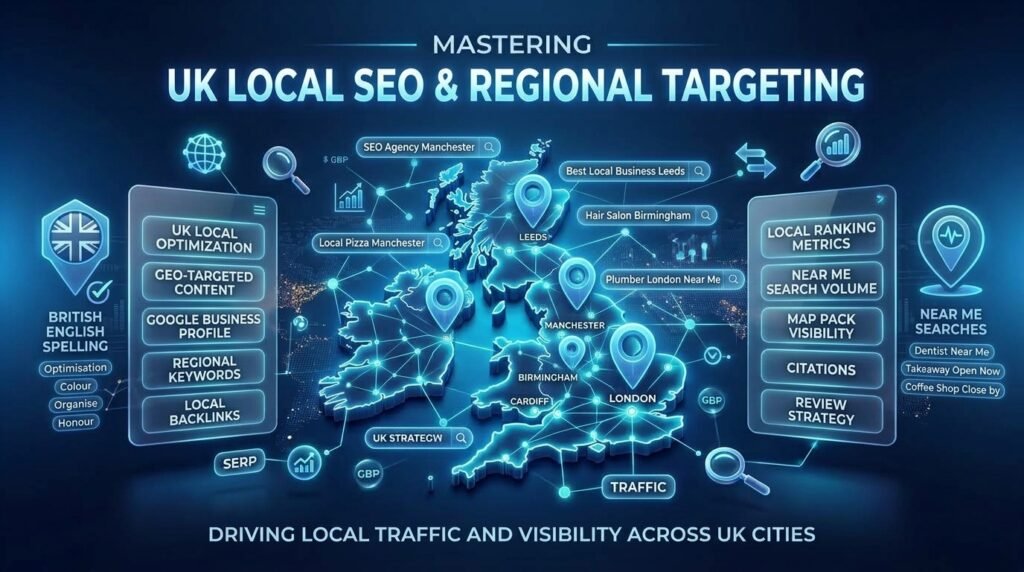
If your target market is the United Kingdom, your keyword strategy should reflect the language and geography of that market. British English can differ from American English, so spelling and terminology deserve attention. Examples include optimisation rather than optimisation, organisation rather than organisation, behaviour rather than behaviour, colour rather than colour, and centre rather than centre.
Location can be equally important. A broad phrase such as ‘SEO agency’ can become much more commercially meaningful when a customer searches for ‘SEO agency London’, ‘SEO agency Birmingham’, ‘SEO agency Manchester’, or ‘SEO agency’. Bristol or an SEO agency in Leeds. Similar patterns occur across trades, professional services, healthcare, hospitality, retail and other local industries.
Location modifiers should not be added simply for the sake of creating pages. A location page should exist because the business genuinely serves that area and can provide useful information about its services there. Thin pages that simply replace one city name with another do not provide the same value as genuine local content.
Local search can also include phrases such as near me, close by, open now and specific neighbourhood or district names. These searches often have strong local intent, so businesses that depend on customers in a defined service area should consider local SEO alongside their broader keyword strategy.
Search Intent Matters More Than Many Businesses Realise
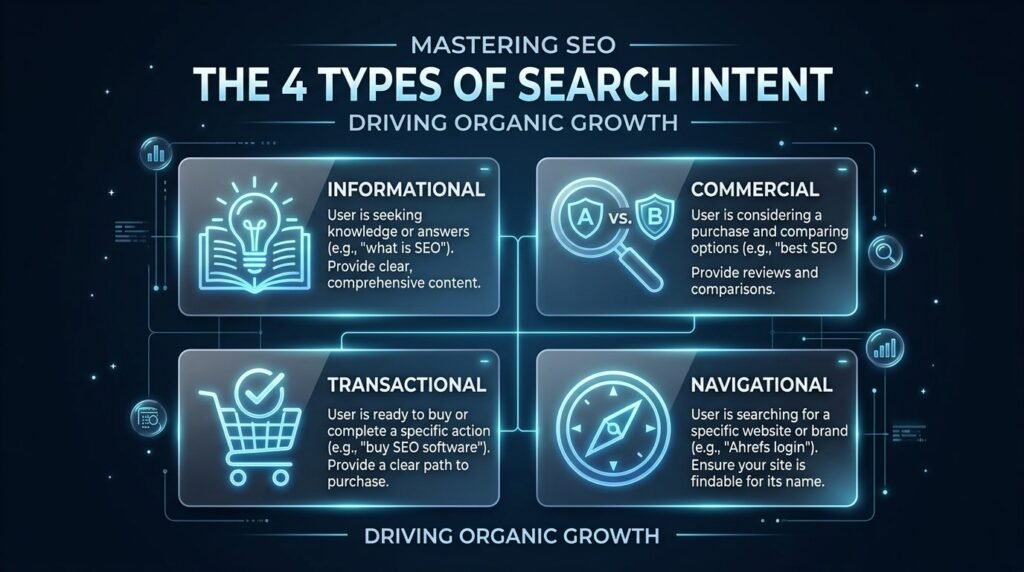
Search intent is the reason behind a search. Understanding intent helps you decide whether a keyword belongs on a blog post, service page, landing page, location page or another type of content. A keyword can be highly relevant to your industry but still be a poor target if the page you create does not match what the searcher expects.
Informational searches are usually made by people who want to learn something. Examples include what SEO is, how keyword research works, and how I can improve my Google ranking. These searches can be addressed with educational guides, blog posts, tutorials and FAQs.
Commercial investigation searches occur when people are researching possible solutions. Examples include best SEO agency UK, SEO agency pricing, web development companies UK and SEO services for small businesses. These searches can be supported by detailed service guides, comparison content, case studies and pages that explain the benefits and approach of a provider.
Transactional searches indicate a stronger intention to take action. Examples include SEO agency Manchester, hiring an SEO consultant, web development services and local SEO agency UK. These terms are often better matched with service pages, landing pages, consultation pages and clear calls to action.
Navigational searches are typically used to find a particular brand or website, such as Prime Flow Digital, Prime Flow Digital SEO or Prime Flow Digital contact. These searches are usually handled by branded pages and a clear website structure.
Search Volume Is Useful, But It Is Not the Whole Story
Search volume estimates how often a term is searched over a given period. It can help you understand demand, but high volume does not automatically make a keyword valuable. A broad keyword may receive many searches while attracting people who are not your target customers.
For example, SEO may have substantially more searches than SEO services for small businesses in the UK. However, the second phrase may be far more relevant to an agency whose ideal clients are UK small businesses. The decision should therefore consider relevance, intent, search demand, competition, location and business value together.
Search volume can also change seasonally. Some industries experience strong variations around holidays, weather, events, tax deadlines, school terms or buying seasons. A keyword that looks small during one period may become much more important during another. Trends and historical data can help you understand these changes rather than relying on one monthly figure.
Long-Tail Keywords Can Create Valuable Opportunities
Long-tail keywords are specific phrases that contain several words and usually provide more context about the searcher’s need. Examples include SEO services for small businesses in the UK, affordable web development for UK businesses, a local SEO agency for dentists and technical SEO services for e-commerce websites.
Broad phrases such as web development or digital marketing may be difficult to interpret because the searcher has not explained exactly what they want. A longer phrase can reveal the service, audience, location or problem in much greater detail.
Long-tail searches may have lower individual search volumes, but they can be valuable because they are more specific. For a smaller UK business, building visibility across a group of highly relevant long-tail searches can be more realistic than trying to compete immediately for the broadest terms in an industry.
Use Keyword Research Tools and Your Own Search Data
Keyword tools can make research faster and help you identify patterns that are difficult to find manually. Google Keyword Planner can provide keyword ideas and search-demand information. Google Search Console is particularly useful because it shows the queries for which your website already receives impressions and clicks.
Google Autocomplete is another simple source of ideas. Start typing a relevant phrase and examine the suggestions. Google’s People Also Ask results can reveal questions related to your main topic, which can then become FAQs, supporting sections or separate articles.
Professional platforms such as Ahrefs and Semrush can provide additional information about keyword difficulty, competitors, ranking pages, related terms and keyword gaps. AnswerThePublic can also help identify question-based searches and the different ways people express a need.
No tool should be treated as the final decision-maker. Data needs to be combined with customer knowledge, business objectives and an inspection of the actual Google results. The strongest keyword strategy uses tools to find opportunities and human judgement to decide which opportunities are worth pursuing.
Study Your Competitors and the Current Search Results
Competitor research can uncover valuable keywords that you may not have considered. Identify three to five genuine competitors that perform well for the services or locations you want to target. Review their main pages, content topics, service descriptions and the queries for which they appear to have visibility.
A keyword gap exists when a competitor has visibility for a relevant search but your website does not have a strong result for that search. A gap does not automatically mean you should create a page. First determine whether the keyword is genuinely relevant, whether the intent fits your business and whether you can produce something more useful than the existing results.
Manual SERP analysis is especially important. Search the keyword in Google and examine the results. Are the ranking pages service pages, guides, product pages, location pages, forums or large brands? What questions do they answer? What information is missing? This helps you understand the type and depth of content that the search currently rewards.
Keyword Difficulty and Realistic Competition
Keyword difficulty is a metric used by SEO tools to estimate how competitive a search term may be. High-competition terms can be dominated by established websites with strong authority, quality backlinks, extensive content and strong relevance.
For newer or smaller businesses, a more practical approach can be to combine realistic long-tail, local, service-specific and question-based keywords with a long-term plan for broader topics. This creates opportunities to build topical authority while gradually strengthening the website.
Difficulty scores should always be treated as guidance rather than absolute truth. Two tools can calculate difficulty differently, and a keyword with a moderate score can still be difficult if the current results are dominated by very strong competitors. Always inspect the SERP before making a final decision.
Group Keywords and Map Them to the Right Pages
After research, you may have hundreds of keywords. The next challenge is organisation. Closely related terms can often be grouped into topics so that one strong page covers the subject comprehensively instead of creating a separate page for every small variation.
For example, a local SEO topic might include local SEO UK, local SEO services, local SEO for small businesses, local search optimisation, local SEO agency and Google Business Profile SEO. Some of these terms may be naturally addressed by one strong service or guide page, while other searches with different intent may deserve separate content.
Keyword mapping is the process of assigning a keyword or keyword group to the most appropriate page. Informational terms are usually mapped to guides or blog posts. Commercial terms can be mapped to service guides or comparison pages. Transactional terms are often appropriate for service or landing pages. Local terms may require location or local service pages.
Mapping also helps prevent unnecessary duplication and keyword cannibalisation. If several pages are all trying to rank for exactly the same intent, they may compete with one another instead of creating a clear and useful site structure.
Prioritise Keywords by Business Value
Once you have a list of potential keywords, prioritise them according to what can realistically help your business. Five questions are particularly useful: Is the keyword relevant? Does its search intent match your page? Is there meaningful demand? Can you compete? And could the search lead to a valuable business action?
Business value is often overlooked. A keyword can bring substantial traffic without producing useful enquiries, while a more specific commercial term may bring fewer visitors but generate more relevant leads. This is why SEO should be connected to business objectives rather than treated as a race for the highest traffic number.
A simple priority system can classify keywords as high priority, medium priority or future opportunity. High-priority keywords are usually highly relevant, commercially meaningful and realistic targets. Medium-priority terms may require more authority or content development. Future opportunities can be revisited as the website grows.
Build Content Around the Searcher, Not the Keyword
Once the research is complete, the next step is to create content that genuinely satisfies the search. Avoid writing an article simply because a keyword has search volume. Instead, ask what the person needs after typing that query.
An informational search should receive a clear explanation. A commercial search may need comparisons, evidence, pricing context or a detailed service explanation. A transactional search should make it easy to understand the service and take the next step. A local search should receive useful location-specific information rather than a page that simply repeats a city name.
Use the primary keyword naturally in the title, headings, copy and relevant page elements where appropriate, but do not force it into every paragraph. Modern search systems can understand related concepts, entities and context. A comprehensive page that uses natural language is usually more useful than a page written primarily to repeat the same phrase.
Connect Keyword Research With Local SEO, AEO and GEO
Keyword research increasingly sits within a wider search strategy. Traditional organic search remains important, but customers are also using conversational tools and AI-powered search experiences. This creates opportunities for businesses to build content around questions, entities, topics and clear answers rather than relying only on exact keyword phrases.
For local businesses, this means combining keyword research with Google Business Profile optimisation, relevant location pages, local content, reviews, consistent business information and appropriate local signals. Prime Flow Digital’s existing local SEO guidance explains how these elements can work together for UK small businesses.
For more local search guidance, see Read Prime Flow Digital’s Complete Local SEO Guide for Small Businesses in the UK.
AEO and GEO also benefit from understanding the questions people ask. Instead of focusing only on a phrase such as SEO agency UK, a business can create supporting content around questions such as what does an SEO agency do, how much does SEO cost in the UK, how long does SEO take and whether SEO is worthwhile for a small business.
Prime Flow Digital’s guide to the relationship between these search approaches is available here: Explore how SEO, AEO and GEO work together for UK businesses.
Common Keyword Research Mistakes
- Choosing keywords only because they have high search volume.
- Ignoring the reason behind a search and its intent.
- Using global data without considering the UK market.
- Targeting only broad, highly competitive phrases.
- Creating location pages that contain little genuine local value.
- Creating a separate page for every small keyword variation.
- Ignoring competitor content and keyword gaps.
- Repeating keywords unnaturally or using keyword stuffing.
- Ignoring the search queries already shown in Google Search Console.
- Measuring only rankings instead of traffic, engagement and enquiries.
- Failing to update keyword research when services, markets or customer needs change.
A Practical Keyword Research Process for UK Businesses
If you want a repeatable process, use the following workflow. First, understand your business, customers, services and locations. Second, create seed keywords that describe what you offer. Third, expand those ideas using keyword tools, Google suggestions, customer questions and competitor research. Fourth, identify UK terminology and location opportunities.
Next, classify search intent and inspect the current search results. Analyse search demand and competition, then identify long-tail opportunities. Group related terms into topic clusters and map them to the right pages. Prioritise the terms that combine relevance, useful intent, realistic competition and meaningful business value.
Finally, create useful content, optimise the relevant pages, connect them through internal links and track performance. Review the data regularly and improve pages based on impressions, clicks, rankings, engagement and conversions.
- Understand your products, services, customers and target locations.
- Create a list of seed keywords.
- Expand the list using search data, customer language and competitor research.
- Identify UK-specific terminology and location variations.
- Classify keywords by search intent.
- Analyse search volume, competition and the current SERP.
- Find relevant long-tail and question-based searches.
- Group related keywords into topics.
- Map keyword groups to the most appropriate pages.
- Prioritise based on relevance, intent, competition and business value.
- Create genuinely useful content and optimise the page naturally.
- Track results and update the strategy over time.
How Prime Flow Digital Can Help
Keyword research is only the beginning. The real value comes from turning keyword data into a structured strategy that improves visibility and supports business goals. Prime Flow Digital can connect keyword research with technical SEO, content, local SEO, website development, AEO and GEO so that search activity is treated as part of a complete digital growth strategy.
You can explore the full range of services at Visit Prime Flow Digital.
For businesses that want to understand their current organic search performance, an SEO review can help identify technical issues, content gaps, keyword opportunities, internal linking improvements and areas where competitors are gaining visibility.
Prime Flow Digital also explains how SEO can support a broader online presence. Learn more about building a strong online presence with SEO.
Businesses comparing SEO investment can also read the guide to SEO costs in the UK.
For more context on choosing an SEO approach, see Understand why cheap SEO services can cost more.
Businesses focused on local visibility may also benefit from learning how to rank for ‘near me’ searches in the UK.
Frequently Asked Questions
What is keyword research?
Keyword research is the process of identifying and analysing the words and phrases people use when searching for information, products and services online.
How do I find keywords for my UK business?
Start with your services and products, identify how customers describe their needs, use keyword research tools, investigate competitors, analyse search intent and consider UK-specific language and locations.
What are the best free keyword research tools?
Google Keyword Planner, Google Search Console, Google Autocomplete and Google’s People Also Ask results can all provide useful ideas and search insights.
How do I find UK-specific keywords?
Use UK-focused search data where available, investigate British English terminology, research relevant cities and regions, and use the language your UK customers actually use.
How many keywords should a page target?
There is no universal number. A page should focus on one main topic and naturally cover closely related terms and questions that satisfy the same search intent.
What is a good search volume for a keyword?
There is no single search volume that makes a keyword good. Relevance, intent, competition and potential business value should be considered alongside demand.
Should small businesses target long-tail keywords?
Long-tail keywords can be useful because they are more specific and can reveal clearer customer intent. They can also provide realistic opportunities where broad terms are highly competitive.
What is keyword difficulty?
Keyword difficulty is a metric used by SEO platforms to estimate how competitive a search term may be. It should be combined with manual analysis of the current search results.
What is search intent?
Search intent is the reason behind a search. Common categories include informational, commercial, transactional and navigational intent.
How do I find local keywords?
Combine relevant services with genuine service areas, research local phrases and near-me searches, and study the language used by customers in the locations you serve.
How often should I conduct keyword research?
Keyword research should be reviewed periodically and whenever your services, customers, competitors or market change. Search behaviour is not static.