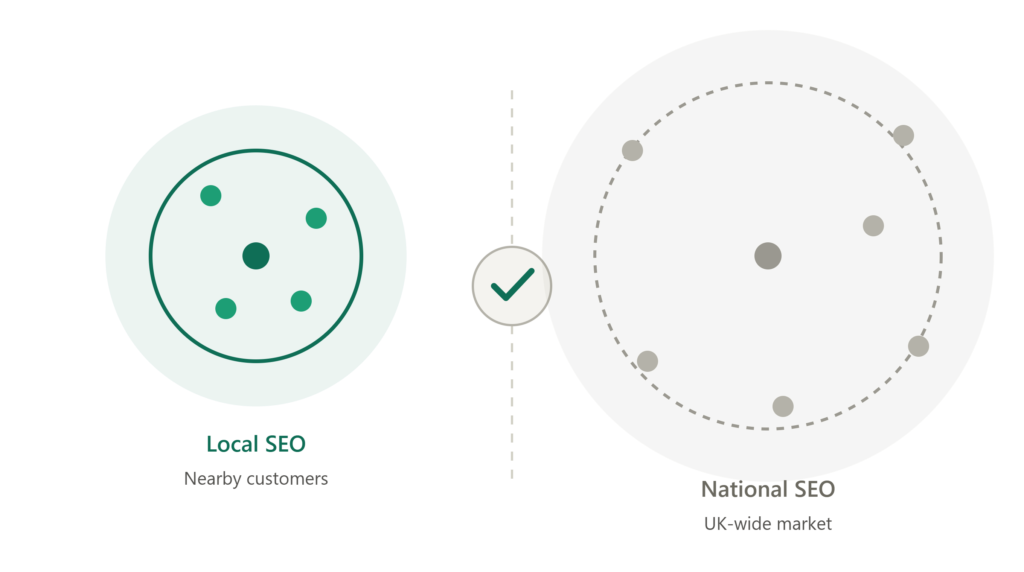
Local SEO helps your business get found by people nearby. Broader SEO, sometimes called national or traditional SEO, helps you get found across a wider market regardless of where the searcher is standing. If you serve customers in a specific town, county, or defined service area, start local. If you sell or provide services UK-wide and location matters less than price, product, or expertise, broader SEO is the better fit. Getting this the wrong way round wastes budget fast.
A quick note on terminology before we go further: when people search “SEO vs local SEO”, they usually already understand SEO as a broad concept and are really asking a narrower question: should they focus on local SEO, national/traditional SEO, or a mix of both? That’s the question this guide answers. If you’ve already decided local SEO is your answer and want the full tactical playbook, Google Business Profile setup, citations, reviews, and NAP consistency, we’ve covered that in complete depth here. This piece stays one level up: helping you decide which strategy actually fits your business in the first place.
SEO vs. Local SEO at a Glance
| Local SEO | Broader (National/Traditional) SEO | |
| Main goal | Get enquiries from nearby customers. | Compete across the UK or a wider market. |
| Best for | Trades, clinics, venues, local services | E-commerce, SaaS, national service firms |
| Main search area | Google Maps and local organic results | Broader organic results and content authority |
| Core assets | Google Business Profile, reviews, local pages | Content hubs, backlinks, technical SEO at scale |
| Main competition | Other local businesses in your area | UK-wide or industry-wide competitors |
How Google Treats Local and Broader Searches Differently
Google genuinely shows different types of results depending on the search. Type “electrician near me”, and you’ll typically see a local pack with map listings above the standard results. Type “best accounting software”, and you’ll get articles, comparison pages, and product pages instead. Different intent, different battlefield.
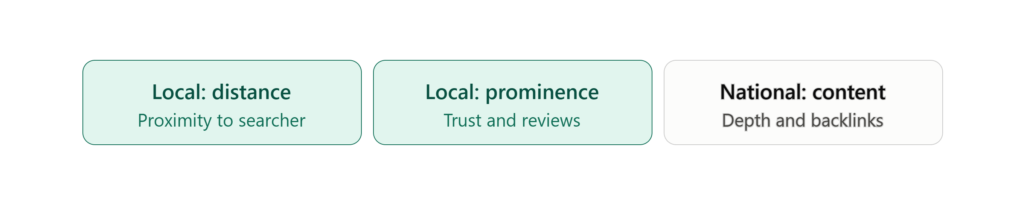
Google’s own published guidance says local rankings come down to relevance, distance, and prominence: does your business match the search, are you close enough to the searcher, and does Google trust you more than the alternatives nearby? For broader searches, distance stops mattering, and Google instead weighs content depth, authority, backlinks, and how well your page answers the underlying intent. We’ve gone deep on exactly how the local side of this works in our guide to ranking in Google Maps, worth reading if local SEO turns out to be your answer.
This difference is why copying a national-style SEO plan onto a local business tends to go badly. A local plumber doesn’t need forty blog posts about the history of central heating. They need clear service pages, genuine local proof, reviews, and a properly completed Google Business Profile.
When Local SEO Is the Right Move
Local SEO makes sense when customers choose you specifically because of where you are, where you’re willing to travel, or how quickly you can reach them. If someone searches “emergency locksmith Leeds”, “dentist Manchester”, or “wedding venue Cheshire”, Google reads clear local intent into that search, and so should you.
That means the goal isn’t ranking nationally for “locksmith”. It’s showing up where the actual customer is looking: in Maps, in local organic results, and increasingly in AI-generated answers pulling from local business data. Local SEO typically involves optimising your Google Business Profile properly, building service pages that match what nearby customers actually search for, keeping your NAP details consistent across citations and directories, and gathering genuine reviews. We’ve broken all of this down in full in our complete local SEO guide.
If you serve a defined area, this is almost always where to start. Get the foundations right before chasing bigger, more competitive keywords that won’t move the needle for a business that only serves one town.
When Broader (National) SEO Is the Right Move
Broader SEO is the right call when location matters less than what you sell, how much it costs, or how good you are at it. If you sell products across the UK, run a remote consultancy, offer an online booking platform, or want leads from anywhere in the country, local signals alone won’t get you there.
The competition here is usually a different scale entirely. You’re not up against the plumber two streets over; you’re up against national brands, comparison sites, directories, and marketplaces, often with content teams publishing every week. Broader SEO typically involves deeper keyword research spanning informational and commercial intent, content hubs that build genuine topical authority over time, technical SEO that can support far more pages and internal linking, and consistent, ethical link building. It’s a longer game, requiring more patience and a stronger technical foundation than local SEO generally does.
Which Strategy Costs More?
Broader SEO usually costs more, and it’s worth being direct about why rather than dodging the question: broader competition simply requires more content, stronger technical foundations, and more link-building work to compete credibly. That doesn’t mean local SEO is easy; it means the amount of work required to actually win looks different.
A local campaign typically centres on your Google Business Profile, core service pages, reviews, and a handful of strong local links. A national campaign often needs a full content strategy, ongoing authority building, competitor analysis, and regular content expansion. We’ve broken down current UK pricing for both in detail in our full SEO cost guide.
The more useful question usually isn’t “which is cheaper.” It’s “which one actually matches how my customers buy.” A locksmith based in Leeds gets nothing from clicks originating in Glasgow unless they genuinely cover Glasgow too. Those clicks might look good in a report, but they won’t put money in the bank.
Which Does Your Business Actually Need?
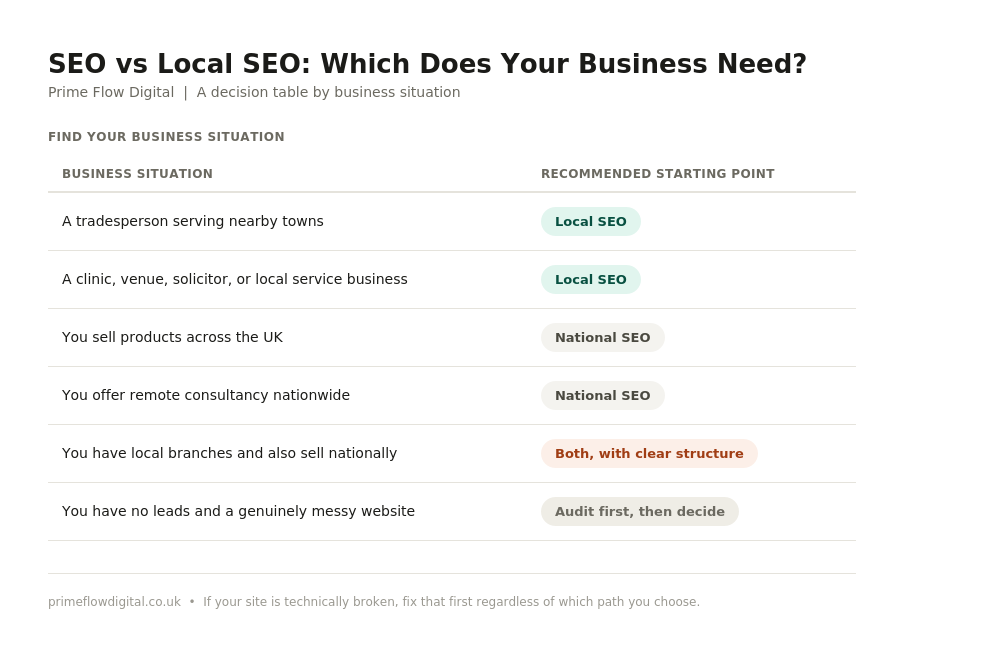
Here’s a direct decision table rather than a vague “it depends”.
| Business situation | Recommended starting point |
| A tradesperson serving nearby towns | Local SEO |
| A clinic, venue, solicitor, or other local service business | Local SEO |
| You sell products across the UK. | Broader (national) SEO |
| You offer remote consultancy nationwide. | Broader (national) SEO |
| You have local branches and also sell nationally. | Both, with a clearly structured site |
| You have no leads and a genuinely messy website. | Audit first, then decide. |
If your site is technically broken to begin with, neither strategy will work properly until that’s fixed. Sort the foundations first, then scale in whichever direction actually matches your business.
Can You Combine Both? (Hybrid Strategies)
Yes, and plenty of UK businesses genuinely should. A multi-branch retail or hospitality chain needs strong national brand visibility alongside dedicated local SEO for each individual branch. An e-commerce retailer might run broader SEO for its product catalogue while using local SEO specifically to drive customers to a physical showroom or collection point. A consultancy might start with local SEO to build a client base in its home city, then gradually build out national pages as it takes on remote clients further afield.
The part that trips businesses up isn’t deciding to combine both; it’s the site structure. Don’t cram local and national intent onto the same handful of pages and hope Google sorts it out. A sensible hybrid setup keeps clear, dedicated local pages for each physical location or service area, alongside separate national pages for anything genuinely available UK-wide, tied together with sensible internal linking rather than left to compete with each other.
Where AI Search Fits Into This
This decision matters just as much for how AI tools discover your business, though the signals differ depending on which path you’re on. If you’re building a local strategy, the same accurate Google Business Profile, consistent citations, and genuine reviews we’ve covered in our Local SEO and Google Maps guides are exactly what AI platforms cross-reference when answering a local question. If you’re building a broader, national strategy, the priority shifts toward the wider authority, structured content, and third-party signals covered in our AEO strategies guide and our guide to optimising for ChatGPT, Google AI, and Perplexity.
Neither path is optional if AI-driven discovery matters to your customers, which for most UK businesses in 2026, it increasingly does.
How to Decide, in Practice
Start with your customers, not with whichever strategy sounds more impressive. Work out where they actually are and how they search for what you offer. If their searches naturally include town names, county names, “near me”, or a specific service area, that’s local SEO territory. If they search for products, comparisons, or UK-wide providers with no location attached, broader SEO fits better.
When genuinely unsure, start local. Local intent tends to sit closer to a ready-to-buy customer, and a smaller, more winnable market lets you prove out what converts before committing to the bigger fight a national campaign usually involves.
How Prime Flow Digital Can Help
We start by understanding your actual business model, where your customers genuinely come from, which services are most profitable, and whether you need local visibility, national reach, or a properly structured mix of both, rather than defaulting you toward whichever service sounds bigger. If you’re not sure which strategy fits your business, or your website has been built to look good without actually being found, get in touch with the Prime Flow Digital team, and we’ll help you work out where to focus before you spend a penny on the wrong approach.
Frequently Asked Questions
Is local SEO better than national SEO?
Neither is automatically better. Local SEO is the better fit if your customers are based in a specific area or you travel to serve them. National SEO fits better if you sell or provide services across the UK. The right choice depends on your market, competition, and how your customers actually search.
Can a small UK business do national SEO?
Yes, but with realistic expectations. A small business can compete nationally with a clear niche, strong pages, solid technical foundations, and a sensible content and link strategy. Trying to rank for huge, generic keywords straight away usually wastes effort; better spent on specific, commercially useful searches first.
Do I need a Google Business Profile if I’m doing national SEO?
If you have a real business location or also serve some customers locally, yes, it still helps with visibility and trust. For a purely online, national-only business, it matters less centrally, but consistent business information across the web still counts toward how credible Google considers you.
How long does local SEO take compared with national SEO?
Local SEO can show earlier movement, particularly in less competitive areas, though meaningful results still typically take a few months. National SEO usually takes longer, since the competition is broader and stronger, and timelines depend heavily on your starting point and how aggressive your competitors already are.
Can I start with local SEO and move to national SEO later?
Yes, and for many businesses that’s the sensible route. Build strong local visibility first, and work out which services actually convert, fix any technical issues, and gather genuine trust signals. Once that foundation is solid, expanding into national pages is a far safer bet than trying to do everything at once.
Which costs more, local SEO or national SEO?
National SEO usually costs more, since the competition is broader and the work required – more content, stronger technical foundations, and more link building – is correspondingly bigger. Local SEO isn’t necessarily easier, but the amount of work needed to compete is smaller in scope.
What if my competitors are ranking both locally and nationally?
Work out which of their rankings are actually producing enquiries rather than just traffic. Some competitors rank for a lot of terms that bring visitors but no real business. Look at their service pages, Google Business Profile, reviews, and content structure, then decide whether your own priority is local improvements, national authority building, or both.
Do I need separate pages for local and national SEO on the same website?
Generally yes. Keeping dedicated local pages for each service area or branch, separate from your broader national pages, gives Google (and AI search tools) a clearer signal about each type of intent, rather than blending everything into a handful of pages that try to do both jobs at once.