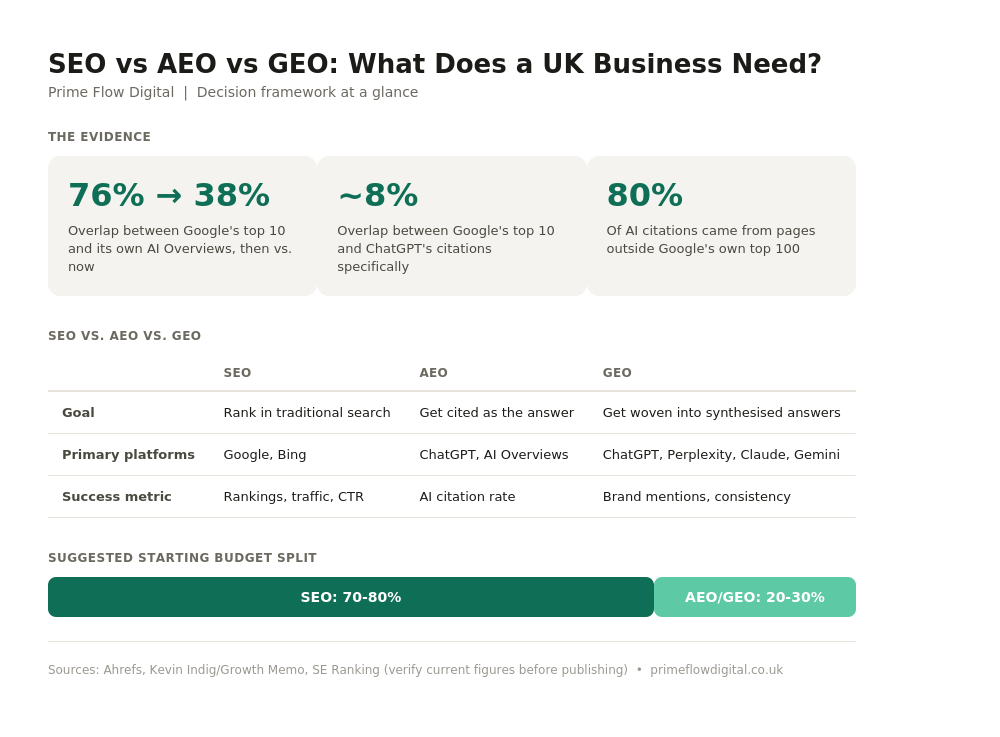
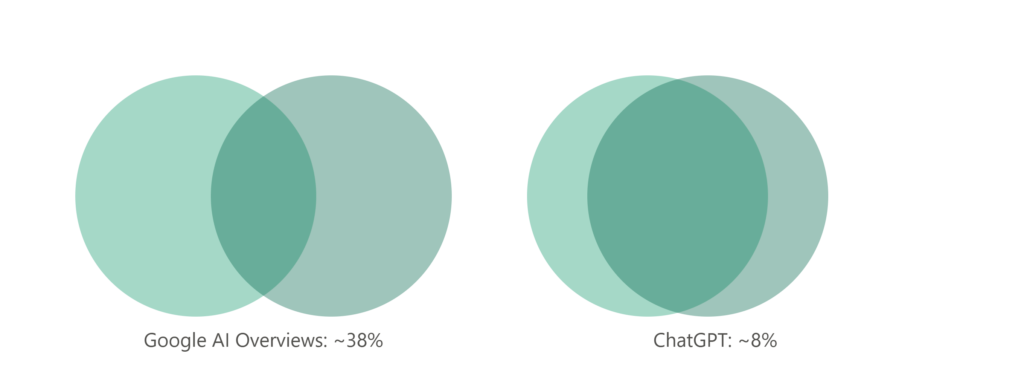
Here’s the evidence that settles this faster than any conceptual explanation could: the overlap between pages cited in Google’s AI. Overviews and pages ranking in Google’s own top 10 organic results have been measured at roughly 38%, down sharply from around 76% previously. For ChatGPT specifically, that overlap drops to roughly 8%. Ranking well on Google no longer tells you much about whether AI platforms will actually cite you. That gap is exactly why SEO, AEO, and GEO now need to be treated as related but genuinely distinct disciplines.
Key takeaway: Most UK businesses need all three, not a choice between them, but in a specific order and proportion. SEO remains the non-negotiable technical and content foundation. AEO and GEO sit on top as the layer that determines whether AI platforms actually cite you once that foundation is solid. A sensible starting budget split for most businesses beginning this work is roughly 70 to 80% SEO and 20 to 30% AEO/GEO, rising as AI-driven discovery becomes a larger share of how your customers actually find you.
This piece assumes you already have a rough grasp of what SEO, AEO, and GEO each mean. If you want the fuller conceptual picture first, we’ve covered how the three relate in depth here. This guide’s job is different: proving, with real evidence, that treating them as distinct actually matters, and giving you a direct, practical answer on where to focus first and how much to spend.
SEO vs. AEO vs. GEO at a Glance
| SEO | AEO | GEO | |
| Goal | Rank in traditional search results | Get cited as the direct answer. | Get woven into synthesised, multi-source AI answers. |
| What it wins you | Sustained organic traffic, compounding authority | High-intent, pre-qualified visits | Brand trust and recommendation across AI platforms |
| Primary platforms | Google and Bing organic results | ChatGPT, Google AI Overviews, voice assistants | ChatGPT, Perplexity, Claude, Gemini |
| Success metric | Keyword rankings, organic traffic, CTR | AI citation rate, share of AI voice | Brand mentions, citation consistency across platforms |
| Measurement maturity | Mature, two decades of established benchmarks | Emerging, but increasingly trackable | Early stage, track trends rather than snapshots |
The Evidence: Why These Aren’t Just the Same Thing Renamed
There’s a genuine, credible debate worth naming directly. Some well-respected voices in search argue AEO is simply good SEO repackaged under a new label, and Google’s own Danny Sullivan has said publicly that “good SEO is good GEO.” There’s real truth buried in that view: strong content, technical health, and E-E-A-T signals matter to both.
But the evidence points toward a meaningful, practical distinction rather than a purely semantic one. Large-scale analysis of over 800,000 keywords found that classic SEO ranking signals, domain authority, raw backlink counts, and keyword density show little to no strong relationship with whether an AI system actually cites a page. What does correlate strongly instead: front-loaded answers appearing in the first 30% of a page, high entity density (proper nouns used at roughly two to three times the typical rate), definitive rather than hedged language, and genuine brand mentions across the open web, on Reddit, review platforms, and industry publications, rather than backlinks specifically.
Separate analysis of over a million ChatGPT responses reached the same conclusion from a different angle: content length showed almost no correlation with citation likelihood, and roughly 80% of AI assistant citations came from pages that didn’t rank anywhere in Google’s top 100 for the query in question. If SEO and AEO were simply the same discipline wearing different labels, that gap wouldn’t exist. It does, consistently, across multiple independent studies.
How Each Platform Actually Sources Its Answers
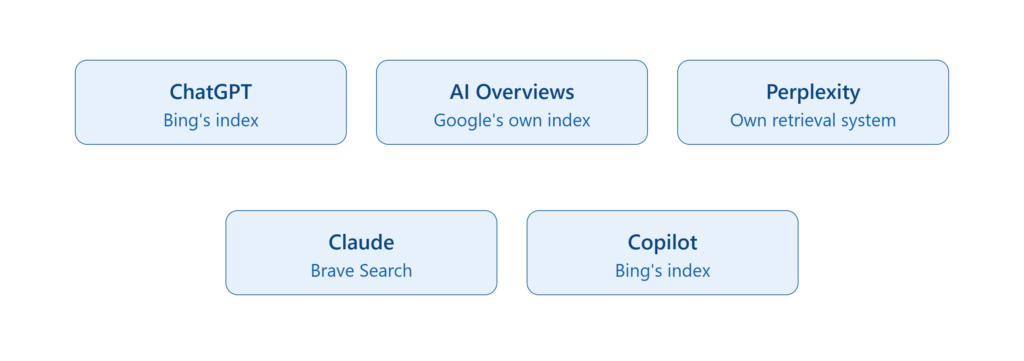
Part of why the overlap is so uneven is that each platform is genuinely built differently underneath.
| Platform | Search backend | What stands out? |
| ChatGPT | Bing’s index | Favours encyclopaedic, high-authority sources; lowest overlap with Google’s own top 10 |
| Google AI Overviews | Google’s own organic index | Highest overlap with traditional rankings, since it draws from the same underlying index |
| Perplexity | Its own retrieval system | Shows sources directly, leans heavily on recency and expert publications |
| Claude | Brave Search | Favours long-form, well-explained, authoritative content |
| Microsoft Copilot | Bing’s index | Similar behaviour to ChatGPT, given the shared backend |
The practical implication is straightforward: optimising purely for Google gives you a real foundation for Google’s own AI Overviews specifically but does relatively little for ChatGPT, Perplexity, or Claude, since each draws from a meaningfully different index and rewards different signals. We’ve gone deep on exactly how each platform sources and weighs content in our dedicated guide to optimising for ChatGPT, Google AI, and Perplexity, worth reading in full if you want to prioritise a specific one.
Why Small Businesses Are Often Invisible to AI (And It Isn’t Their Content)
Here’s a technical point that gets missed constantly, and it’s often the actual reason a genuinely good business shows up nowhere in AI-generated answers. A significant share of AI crawlers cannot execute JavaScript. If your website relies heavily on client-side rendering, where the page’s real content only appears after JavaScript runs in the browser, an AI crawler visiting that page may see something close to a blank page, regardless of how good the content actually is once it loads for a human visitor.
This is a genuinely different, more specific problem than general SEO crawlability advice. A site can be technically fine for Google’s own crawlers, which have had years to develop sophisticated JavaScript rendering, while remaining functionally invisible to several AI-specific crawlers that haven’t caught up yet. The fix is usually server-side rendering, sending the complete, already-built HTML to any crawler that visits, rather than making it wait for JavaScript to construct the page. Worth checking directly rather than assuming: view your own page’s source code, not the rendered page in your browser, and see whether your actual content is present in that raw HTML.
Which Does Your Business Actually Need?
The honest, direct answer: all three. But in a specific order, not all at once.
Start with SEO, the non-negotiable foundation.
If your site isn’t technically sound, fast, crawlable, and built on genuinely useful content, nothing else in this guide will compensate for that. Server-side rendering, clean technical health, solid Core Web Vitals, and content with real depth remain the base everything else sits on. This is the cost of entry, not the finish line.
Then build for AEO.
Once the foundation is solid, restructure your most important pages so AI systems can extract a clean, confident answer from them. Lead with the direct answer in the first few sentences of each section rather than building up to it. Add a proper FAQ schema to genuine question-and-answer content. Think specifically about what your ideal customer would type into ChatGPT, and make sure your page gives the clearest, most complete answer available anywhere.
Then layer on GEO.
With AEO groundwork in place, focus outward: building the broader authority and entity signals that get you woven into synthesised, multi-source AI answers rather than cited as a single standalone source. This means genuine third-party mentions, contributing real expertise to industry publications and communities, keeping your business information consistent everywhere it appears, and connecting your various online profiles together through schema so AI systems can build a confident, corroborated picture of who you actually are.
We’ve written a full, dedicated tactical playbook for the AEO and GEO stages specifically in our AEO Strategies for UK Businesses guide, worth reading once you’re ready to move past this decision stage into execution.
How to Allocate Your Budget
For most UK businesses starting this work, a sensible split is roughly 70 to 80% toward SEO and 20 to 30% toward AEO/GEO, consistent with the pricing bands we’ve set out in our full UK SEO cost guide, which also covers what AEO/GEO specifically costs as either an add-on or a dedicated programme. That proportion should shift over time as AI-driven discovery accounts for a larger share of how your customers actually find you, but it’s a reasonable, defensible starting point rather than an even split or an AEO-first approach most businesses aren’t ready for yet.
If the budget is genuinely tight right now, three actions cost nothing beyond your own time and deliver real, fast impact:
Audit your AI crawler access. Check your robots.txt file for rules affecting AI crawlers specifically. Allow the ones responsible for live citation and search, OAI-SearchBot, ClaudeBot, and PerplexityBot, among them, rather than blocking everything indiscriminately.
Restructure your top pages for extractability. No new content needed; just rework what you already have. Add a direct, clear answer near the top of each key section rather than burying it several paragraphs in.
Set up basic AI visibility tracking. Create a simple routine, manually asking your priority questions across ChatGPT, Perplexity, and Google directly on a regular schedule, and note whether and how accurately your business is mentioned.
How to Measure Success Across All Three
SEO measurement is genuinely mature: keyword rankings, organic traffic, and click-through rate are tracked through Google Search Console, GA4, and standard SEO tools, with two decades of established benchmarks behind them. AEO and GEO measurement is real but younger: AI citation rate (how often you’re mentioned for your priority queries), share of AI voice relative to named competitors, and the quality of any AI-referred traffic you do get, which tends to convert at a meaningfully higher rate than standard organic traffic since the AI has effectively pre-qualified the visitor before they ever arrive.
One honest caveat worth building into how you think about this measurement: research has found a surprisingly low chance that an AI system gives the same answer to the identical question asked twice in separate sessions. That makes single-point-in-time tracking unreliable on its own. Track trend lines over weeks and months rather than treating any one check as a definitive result.
How Prime Flow Digital Can Help
We run SEO, AEO, and GEO as one coordinated strategy, not three disconnected services competing for the same budget. That means a sensible starting allocation, a clear sequence, and ongoing tracking across both traditional rankings and AI citation, rather than treating AI visibility as an afterthought bolted onto an existing SEO retainer.
If you’re not sure where your business currently stands, whether your SEO foundation is genuinely solid, whether AI crawlers can actually see your content, or how you compare to competitors inside ChatGPT and Perplexity right now, get in touch with the Prime Flow Digital team for an AI visibility audit and a clear, honest view of where to focus first
Frequently Asked Questions
Is AEO or GEO replacing SEO?
No. AEO and GEO are an additional layer on top of SEO, not a replacement for it. Most AI platforms still draw on an underlying search index that rewards many of the same foundations good SEO already builds, technical health, content depth, and genuine authority.
What’s the actual difference between AEO and GEO?
AEO focuses on getting your content cited directly as the answer to a specific question. GEO focuses on getting your brand woven into broader, synthesised responses pulled from multiple sources and on building the wider trust and authority signals that make an AI system comfortable recommending you at all. In practice, the two overlap significantly and are often built through the same work.
How much of my budget should go toward AEO/GEO versus traditional SEO?
A sensible starting point for most UK businesses is roughly 70 to 80% toward SEO and 20 to 30% toward AEO/GEO, shifting gradually as AI-driven discovery becomes a larger part of how your customers find you. Several zero-cost actions, like auditing AI crawler access, deliver real impact regardless of budget size.
Which AI platform should a UK business prioritise first?
If you already rank well in Google’s organic results, Google AI Overviews is a natural starting point, since it draws from the same index you’re already optimised for. ChatGPT and Perplexity generally require more dedicated, separate work given how differently they source their answers.
Can my existing SEO team handle AEO and GEO, or do I need specialists?
Most businesses run this through their existing SEO team successfully, since the underlying skills, technical auditing, content strategy, and analytics overlap significantly. Some additional training on AI-specific tactics, crawler management, answer structuring, and multi-platform tracking tends to be worthwhile rather than essential from day one.
Why might my business rank well on Google but never get cited by ChatGPT?
Because ChatGPT draws primarily from Bing’s index and evaluates different signals than Google’s own ranking systems. Strong Google rankings help most with Google’s own AI Overviews specifically, but don’t transfer automatically to platforms with an entirely different backend and different citation criteria.
How long does it take to see results from AEO and GEO work?
Some technical fixes, correcting AI crawler access or restructuring an existing page for a clearer answer, can show impact within weeks. Genuinely consistent citation across your priority queries and multiple platforms typically takes several months of sustained, ongoing work, closer to the SEO timeline than an instant fix.
Is my SEO team’s work wasted if AI citation depends on different signals?
No. SEO remains the essential foundation both approaches rely on; a technically broken, thin, poorly structured site won’t get cited by AI systems any more than it will rank well on Google. What changes is that strong SEO alone is no longer sufficient on its own; it’s the necessary starting point, not the finish line.