No, they’re not the same, though it’s an easy mix-up to make. The two terms get used interchangeably in everyday conversation, and plenty of people, business owners included, use “SEO” and “digital marketing” as if they mean the exact same thing. They don’t. SEO is one specific discipline that sits inside the much broader field of digital marketing, not a separate, competing approach to it. Understanding that relationship properly is the whole point of this guide.
Key takeaways:
- SEO is one part of the broader digital marketing field, not a separate thing
- Digital marketing includes SEO alongside social media, email, paid ads, and content marketing
- SEO typically takes longer to show results but tends to be more cost-effective over time
- Combining both tends to outperform using either one alone
- AEO and GEO (AI search optimisation) are the newest additions to this same broader digital marketing family, covered further down
What Is SEO?
SEO stands for Search Engine Optimisation. It’s the practice of improving a website so it shows up higher in unpaid, organic search results, the regular listings on Google, not the ads at the top of the page.
SEO covers several sub-disciplines working together:
- On-page SEO, making sure individual pages are structured well, with the right keywords in the right places
- Technical SEO, keeping the site fast, mobile-friendly, and easy for search engines to crawl
- Content SEO, creating genuinely useful pages and articles that answer what people are searching for
- Local SEO, helping a business show up in map results and “near me” searches
- AI search optimisation, a newer discipline focused on being found and recommended by tools like ChatGPT and Google’s AI Overviews, which we cover in full in our guide to how SEO, AEO and GEO work together
The goal across all of these is the same: getting found by the right people, for free, when they search for what you offer.
What Is Digital Marketing?
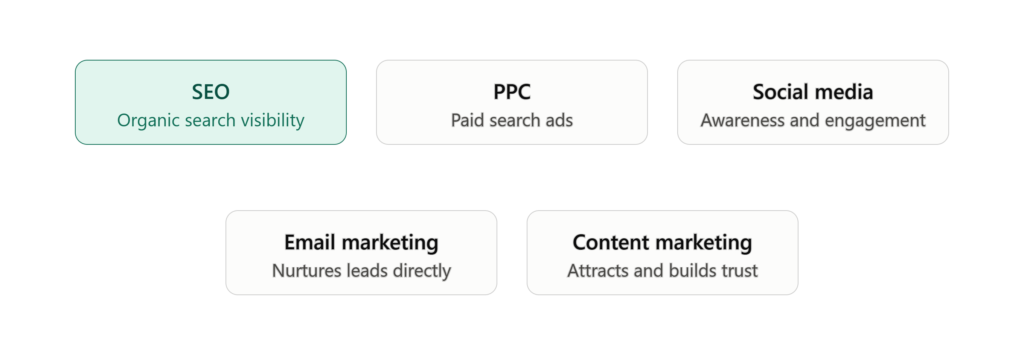
Digital marketing is the umbrella term for all marketing done through digital channels, paid and unpaid alike. SEO is one discipline inside that umbrella, sitting alongside several others:
- Social media marketing, building a presence and engaging audiences on platforms like Instagram and Facebook
- Email marketing, nurturing leads and existing customers directly
- Paid search and PPC advertising, paying for visibility through Google Ads and similar platforms
- Content marketing, producing blogs, videos, and guides that attract and build trust with an audience
- Display and affiliate advertising, and increasingly, the same AI-visibility work mentioned above
Digital marketing’s job is broader than SEO’s: building brand awareness, driving traffic from many different sources, and converting that traffic into leads and sales, using whichever channels make sense for the business.
So Is SEO Part of Digital Marketing?
Yes. SEO is a subset of digital marketing, not an alternative to it.
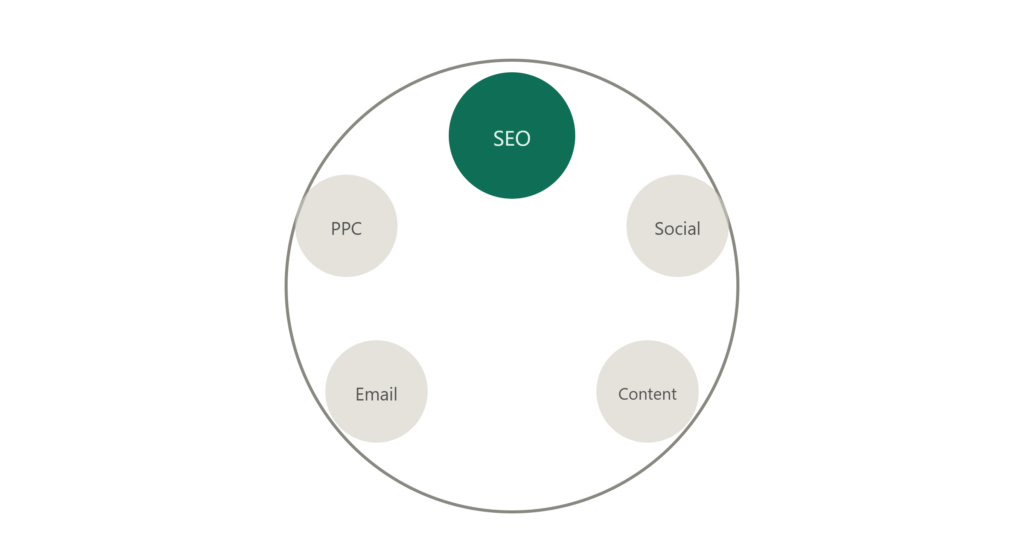
Picture digital marketing as one large circle. Inside it sit several smaller circles: SEO, PPC, social media, email, and content marketing. Each does a different job, but all of them exist to serve the same overall goal, and none of them is a rival discipline standing outside that larger circle. When someone asks, “Should I do SEO or digital marketing?” the honestly framed answer is closer to “Should I do one type of fruit, or fruit?”
How SEO and Digital Marketing Differ in Practice
Goals
SEO’s goals are narrower and more specific:
- Improve organic search rankings
- Increase organic (unpaid) website traffic
- Build long-term domain authority and trust
- Support and amplify content that’s already been created
- Reduce reliance on ongoing ad spend over time
Digital marketing’s goals are broader:
- Build brand awareness across multiple channels
- Drive traffic from several different sources at once
- Generate leads directly, often faster than organic search alone
- Increase sales and revenue through paid and owned channels together
- Build ongoing customer relationships and loyalty, not just first-time visits
Timeframe
This is one of the clearest practical differences. SEO typically takes around three to six months to show meaningful movement, since it depends on search engines re-crawling and re-evaluating a site over time. Certain digital marketing tactics, paid search and social ads especially, can start driving traffic within hours of launch.
Neither timeline is better or worse on its own. Paid tactics buy speed. SEO buys durability, since organic rankings tend to hold far longer than a paid campaign does once the budget stops.
Cost structure
SEO tends to behave like a compounding investment: the cost is largely fixed (time, expertise, ongoing content and technical work) rather than tied directly to each visitor it brings in, and its value tends to build over months and years rather than disappearing the moment spend stops. Digital marketing’s paid channels, by contrast, often work on a pay-per-result basis; you pay for each click or impression, and traffic tends to stop the moment the budget does.
We’ve broken down real, current UK pricing for SEO specifically in our complete guide to SEO costs in the UK, which is worth reading in full if budget is the main thing on your mind right now.
Why Most Businesses Need Both
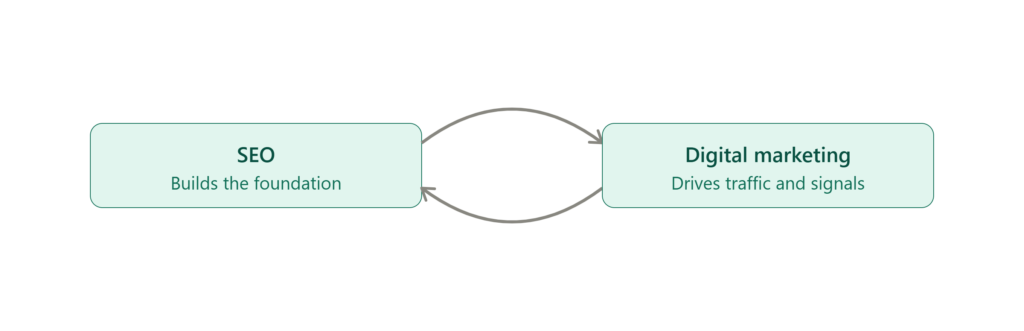
SEO and digital marketing genuinely work better together than either does alone. SEO builds the foundation: a fast, well-structured site with genuinely useful content that makes every other channel work harder, better-converting landing pages for your paid ads to point to, and stronger content for your social and email channels to share. In turn, the traffic, engagement, and social signals your wider digital marketing activity generates often feed back into your SEO performance too.
Several agencies report meaningfully higher conversion rates when the two are run together rather than in isolation, though the exact figure varies by source and market, so treat any single specific percentage with a healthy amount of caution rather than a hard promise. The directional point holds regardless: a business relying on only one of the two is leaving real performance on the table.
Where AI Search Fits Into This
There’s a genuinely new member of the digital marketing family as of 2026: making sure your business is found and recommended by AI tools like ChatGPT, Perplexity, and Google’s AI Overviews, often called AEO (answer engine optimisation) or GEO (generative engine optimisation).
It’s best understood the same way SEO is: a specific discipline sitting alongside the others inside the broader digital marketing umbrella, not a separate strategy competing with it. We’ve written a full, dedicated explainer on exactly how SEO, AEO, and GEO relate to and build on each other in this guide, worth a read if AI search visibility is something you’re starting to think about.
Which Should You Focus on First?
There’s no single right answer, but a reasonable starting point looks like this: if you need fast, immediate results, a product launch, or a time-limited offer, weigh your early effort toward paid digital marketing tactics. If you’re building for the long term, start SEO fundamentals early, since the three- to six-month runway means the sooner you start, the sooner it compounds, ideally alongside at least some complementary digital marketing activity rather than putting all your effort into just one channel.
Most established businesses eventually run both together. The question usually isn’t “which one”; it’s “which one deserves more of this month’s attention.”
How Prime Flow Digital Can Help
Whichever mix of SEO and digital marketing your business actually needs, that’s exactly the kind of question we help answer, rather than pushing one service regardless of fit. If you already know you want to go deeper into a specific area, we’ve built full, practical guides on local SEO, ranking in Google Maps, optimising for ChatGPT, Google AI, and Perplexity, and what SEO actually costs in the UK.
If you’re still working out where to start, get in touch with the Prime Flow Digital team and we’ll help you figure out the right next step for your business.
Frequently Asked Questions
Is SEO the same as digital marketing
No. SEO is one specific discipline focused on organic search visibility. Digital marketing is the broader term covering SEO alongside social media, email, paid advertising, and content marketing.
Is SEO part of digital marketing or separate from it?
SEO is part of digital marketing. It’s a subset, one of several disciplines inside the wider field, not a separate or competing approach.
Can a business do SEO without doing any other digital marketing?
Yes, technically, since SEO can function as a standalone effort. In practice, it tends to perform better alongside at least some other digital marketing activity, since paid and social channels help drive the traffic and engagement that reinforce SEO’s own signals.
Which is better for my business, SEO or digital marketing?
It’s not really an either/or choice, since SEO is one part of digital marketing rather than an alternative to it. The more useful question is which specific channels, SEO included, deserve your budget and attention right now, based on how quickly you need results.
Which one shows results faster, SEO or digital marketing?
Certain digital marketing tactics, particularly paid search and social ads, can generate traffic within hours or days. SEO typically takes three to six months to show meaningful results but tends to be more durable and cost-effective once it does.
Do I need to hire separate people for SEO and digital marketing?
Not necessarily. Many agencies and specialists cover both, since SEO is simply one part of a wider digital marketing skill set. Larger businesses sometimes split the two across specialists, but it isn’t required for most.
Is AI search optimisation (AEO/GEO) part of digital marketing too?
Yes. It’s the newest addition to the same family, focused specifically on being found and recommended by AI tools like ChatGPT and Google’s AI Overviews, sitting alongside SEO rather than replacing it.