For most UK businesses, a website used to be treated like a digital brochure: something you built once, uploaded, and left alone. That approach no longer works. Today, your website is often the first, and sometimes the only, interaction a potential customer has with your business before deciding whether to trust you.
Professional web development changes what a website can do. Instead of sitting quietly in the background, a well-built site actively drives traffic, builds credibility, generates leads, and converts visitors into paying customers around the clock. In this guide, we will break down exactly how web development contributes to business growth in the UK, what separates a website that performs from one that simply exists, and how to choose the right approach for your business.
What Is Web Development, and Why Does It Matter for Growth?
Web development covers everything involved in building and maintaining a functional website: the visual design and layout (front-end), the systems running behind the scenes that manage data and logic (back-end), the technical performance, and the ongoing SEO and security work that keeps a site running smoothly.
In a crowded UK market, a basic template site is rarely enough. Customers expect fast load times, mobile-friendly layouts, and a smooth path from landing page to purchase or enquiry. Businesses that treat their website as a strategic asset, rather than a one-off expense, are the ones that see real returns from it. That is the core idea behind everything in this article: web development is not a cost centre. It is a growth channel.

How Web Development Directly Impacts Business Growth
Improving User Experience (UX) and Building Trust
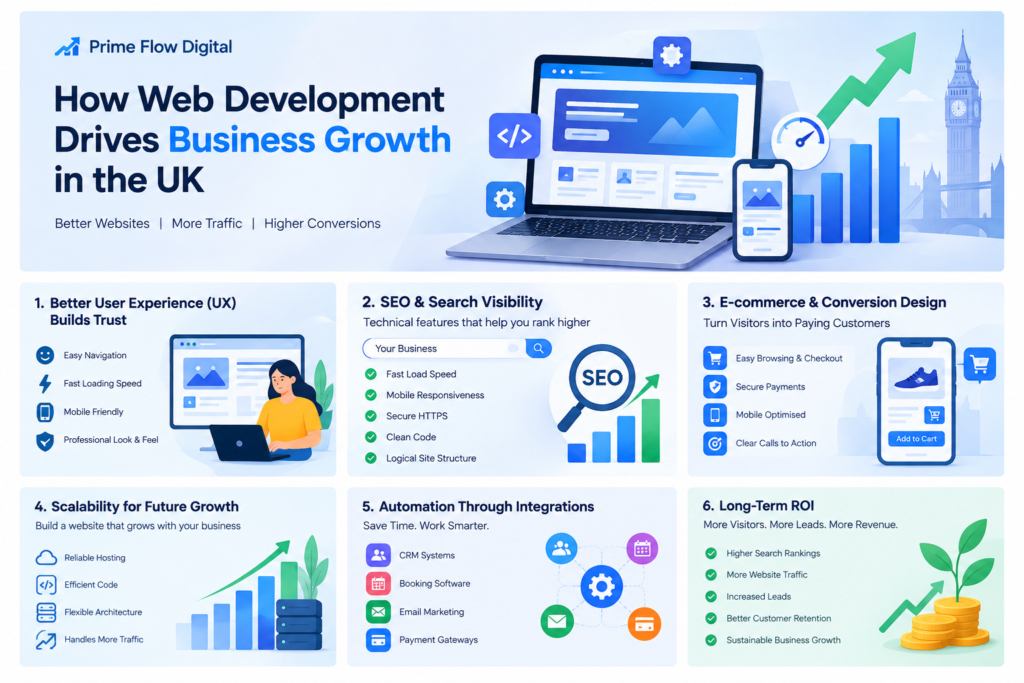
User experience shapes how visitors feel about your business within seconds of landing on your site. Clear navigation, fast-loading pages, and a layout that guides visitors toward what they need all contribute to a positive first impression.
A well-designed website also builds credibility. Customers often judge how trustworthy and professional a business is based on how its website looks and functions. If a site feels outdated, cluttered, or difficult to use, visitors are quick to leave and look elsewhere. A clean, intuitive experience keeps them engaged long enough to convert.
Boosting SEO and Search Visibility
Web development and SEO are closely connected. Search engines reward websites that load quickly, work well on mobile devices, and use clean, well-structured code. These technical foundations directly influence how highly your site ranks in search results.
Key technical factors that affect both SEO and user experience include:
- Page load speed
- Mobile responsiveness
- Secure HTTPS connections
- Clean, error-free code
- Logical site structure and internal linking
Without these fundamentals in place, even strong content and design will struggle to rank. This is why SEO should be considered from the very start of a web development project, not added as an afterthought once the site is already live.
Driving Sales Through E-commerce and Conversion-Focused Design
For businesses that sell products or services online, the website itself becomes the sales engine. A well-built e-commerce platform makes it simple for customers to browse, choose, and check out with minimal friction. Every unnecessary step in that journey is a chance for a customer to abandon their cart.
Effective e-commerce development includes secure payment gateways, clear product information, a mobile-optimised checkout, and prominent calls to action throughout the site. Even for service-based businesses without an online shop, conversion-focused design still matters: clear contact forms, visible enquiry buttons, and a straightforward path to booking a consultation all play a direct role in turning visitors into customers.
Supporting Scalability as the Business Grows
A website that works well for a small business today may struggle to keep up as that business grows. Increased traffic, new product lines, additional services, and third-party integrations all put pressure on a site’s technical foundation.
Scalable web development means building a site that can handle this growth without constant, costly rebuilds. This includes choosing the right hosting infrastructure, writing efficient code, and planning the site’s architecture with future features in mind from the outset. Businesses that invest in scalability early avoid the disruption and expense of migrating to a new platform later.
Automating Operations Through Integrations
A modern website can do far more than present information. Integrating your site with a Customer Relationship Management (CRM) system, booking software, or email marketing tools automates tasks that would otherwise eat up staff time.
For example, a contact form connected to a CRM can automatically log new enquiries, assign them to the right team member, and trigger a follow-up email, all without manual input. Booking systems can manage appointment scheduling, send automated reminders, and even take deposits, freeing up time that would otherwise go toward phone calls and admin.
Local SEO and Visibility for UK Businesses
For businesses that serve specific towns, cities, or regions, local SEO is one of the most valuable growth levers web development can support. This includes optimising your Google Business Profile, ensuring your site includes location-specific pages where relevant, and structuring your content so it answers the questions local customers are actually searching for.
Local search behaviour in the UK often differs from broader national search trends. A UK-based development partner who understands regional customer expectations, seasonal demand patterns, and local competition can build a site that speaks directly to the audience you are trying to reach, rather than a generic template aimed at a global market.
CMS vs. Custom Web Development: Which Drives Better Growth?
One of the biggest decisions in any web development project is whether to build on a Content Management System (CMS) like WordPress or invest in a fully custom-built platform. Neither option is universally better. The right choice depends on your goals, budget, and long-term plans.
| Factor | CMS (e.g., WordPress) | Custom Development |
| Speed to market | Fast, often live within weeks | Slower, typically several months |
| Initial cost | Lower, less bespoke coding required | Higher, full design and build process |
| Flexibility | Good, but limited by the platform | Unlimited, built to exact requirements |
| Scalability | Can scale but may need workarounds | Highly scalable from the ground up |
| Ease of use | Simple for non-technical teams to manage | Usually needs a developer for changes |
| Best for | Blogs, brochure sites, standard e-commerce | Unique platforms, complex functionality |
A CMS is often the right starting point for small businesses that need to launch quickly and manage their own content. Custom development becomes the better investment once a business has highly specific requirements, a unique customer journey, or functionality that no off-the-shelf platform can support.
Key Website Features That Fuel Online Growth
Beyond the core build, certain features consistently show up in websites that actively contribute to business growth:
- E-commerce and payment gateways: Secure, frictionless checkout processes that reduce cart abandonment
- Booking and scheduling systems: Automated appointment management, reminders, and upfront payments
- CRM and third-party integrations: Connected systems that track leads and streamline follow-up
- Analytics and reporting tools: Data on visitor behaviour that informs ongoing improvements
Each of these features turns a passive website into an active part of the business, one that generates leads, manages customer relationships, and produces the kind of data that helps you make smarter decisions over time.
How to Choose the Right Web Development Partner in the UK
Choosing a development partner is one of the most important decisions in the entire process. The right agency does more than write code. They understand your business goals and help translate them into a site that actually performs.
When evaluating potential partners, consider:
- Portfolio quality: Visit their live websites, not just screenshots. Test navigation, speed, and mobile responsiveness for yourself.
- Client testimonials: Look for specific, detailed feedback about communication, reliability, and results, rather than generic praise.
- Industry experience: A partner familiar with your sector will understand common challenges and customer expectations.
- Transparent pricing: A trustworthy agency will be upfront about costs, timelines, and what is included in ongoing support.
- UK market understanding: A local agency brings insight into UK consumer behaviour, search trends, and regional competition that an offshore or generic provider may miss.
At Prime Flow Digital, we work closely with UK businesses to build websites that are designed around real growth goals, not just aesthetics. From initial strategy through to launch and ongoing support, our approach centres on making sure your site actively contributes to your bottom line.
Turning Your Website Into a Growth Engine
A website is no longer a static digital placeholder. When it is built with the right foundations, from UX and SEO to scalability and smart integrations, it becomes one of the most valuable growth assets a UK business can own.
Whether you are launching your first site or rethinking one that is holding your business back, the goal is the same: a website that works as hard as you do. Get in touch with Prime Flow Digital today to discuss how we can help your business grow online.
Why Prime Flow Digital?
Prime Flow Digital works with UK businesses to build websites that do more than look good; they are designed to actively support growth. Our team combines web development, technical SEO, and conversion-focused design to make sure every site we build performs on the metrics that matter: speed, search visibility, and the ability to turn visitors into customers. Rather than treating a website as a one-off project, we approach it as an ongoing growth asset, working closely with each client to understand their goals, their customers, and the UK market they operate in. From initial strategy through to launch and long-term support, Prime Flow Digital acts as a genuine digital partner, helping businesses build a stronger, more scalable presence online.
Frequently Asked Questions
How much does web development cost for a UK business?
Costs vary depending on complexity. A simple brochure-style website using a well-designed template can cost a few thousand pounds, while a custom-built platform with e-commerce or bespoke functionality typically ranges from £10,000 to £50,000 or more, depending on requirements.
How long does it take to build a website?
A standard informational website can often be designed and launched within four to eight weeks. Larger, custom-built platforms with complex functionality usually take three to six months from initial discovery through to launch.
Does web development really affect SEO rankings?
Yes. Site speed, mobile responsiveness, clean code, secure HTTPS, and a logical site structure are all factors search engines use to rank websites. A professionally built site gives your SEO strategy a strong technical foundation to work from.
Do I need both a website and a mobile app?
Most small and medium-sized businesses do not need a dedicated app right away. A responsive website that works well across desktop and mobile devices covers the needs of most customers. An app becomes worth considering when your business would genuinely benefit from features like push notifications or offline access.
What ongoing costs should I budget for after launch?
Expect annual costs for domain and hosting, typically in the range of £100 to £500 per year, plus an SSL certificate for security. A maintenance plan covering updates, security patches, and technical support can range from £50 to £500 or more per month, depending on the complexity of your site and the level of support required.