If you want your website to show up in ChatGPT, Google’s AI Overviews, Perplexity, and Copilot, you need three things working together: your site has to be accessible to AI crawlers, your content has to be structured so it can be extracted and quoted accurately, and your brand needs enough authority signals, on your site and off it, for AI systems to trust you as a source. Miss any one of these, and the other two won’t save you.
What Is AI-Powered Search, and How Is It Different From Google?
For two decades, “search visibility” meant one thing: rank a page high enough on Google that people click through to your site. AI-powered search changes the goal. Instead of showing a list of links, tools like ChatGPT, Google’s AI Mode, Copilot, and Perplexity generate a direct answer, and they either cite your page as a source or they don’t. There’s no middle ground, no page two.
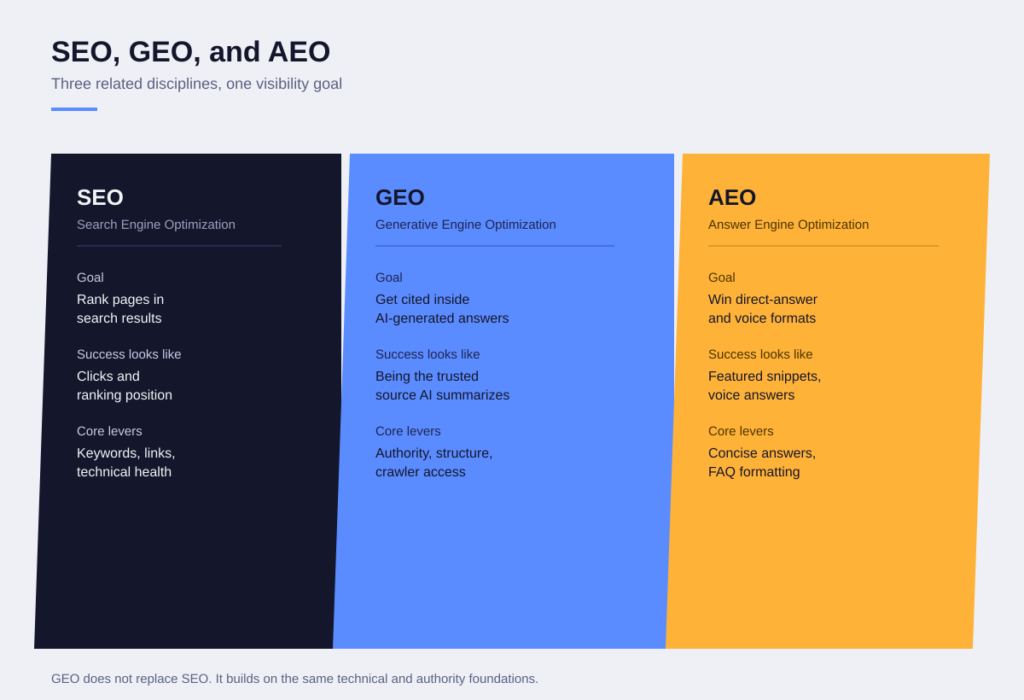
This shift has a name: Generative Engine Optimisation, or GEO. You’ll also see the term AEO, Answer Engine Optimisation, used for the same general idea, with a slightly stronger focus on getting featured in direct-answer formats like featured snippets, voice assistants, and AI summaries.
It’s worth being clear about one thing up front: GEO doesn’t replace SEO. It builds on it. The sites winning in AI search are, in almost every case, sites that already have solid technical SEO, clean site structure, and real authority. GEO adds a layer on top, focused on clarity, structure, and citation-worthiness rather than pure ranking position.
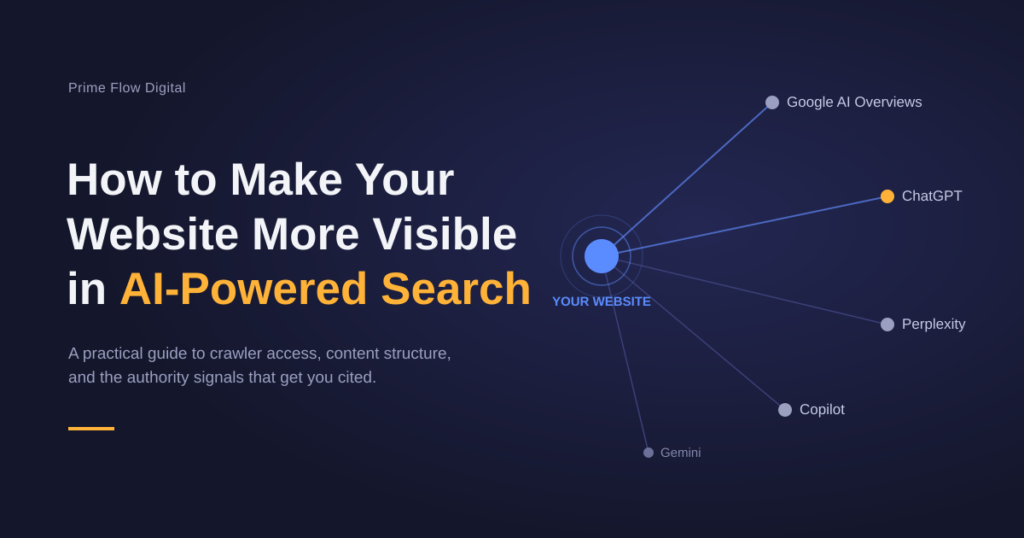
How AI Search Engines Actually Find Your Content
AI search tools don’t all work the same way, and understanding the differences matters for where you focus your effort.
- Google’s AI Overviews and AI Mode build directly on Google’s existing index. If you’re not visible in traditional Google Search, you won’t show up here either.
- Microsoft Copilot relies on Bing’s index. This means your Bing presence matters as much as, or more than, your Google rankings for showing up in Copilot.
- ChatGPT uses its own crawlers, GPTBot for training data and OAI-SearchBot for search indexing, and it also draws heavily on Bing’s index for real-time search results. That’s why submitting your sitemap to Bing Webmaster Tools is a step people often skip and shouldn’t.
- Perplexity uses PerplexityBot for scheduled crawling but also performs live retrieval at the moment someone asks a question, pulling in fresh content even if it isn’t permanently indexed.
In short, these systems combine stored indexes with real-time retrieval. That hybrid model is why technical accessibility and content quality both matter, sometimes for different reasons on different platforms.
Is Your Website Technically Accessible to AI Crawlers?
Before you touch a single word of content, confirm that AI systems can actually reach your site. This is the step most businesses skip, and it makes every other effort pointless if it’s wrong.
Check and Update Your robots.txt
Most websites’ robots.txt files were written years before AI crawlers existed, and default configurations on some platforms block them without anyone noticing. Make sure these crawlers are explicitly allowed if you want to be indexed and cited:
- GPTBot and OAI-SearchBot (OpenAI/ChatGPT)
- PerplexityBot (Perplexity AI)
- ClaudeBot (Anthropic)
- Bingbot (Microsoft/Copilot)
- Googlebot (Google Search, AI Overviews, AI Mode)
Submit Your Sitemap to Bing
Because ChatGPT Search leans on Bing’s index, a strong Bing presence can matter more than your Google rankings for showing up in ChatGPT specifically. If you’ve only ever submitted your sitemap to Google Search Console, add Bing Webmaster Tools to your routine as well. It’s a small step that’s frequently overlooked.
Fix the Basics of Indexation
No amount of content rewriting fixes a page that AI systems can’t reach or trust technically. Work through:
- Important pages return a clean 200 status, not 404s or long redirect chains
- Your robots.txt and meta robots tags aren’t accidentally blocking valuable pages
- Your XML sitemap actually lists the pages you want indexed
- Google Search Console shows no widespread indexation errors
- Core Web Vitals are acceptable on the templates that matter most
Should You Add an llms.txt File?
You’ll see llms.txt recommended as an emerging standard, a plain-text file in your site’s root that describes your content for language models, similar in spirit to robots. txt. The honest answer is that the evidence on its impact is mixed. Some analysis suggests it currently has little to no measurable effect on whether tools like ChatGPT or Google’s AI Mode choose to cite your content. It’s low-effort to add and unlikely to hurt, but don’t treat it as a shortcut around the technical and content work described in this guide.
How Do You Structure Content So AI Systems Can Extract and Cite It?
AI systems don’t read your page the way a human does, start to finish, absorbing tone and nuance. They scan for extractable, accurate passages they can lift with confidence. That changes how you should write.
Write the answer first, and explain second.
Every section should open with a direct, standalone statement of the answer, then follow with context and supporting detail. Vague openers like “there are many factors to consider” get skipped over. Specific ones, like “to improve your AI search visibility, start by checking your robots.txt,” get extracted and cited. Aim for your first sentence in each section to make sense even if nothing else on the page were quoted alongside it.
Use Question-Based Headings
Structure your H2s and H3s around the actual questions your audience types into AI tools. “How do I appear in generative AI answers?” matches conversational search intent far better than a heading like “Our Approach”. This single change does a lot of work, because it aligns your page’s structure with how people phrase queries in the first place.
Keep Sections Short and Scannable
Walls of prose are hard for any system, human or machine, to extract cleanly. Break content into short paragraphs, use bullet points and numbered lists where they genuinely help, and try to keep each section between roughly 100 and 150 words before the next heading. One core idea per section beats several ideas crammed together.
Add a Genuine FAQ Section
Three to five real, frequently asked questions, written in natural language, help AI systems identify clear, self-contained answers on your page. The key word is genuine. Don’t stuff an FAQ section with keyword variations disguised as questions; use it for questions people actually ask.
Include Specific, Sourced Statistics
AI systems tend to favour content with concrete, attributed data over vague claims. “Many businesses are adopting AI search optimisation,” says nothing. According to McKinsey’s research, a large and growing share of AI search users now treat it as their primary way of finding information, giving a system something specific to cite. Always attach a named source and a date, and check that the figure is still current before you publish.
What Structured Data Should You Add?
Schema markup helps machines understand what type of content is on a page, and it remains a reasonable piece of the puzzle, though it’s not a magic switch. The types most relevant to AI visibility are:
- Organisation or Local Business: who you are, where you operate, with the same As links to profiles you control
- Service: what you actually offer, linked from your service pages
- Article or Blog Posting: insight content with visible author and publish/update dates
- FAQPage: only when the FAQ content is genuinely visible and accurate on the page
- HowTo: for genuinely instructional, step-by-step content
One caution worth repeating: a schema describes your content; it doesn’t improve it. Adding an FAQ schema to a page with no real FAQ content, or piling on markup as a substitute for clear writing, won’t move the needle. Validate everything with Google’s Rich Results Test and fix errors before layering on more types.
How Do You Build the Authority Signals AI Systems Trust?
Google’s E-E-A-T framework, Experience, Expertise, Authoritativeness, and Trustworthiness, isn’t just a Google concept anymore. AI systems weigh very similar signals when deciding which sources are safe to cite.
On-Site Signals
- A visible author bio with real credentials or role, not an anonymous “admin” byline
- Dedicated about and contact pages with clear, specific information
- Service pages that describe what you actually deliver, rather than one generic catch-all page
- Genuine reviews or testimonials, where permitted
- Case studies or examples that demonstrate real experience, not just claims of expertise
Off-Site Signals
- Backlinks and mentions from reputable, relevant websites. Referring domains are consistently one of the strongest predictors of AI citation across platforms.
- Brand mentions on community platforms like Reddit and Quora, which several studies link to meaningfully higher citation rates
- A presence on review platforms such as Trustpilot, G2, Capterra, and Yelp
- Consistent name, address, and phone details wherever your business is listed
- A complete, accurate Google Business Profile aligned with your website
It’s worth noting that strong organic Google visibility itself remains one of the better predictors of showing up in Google’s AI Mode responses specifically. AI systems don’t operate in isolation from the search ecosystem around them; a page that already performs well organically has a real head start.
How Do You Check and Track Your AI Search Visibility?
You can’t improve what you don’t measure, and AI visibility is trickier to track than a traditional keyword ranking.
Manual Testing
Query ChatGPT, Perplexity, Copilot, and Gemini directly with the questions your customers would ask. Always test in an incognito window or logged-out session rather than your personal account, since these tools can personalise answers based on your history and reduce how representative the result is.
Use AI Visibility Tracking Tools
Manual spot-checks have real limits, since answers can vary by session, model updates, and how a prompt is phrased. Dedicated AI visibility tracking tools can monitor brand mentions, citation frequency, and competitor comparisons across platforms over time, turning a moving target into something you can actually report on.
Watch for AI-Generated Follow-Up Questions
Tools like Perplexity and Copilot often surface follow-up questions after an answer. These are a genuinely useful, free source of content ideas, since they reveal exactly what related questions real users have that your current content doesn’t yet answer.
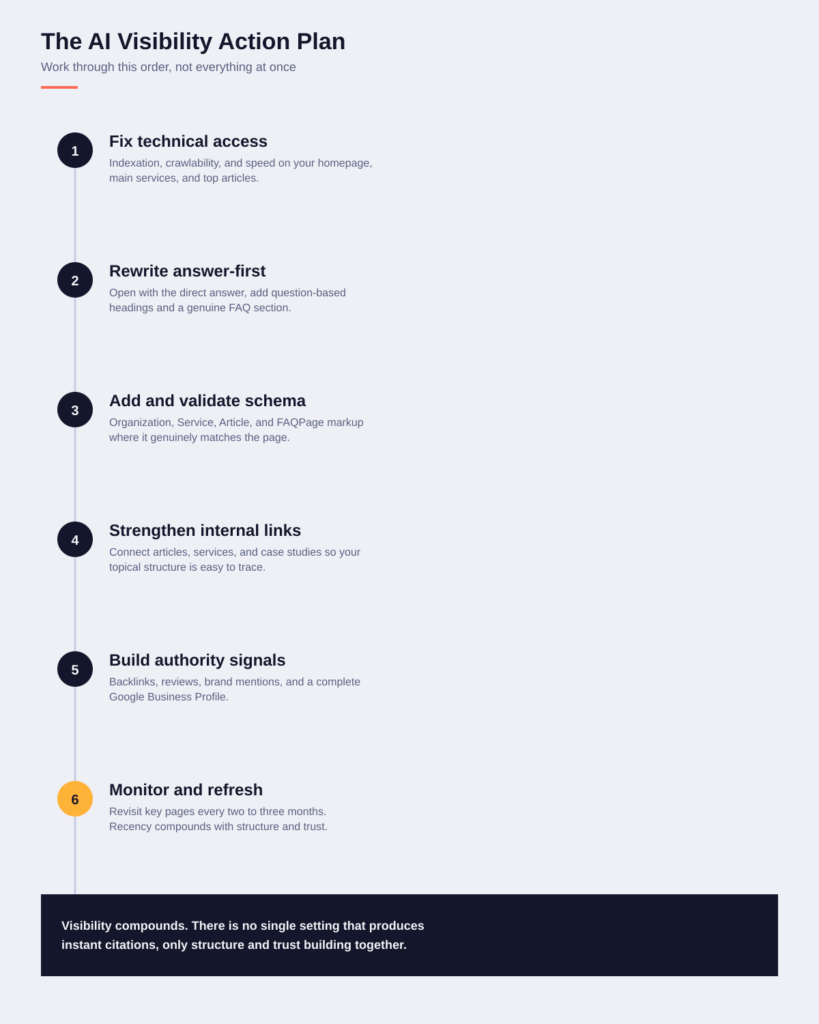
A Practical Action Plan
Rather than trying to do everything at once, work through this sequence:
- Fix technical access first. Confirm indexation, crawlability, and site speed on your homepage, main service pages, and top-performing articles.
- Rewrite priority pages to answer first. Add a clear opening summary, question-based headings, and a genuine FAQ section to the pages that already drive traffic or enquiries.
- Add and validate schema. Apply organisation, service, article, and FAQ page markup where it genuinely matches your content, and test it.
- Strengthen internal linking. Connect related articles, service pages, and case studies so both users and AI systems can trace your site’s topical structure.
- Build authority on and off the site. Pursue backlinks, encourage reviews, keep your Google Business Profile current, and stay active where your audience already discusses your industry.
- Monitor and refresh. Revisit key pages every two to three months. AI systems appear to weigh recency, particularly on fast-moving topics, so stale pages tend to lose ground even when the information is still accurate.
What Doesn’t Move the Needle
Some tactics get recommended often and deliver little in practice:
- Keyword-stuffed titles and URLs
- Relying on llms.txt alone as a visibility strategy
- Schema markup layered onto thin or generic content
- Publishing AI-generated pages with no real expertise behind them
- Duplicating the same boilerplate copy across multiple pages or locations
- Ignoring internal linking while focusing only on individual pages
- Expecting citations to appear overnight
Visibility in AI search compounds over time as structure, trust, and authority build up together. There’s no single setting to flip that produces instant results.
Where Prime Flow Digital Fits In
AI search visibility touches technical SEO, content structure, and brand authority all at once, which is exactly why most businesses find it harder to tackle than traditional SEO. Prime Flow Digital works across all three: auditing crawler access and indexation, restructuring content so it’s genuinely citable, and building the authority signals that give AI systems a reason to trust your site. If you want a clear picture of where your website stands today, that’s a conversation worth having before your competitors have it first.
Frequently Asked Questions
Does my Google ranking affect my visibility in ChatGPT?
Not directly. ChatGPT leans heavily on Bing’s index for search results, so a strong Bing presence often matters more than your Google position specifically for ChatGPT citations, even though strong overall SEO tends to help across the board.
How long does it take to see results?
Technical fixes, like unblocking crawlers or fixing indexation, can show effects within weeks. Content and authority signals typically take longer, often a few months, to meaningfully influence citation rates.
Is AI search visibility the same as SEO?
Not exactly. SEO focuses on ranking in search results. AI visibility is about being understood and cited when a system synthesises an answer. The technical groundwork overlaps heavily, but the emphasis on clear, quotable, well-structured content is stronger for AI search.
Which pages should I optimise first?
Start with the pages that already drive the most traffic or enquiries, typically your homepage, core service pages, and your best-performing articles. Get the foundations right there before expanding to lower-priority pages.
Do I need schema markup for AI search visibility?
It helps, but it isn’t a substitute for genuinely useful, well-structured content. Treat schema as a supporting layer, not the main strategy.