Most businesses assume more traffic means more ad spend. The evidence says otherwise. Organic search already accounts for roughly 53% of all website traffic, compared with around 27% for paid search, according to Sagapixel’s 2025 research. Once it’s built properly, organic search outperforms paid on nearly every metric that actually matters: traffic share, click-through rate, and trust. Growing it doesn’t require a bigger budget. It requires matching your content to real search intent, fixing the technical basics, and staying consistent.
Quick summary:
- Organic search already captures a majority of all website traffic and converts more efficiently than paid ads once it’s established
- Growing it doesn’t take more money; it takes better-matched content, solid technical foundations, and consistency
- A simple five-step loop, research, plan, build, promote, optimise, is enough to run this without a dedicated in-house SEO team
- UK businesses with a physical presence or service area get an additional, largely free lever through Google Business Profile optimisation
Why Organic Traffic Beats Paid on Value, Not Just Cost
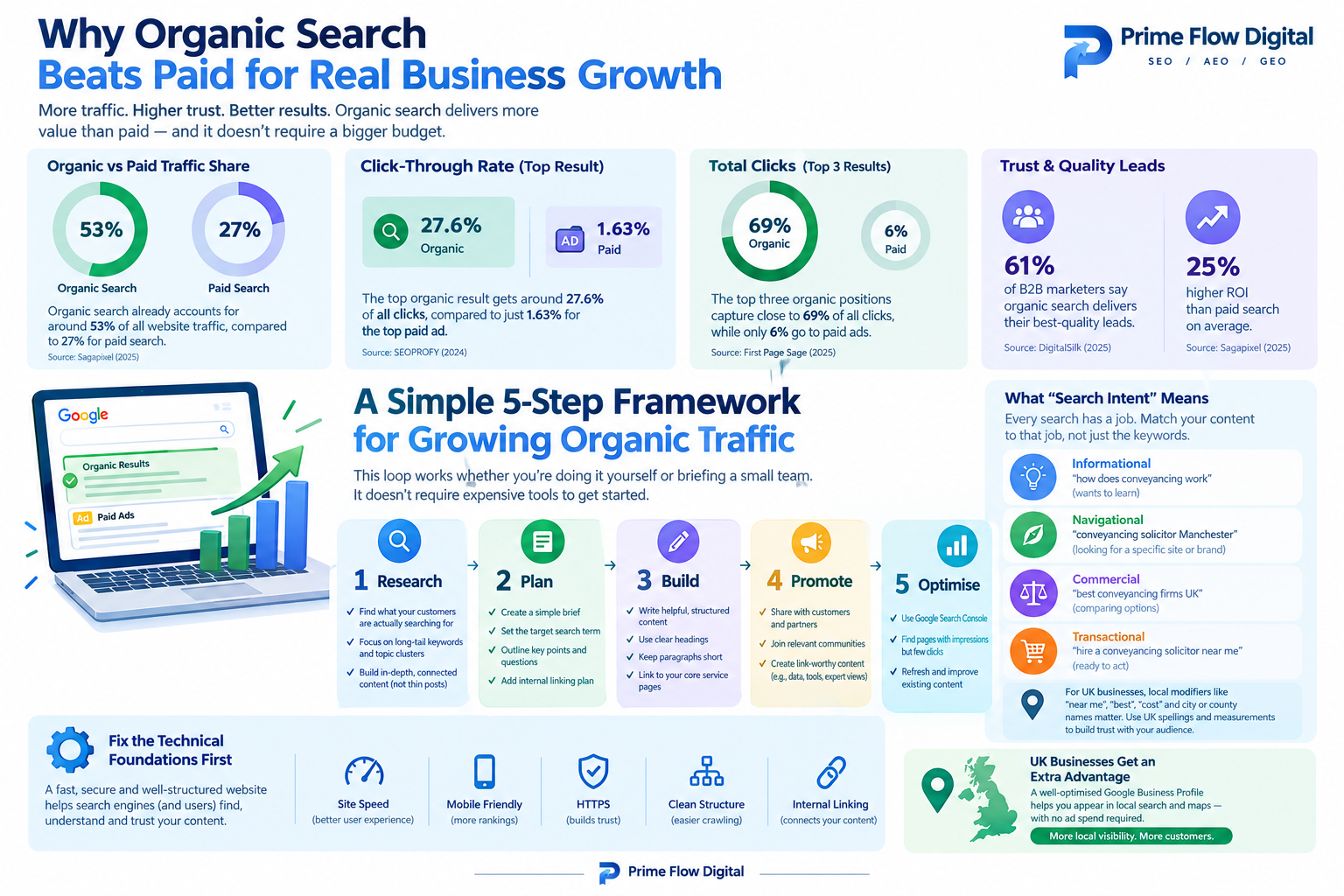
The gap between organic and paid isn’t small, and it isn’t just about cost per click. The top organic search result captures around 27.6% of all clicks, compared with roughly 1.63% for the top paid ad, according to SEOPROFY’s 2024 data. Zoom out further, and the top three organic positions combined capture close to 69% of all clicks, per First Page Sage’s 2025 figures. On Google specifically, organic listings receive around 94% of all clicks, with only about 6% going to paid ads, according to DigitalSilk’s 2025 research.
Trust plays a real role here. People consistently click organic results more than ads because organic ranking signals relevance and credibility that a paid placement simply doesn’t carry in the same way. A majority of B2B marketers, roughly 61% according to DigitalSilk, say organic search delivers their best-quality leads, and Sagapixel’s research puts organic SEO’s average ROI at around 25% better than paid search.
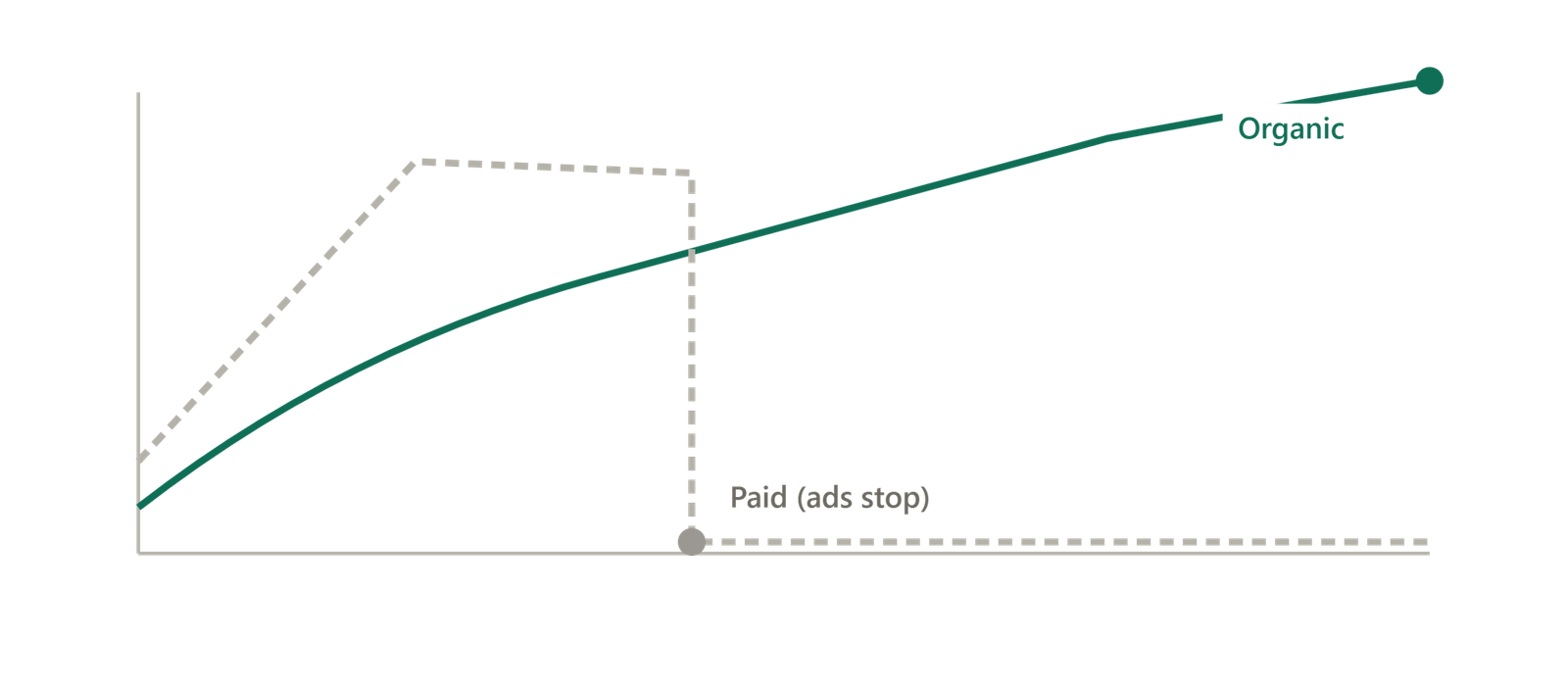
None of this means organic is literally free. It costs time, expertise, and consistent effort. What it doesn’t do is disappear the moment you stop spending, the way paid traffic does. Your cost per lead through organic tends to fall over time as content and authority compound, rather than staying fixed per click indefinitely.
What “Search Intent” Actually Means for a UK Business
Every search has a job behind it, and matching your content to that job matters more than chasing keyword volume. Broadly, searches fall into four types: informational (someone wants to learn something), navigational (they’re looking for a specific site or brand), commercial (they’re comparing options before deciding), and transactional (they’re ready to act).
A page built for the wrong intent won’t convert, no matter how well it’s optimised technically. Someone searching “how does conveyancing work” wants an explanation, not a sales pitch. Someone searching “conveyancing solicitor Manchester” wants a service page they can actually book from.
For a UK audience specifically, local modifiers carry real weight; “near me”, “best”, “cost”, and actual city or county names all signal a different kind of intent than a generic version of the same search. Using UK spellings and UK measurements throughout your content is a small detail, but it genuinely affects trust and click-through rate for a UK reader who notices when something reads as written for a different market.
A Simple Five-Step Framework for Growing Organic Traffic
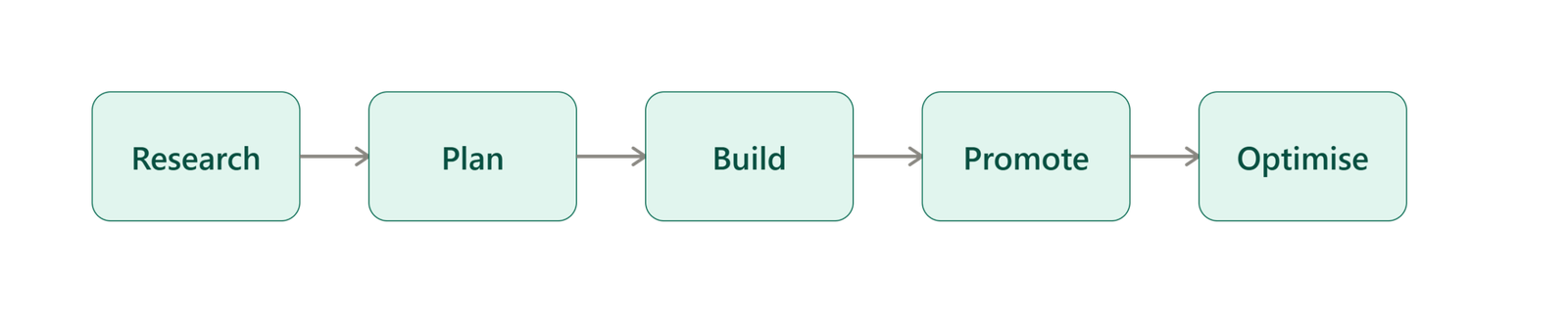
This loop works whether you’re running it yourself or briefing a small team, and it doesn’t require expensive tools to get started.
1. Research
Map out what your customers are actually searching for, not just what sounds impressive. Favour long-tail and topic-cluster targets over broad, high-competition terms; a smaller budget realistically can’t win against established players. Ten strong, well-connected pages covering a topic in genuine depth will consistently beat forty thin, scattered posts chasing unrelated keywords.
2. Plan
Before writing anything, build a simple brief: a working title, the target search term, a rough outline, likely questions to answer, and where this page should link internally. Five minutes of planning here saves considerably more time later.
3. Build
Publish content that’s genuinely structured to help, not just to exist. Use clear headings, keep paragraphs short, and link internally back to your core service pages so both readers and search engines can trace the connection between your supporting content and what you actually sell.
4. Promote
You don’t need an ad budget to get attention. Share new content with existing customers and partners. Contribute genuinely to relevant industry communities rather than dropping links and leaving. The most reliable way to earn organic mentions without spending money is creating something genuinely worth linking to: original data, a useful free tool, or a well-argued opinion piece other people in your industry want to reference.
5. Optimise
Use Google Search Console to see what’s actually happening: which pages get impressions but few clicks, which rank on page two and just need a push, and which have gone stale. Refreshing and improving what you already have is often faster and cheaper than starting from scratch, and it’s a step most businesses skip entirely in favour of only publishing new content.
Fix the Technical Foundations First
No amount of good content will compensate for a technically broken site. Before investing heavily in content, work through the basics:
- Crawlability and indexation: confirm search engines can actually find and index your important pages
- Page speed and Core Web Vitals: a slow site loses visitors and rankings before your content even gets a chance
- Mobile usability: the majority of searches now happen on mobile, and a clunky mobile experience undermines everything else
- Clean site architecture and internal linking: a logical structure helps both visitors and search engines understand how your pages relate to each other
- Basic schema markup: helps search engines (and increasingly AI tools) understand exactly what your pages represent
Get these right once, and every piece of content you publish afterward performs better than it would on a shaky foundation.
Don’t Overlook Local SEO (If It Applies to You)
If your business has a physical location or serves a defined area, a complete, accurate Google Business Profile is one of the highest-leverage, genuinely free levers available to you. It costs nothing beyond your time to claim, verify, and fully complete, and it’s frequently neglected even by businesses that would benefit enormously from getting it right.
We’ve covered the full tactical playbook for this in depth in our complete local SEO guide and our guide to ranking in Google Maps, both worth reading in full if local visibility matters to your business.
Refresh Before You Publish New
A striking data point worth acting on directly: Ahrefs’ research has found that roughly 73% of pages ranking in Google’s top 10 are three years old or older. Fresh content matters, but there’s a strong, underused case for auditing what you already have before writing something entirely new. A page sitting on page two with outdated statistics, thin sections, or a stale structure is often one solid update away from a meaningfully better position, and that update usually takes far less time than a brand-new piece would.
Organic Growth Extends Beyond Google Now
Here’s the natural next step in this whole argument, one worth taking seriously in 2026. Everything above is really about growing visibility without paying for clicks. Being cited by ChatGPT, Perplexity, or Google’s AI Overviews is exactly the same kind of channel: genuinely organic, genuinely free, and increasingly where a meaningful share of research and discovery now actually happens before someone ever runs a traditional search.
The same fundamentals that build strong organic SEO, clear, well-structured, genuinely useful content and a technically sound site, also feed directly into whether AI tools cite and recommend your business. We’ve covered this connection in full across how SEO, AEO, and GEO work together, practical AEO strategies for UK businesses, and how to optimise specifically for ChatGPT, Google AI, and Perplexity, all worth reading once you’re comfortable with the fundamentals covered here.
When to Get Professional Help
Plenty of this is genuinely achievable without outside help, particularly the technical checklist and the five-step content loop above. Professional support tends to earn its cost when you hit technical issues beyond your team’s comfort zone or when you’ve been consistent for months and still see no meaningful movement.
One clear warning worth repeating: be cautious of any agency promising guaranteed rankings or fast, dramatic results. No legitimate provider can guarantee a specific Google position, and anyone claiming otherwise is either overselling or planning to use tactics that risk a penalty further down the line. Look instead for a provider who’s transparent about their methods, realistic about timelines, and willing to point to genuine, verifiable results.
How Prime Flow Digital Can Help
Building durable organic growth on a limited budget isn’t about finding a shortcut; it’s about doing the fundamentals properly and consistently, across both traditional search and the AI-driven discovery that’s increasingly part of the same picture. At Prime Flow Digital, we help UK businesses do exactly that: matching content to genuine search intent, fixing the technical issues holding a site back, and building the kind of authority that compounds rather than disappearing the moment you stop paying for it.
If you’re currently relying more heavily on ads than you’d like, get in touch with the Prime Flow Digital team, and we’ll help you work out where your organic opportunity actually is.
Frequently Asked Questions
How long does it take to see results from organic SEO instead of ads?
Most UK businesses start seeing measurable improvement within three to six months of consistent effort, with quicker, smaller wins possible for lower-competition, long-tail terms. Paid ads deliver traffic immediately but stop the moment spending stops; organic takes longer to build but keeps compounding.
Is organic traffic really free, or does it just cost time instead of money?
It costs time and expertise rather than a per-click fee. You may pay for tools, content creation, or professional help, but that cost doesn’t scale directly with how much traffic you receive, unlike paid ads, where every additional click adds to the bill.
Can a small UK business compete for organic traffic against bigger competitors?
Yes, particularly by targeting long-tail, specific searches rather than broad, high-competition terms dominated by larger brands. A smaller business with genuinely useful, well-structured content on a narrower set of topics can outperform a much bigger competitor’s thinner, more generic pages.
Should I stop running ads completely and focus only on organic traffic?
Not necessarily. Paid ads still have a place for immediate visibility, time-limited offers, and testing what converts before committing organic effort to it. The strongest long-term position usually combines both, with organic doing more of the heavy lifting over time.
What’s the fastest way to increase organic traffic with a limited budget?
Start by refreshing existing content that’s already ranking reasonably well rather than writing something new; the improvement often shows up faster than a brand-new page would. Alongside that, fix any obvious technical issues; slow load times or poor mobile usability quietly undermine everything else.
Do I need to hire an SEO agency, or can I do this myself?
Many of the fundamentals, the five-step content framework, basic technical fixes, and Google Business Profile optimisation are achievable in-house. Professional help tends to add the most value for deeper technical issues or when consistent effort isn’t producing results.
How much of my organic traffic could come from AI tools like ChatGPT rather than Google?
This share is growing quickly and varies significantly by industry and how people in your market actually research decisions. The same fundamentals that build strong organic SEO also support AI visibility, so investing in one increasingly supports the other rather than requiring a completely separate effort.