Many UK businesses know the feeling. The ad budget goes in, the enquiries come out, and the moment the budget stops, so does the growth. It works, but it never builds on itself.
A long-term organic growth strategy is the alternative. Instead of renting attention, you earn it with a website that is easy to find and easy to use, content that answers real questions, and customers who come back and tell others about you. Each piece of work you do keeps paying you back long after it goes live.
This guide shows you how to build that kind of strategy step by step. You will learn what organic growth really means, which foundations to lay first, which growth approach suits your business, the seven pillars that drive results, and how to measure progress with a 12-month roadmap. We wrote it for UK business owners, founders and marketing managers, and we have included the UK specifics that most guides ignore.
What Is a Long-Term Organic Growth Strategy?
Organic growth means expanding your business using the resources you already have: your people, your expertise, your products, your content and your customer relationships. A long-term organic growth strategy is a deliberate plan to do this consistently over years so that each result builds on the last.
Think of it as the difference between paying rent and owning property. Rent gets you in the door today. Property gains value while you sleep.
Organic growth vs inorganic growth
Inorganic growth is growth you buy. That usually means paid advertising, acquisitions, mergers or outside funding. It can be fast, and there are times when it makes sense. The trade-off is cost and dependence. When the spending stops, the growth often stops with it.
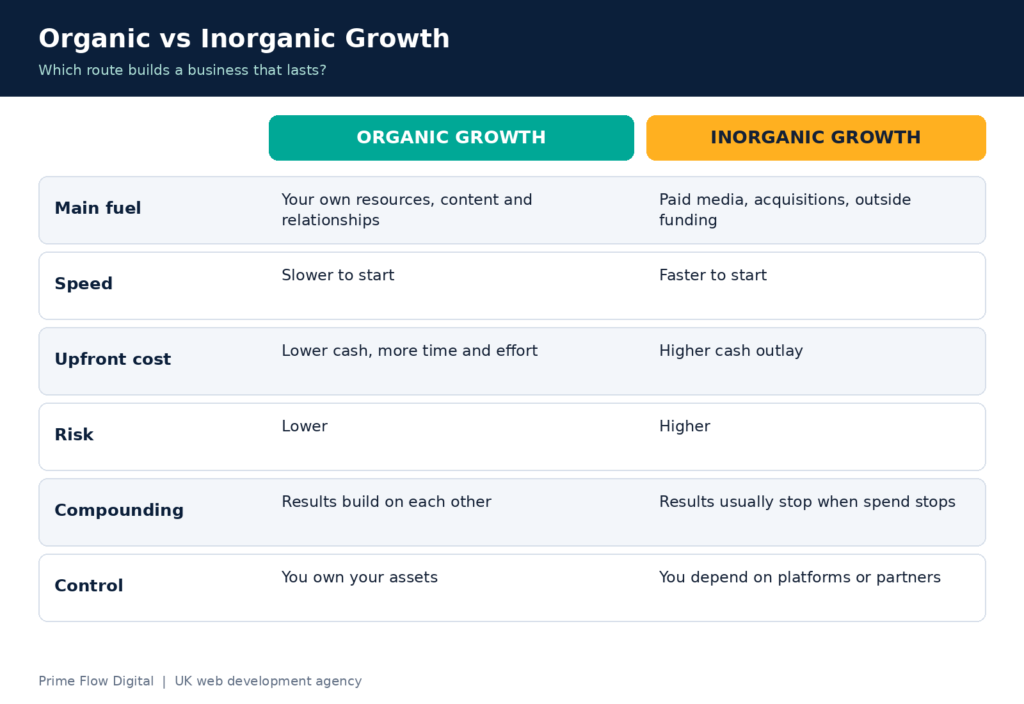
Most healthy businesses use both. The point of this guide is to make sure the organic side is strong enough to carry you when paid slows down.
Why it pays off over time
There are three reasons a long-term approach wins.
- Compounding returns. A well-optimised page can bring in visitors for months or years. A customer who loves your service can refer several more. Your effort today keeps working tomorrow.
- Trust. People tend to trust brands they find through helpful content, search results and recommendations more readily than brands that interrupt them.
- Resilience. When your growth comes from owned assets, a rise in ad costs or a change in a platform’s rules hurts far less.
Lay the Foundations Before You Chase Traffic
It is tempting to jump straight to tactics. Resist it. A strategy built on weak foundations leaks effort at every stage. Three foundations matter most.
A fast, mobile-friendly, crawlable website
Your website is the engine of organic growth. Every blog post, email link and referral ends up there. If it is slow or awkward, visitors leave, and search engines notice.
For a UK business, start with these technical basics:
- Speed and Core Web Vitals. Google measures real-world experience through Largest Contentful Paint (loading), Interaction to Next Paint (responsiveness) and Cumulative Layout Shift (visual stability). Aim for the “good” thresholds: loading within 2.5 seconds, interaction responses within 200 milliseconds and a layout shift score under 0.1.
- Mobile-first design. Most searches happen on phones, and Google indexes the mobile version of your site first.
- Clean structure. Logical menus, sensible URLs and internal links help both visitors and search engines understand what you offer.
- Security and crawlability. Use HTTPS, fix broken links and make sure search engines can reach your important pages.
This is where good web development pays for itself. A site built with performance and search in mind from day one is far cheaper than a rebuild after you have already invested in content.
Clear goals and a sharp view of your ideal customer
Before you plan content or campaigns, decide what growth means for you. More enquiries? Higher repeat orders? Better lead quality? Pick one to three measurable goals.
Then get specific about who you want to reach. Look at your best customers. What do they have in common? What problems were they trying to solve when they found you? The better you understand how your customers think and decide, the easier it becomes to invest in the right services and write content that fits.
The right people, processes and mindset
Even the best plan fails without people who can carry it out. Organic growth is an iterative process, so you need a team and a culture that are comfortable testing, learning and adjusting.
- Write simple checklists and standard processes for repeatable jobs such as publishing content, checking rankings and reviewing reports. Consistency beats heroics.
- Encourage a growth mindset, where people believe skills can be developed and small failures are treated as information.
- Make time for regular reviews so lessons turn into action.
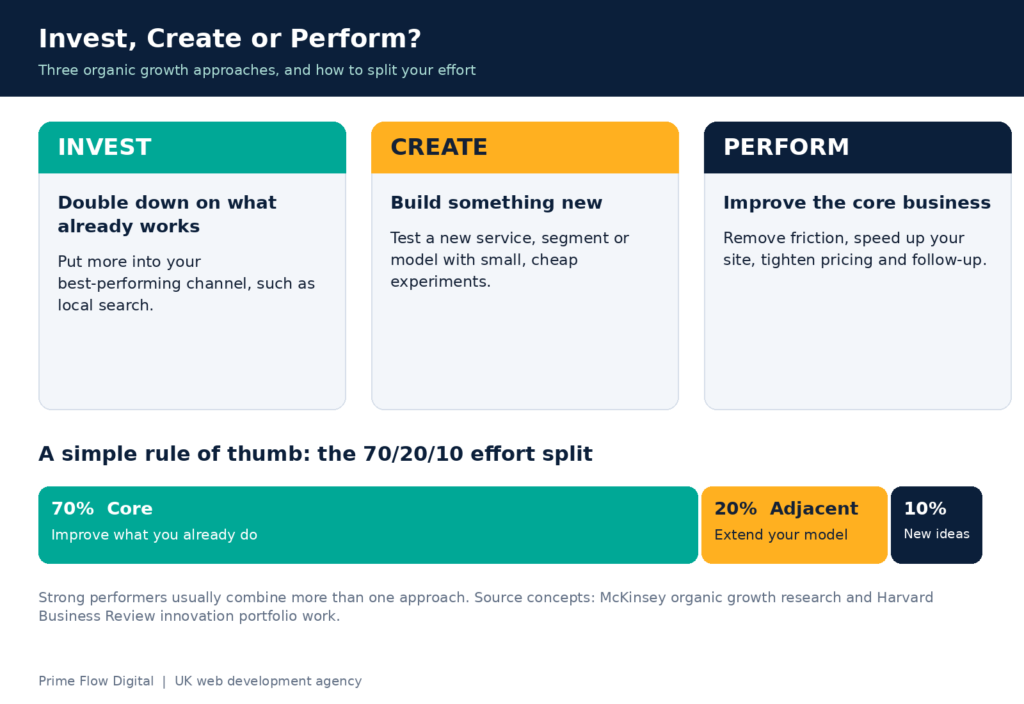
Choose Your Growth Approach: Invest, Create or Perform
McKinsey’s research into organic growth describes three broad approaches. Strong performers tend to use more than one. Knowing which one you are leaning on helps you make better decisions.
Invest. Double down on what already works. If your best leads come from local search, put more effort into local search. This approach needs clear data about where your growth is really coming from. Without it, you are guessing with a bigger budget.
Create. Build something new: a new service, a new customer segment or a new business model. Shopify is a classic example, moving from selling snowboards online to selling the ecommerce software behind online shops. This approach carries more risk, so test ideas cheaply before committing.
Perform. Improve the core business you already have. Remove friction from your sales process, speed up your website, tighten your pricing and follow up faster. Many small gains add up, and this is often the most reliable place to start.
A simple way to split your effort: 70/20/10
A popular rule of thumb from Harvard Business Review’s work on innovation portfolios suggests putting about 70 percent of your growth effort into core initiatives, 20 percent into adjacent ideas that extend what you do, and 10 percent into genuinely new experiments. It is a guide, not a law, but it stops you from either neglecting the core or chasing every shiny idea.
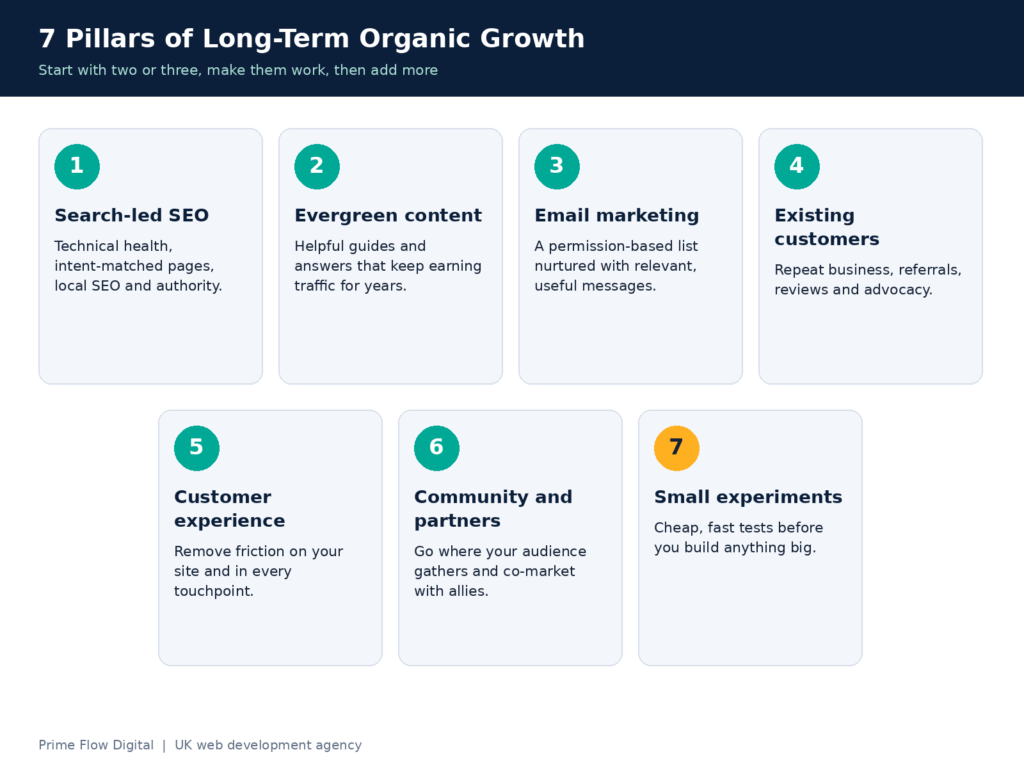
7 Pillars of a Long-Term Organic Growth Strategy
These seven pillars work together. You do not need to launch them all at once. In fact, you should not. Start with the first two or three, make them work, then add more.
Pillar 1: Search-led SEO
Search is the one channel where visibility can grow without your budget growing at the same pace, because rankings build on themselves. Better rankings bring more visits, which bring more links and mentions, which support better rankings.
How to approach it:
- Audit the technical foundations. Check speed, mobile usability, HTTPS, site structure and crawl errors.
- Map keywords to intent. Decide whether each search is informational (“how to”), navigational (looking for a brand) or transactional (ready to buy), and match a page to each.
- Optimise on the page. Use clear titles, meta descriptions, headings, descriptive image alt text and structured data where it fits.
- Build authority. Earn links from relevant, trusted sites through useful content, PR, partnerships and guest contributions. Link between your own pages too.
- Do not forget local SEO. If you serve a UK town or region, claim and complete your Google Business Profile, keep your name, address and phone details consistent, and create helpful location pages.
Search is also changing. AI-generated answers and rich results mean more people get answers without clicking. The best response is content that is well structured, genuinely helpful and clearly written by people who know the subject so that you are the source worth citing.
Pillar 2: Evergreen, genuinely helpful content
Evergreen content answers questions that stay relevant for a long time: how-to guides, explainers, checklists and comparisons. Unlike a news post, it can keep attracting visitors, links and leads for years.
HubSpot built much of its growth on detailed guides across a wide range of marketing topics. Canva grew by creating search-friendly pages around the things people were already looking for, such as design templates. The lesson is the same: be useful first, and let search find you.
To make content that lasts:
- Start with real customer questions from sales calls, support emails and search data.
- Go deep. A thorough answer with examples, visuals and clear steps beats a thin list of tips.
- Use a consistent structure so pages are easy to scan.
- Refresh your best pages every six to twelve months. Update facts, improve weak sections and add new examples. Remove or merge pages that no longer earn their place.
Pillar 3: Email marketing and lead nurturing
Email reaches people who have already said they are interested. That makes it one of the most efficient organic channels you can own, and nobody can switch off your list.
- Build the list properly. Use clear opt-in forms and explain what subscribers will receive. In the UK, comply with UK GDPR and the Privacy and Electronic Communications Regulations (PECR): get valid consent where required, make it easy to unsubscribe, and keep records.
- Segment. Group subscribers by interest, behaviour or stage so that messages feel relevant.
- Automate the basics. A welcome sequence and a simple nurture series keep your brand in mind until people are ready.
- Give before you ask. Tips, guides and useful updates earn more trust than constant promotion.
- Test. Try subject lines, send times and formats, and keep what performs.
Pillar 4: Existing customers, referrals and advocacy
Your current customers are your cheapest and most reliable source of growth. They already know and trust you, they convert more easily, and they often spend more over time.
- Make repeat business easy with follow-ups, helpful reminders, loyalty benefits and early access to new things.
- Create a simple referral route, with a share link, a short form or a thank-you offer.
- Ask happy customers for reviews and testimonials, and display them on your site and on your Google Business Profile.
- Track where referrals come from so you can encourage more of what works.
Pillar 5: Customer experience
Experience is where retention is won or lost. A customer who has a smooth, friendly experience is more likely to return, recommend you and be forgiving when something goes wrong.
- Map the journey. List every touchpoint from first visit to after-sales support and look for friction.
- Fix website friction. Confusing navigation, long forms, slow pages and unclear calls to action quietly cost you enquiries. Small improvements to conversion rate add up as much as extra traffic does.
- Listen systematically. Use short surveys and a simple Net Promoter Score question to hear what customers think, and act on it.
- Respond quickly. Offer clear contact options and aim to answer fast.
Pillar 6: Community and strategic partnerships
Growth does not have to be a solo effort. A community gives your audience a place to talk, learn and share. A partnership puts you in front of an audience that already trusts someone else.
- Community. Go where your audience already gathers, such as LinkedIn groups, industry forums or a customer group, and contribute before you promote.
- Co-marketing. Find a complementary business that serves the same customers without competing with you. Create something together, such as a guide, webinar or event, and promote it to both audiences.
- Track it. Use tagged links so you can see which partners send visitors who actually become customers.
Pillar 7: Innovation through small experiments
Growth is a moving target. What works this year may fade next year, so you need a steady habit of trying new things without risking the business.
- Run small, cheap tests before you build anything big. A simple landing page, a short survey or a pilot offer can show whether an idea is worth pursuing.
- Set a clear question, a time limit and a success measure for each experiment.
- Stop quickly when something is not working, and write down what you learned.
This is the “Create” approach in practice, and it fits the 10 percent slice of your effort.
Your 12-Month Organic Growth Roadmap
Strategy only works when it turns into a sequence. Here is a realistic plan you can adapt.
| Phase | Focus | Key actions |
| Months 1 to 3: Foundations | Fix and plan | Run a website and SEO audit; fix speed, mobile and structure issues; set up GA4 and Google Search Console with proper consent; define goals and ideal customers; build a keyword and content plan |
| Months 4 to 6: Build momentum | Publish and connect | Publish your first priority content; set up email capture and a welcome sequence; claim and complete your Google Business Profile; start earning links and reviews; launch your first small experiment |
| Months 7 to 12: Scale what works | Refine and grow | Double down on the pages and channels that perform; refresh older content; build referral and partnership programmes; improve conversion on key pages; review results and set next year’s goals |
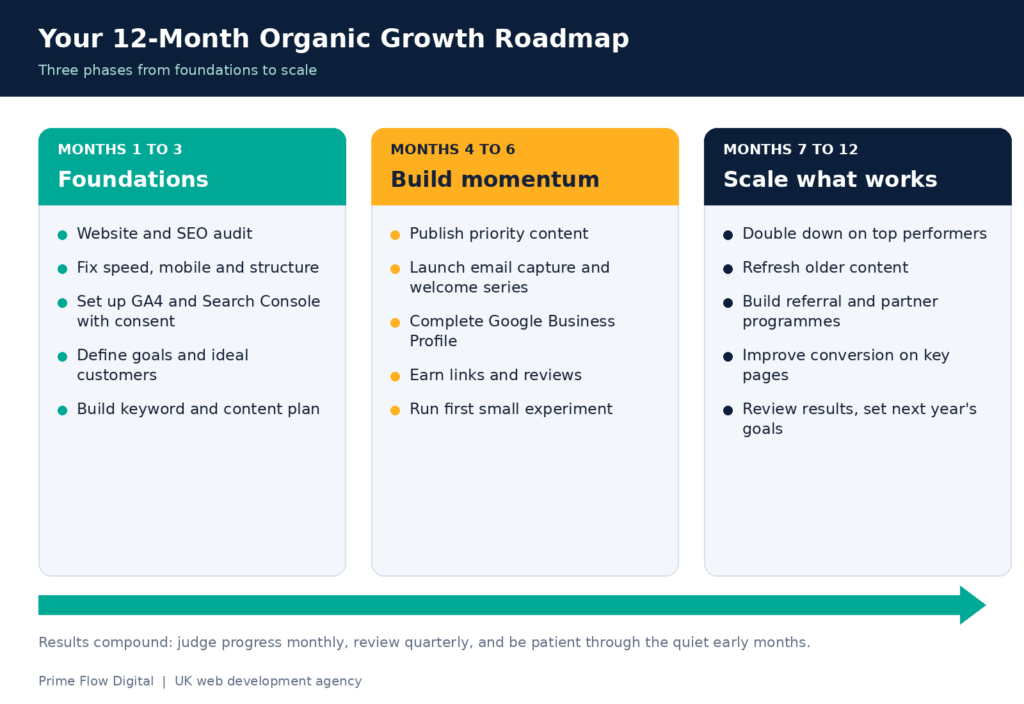
Be patient. Content and SEO work commonly take a few months before the effects become clear, and the biggest gains usually arrive well after that. The businesses that win are the ones that keep going through the quiet early months.
How to Measure Long-Term Organic Growth
You cannot improve what you do not measure, but you also do not need a hundred dashboards. Start with a small set of measures and review them on a steady rhythm.
| What to track | Why it matters |
| Organic sessions | Shows whether search visibility is growing |
| Keyword rankings for priority terms | Shows progress on the topics that matter most |
| Organic conversions (enquiries, sign-ups, sales) | Connects traffic to real business results |
| Returning users | Signals loyalty and content value |
| Referral traffic | Shows which partners and advocates deliver |
| Customer acquisition cost | Tells you how efficiently you are growing |
| Customer lifetime value | Shows the long-term worth of the customers you win |
Use Google Analytics 4 for behaviour and conversions, and Google Search Console for search performance and technical issues. Check the numbers monthly and take a deeper look every quarter.
One UK-specific point: analytics and tracking tools often rely on cookies and similar technologies, so make sure your cookie consent set-up complies with UK rules, and understand that consent choices can affect how much data you see. Planning for that early avoids nasty surprises later.
Common Mistakes to Avoid
- Trying everything at once. Spreading effort too thin means nothing gets done well. Start with two or three pillars.
- Expecting quick results. Organic growth compounds. Judge it over quarters, not weeks.
- Guessing instead of measuring. Use data to decide what to do more of and what to stop.
- Ignoring the website itself. Great content on a slow, confusing site wastes the effort behind it.
- Publishing and forgetting. Content decays. Schedule time to refresh your best pages.
- Neglecting customers after the sale. Retention and referrals are some of the cheapest growth you will ever find.
Conclusion: Build Growth That Keeps Working
A long-term organic growth strategy is about owning your growth. Start with a fast, well-built website. Choose your approach, build the seven pillars one at a time, measure honestly and keep refining. The effort compounds, and in a year or two you will have a business that grows from its own momentum instead of its ad spend.
If you would like help laying those foundations, Prime Flow Digital is a UK web development agency that builds fast, search-friendly websites designed to support long-term organic growth for UK businesses. Book a free website and organic growth review with our team and we will show you where your biggest opportunities are
Frequently Asked Questions
What is a long-term organic growth strategy?
It is a planned, consistent approach to growing your business using owned assets such as your website, content, customer relationships and reputation, rather than relying mainly on paid advertising or acquisitions. The aim is for results to build on each other over time.
How long does organic growth take?
It varies by industry, competition and starting point. Many businesses start to see meaningful movement from SEO and content within a few months, with stronger results building over the following year or more. Email and referral programmes also gain strength gradually.
Can a small business grow using organic methods alone?
Yes, many do, especially when budgets are tight. Combining a well-built website, helpful content, email and strong customer relationships can produce steady growth. Some businesses add a little paid activity to speed things up, which is fine as long as the organic foundations are solid.
What is the difference between organic and paid growth?
Organic growth comes from unpaid sources such as search, content, referrals and community. Paid growth comes from advertising and sponsored placements. Paid is quicker to switch on and off. Organic is slower to build but keeps delivering after the effort is done.
Which metrics show that organic growth is working?
Watch organic sessions, priority keyword rankings, organic conversions, returning users, referral traffic, customer acquisition cost and customer lifetime value. Together they show whether you are attracting, converting and keeping the right people.
How much should a UK SME budget for organic growth?
There is no single figure. A sensible approach is to commit to a monthly amount you can sustain for at least six to twelve months, then split it across technical foundations, content creation and measurement. Consistency matters more than size, because organic growth rewards steady effort