Search used to mean scrolling through a page of blue links until you found the one that answered your question. That’s no longer how most people search. When someone asks ChatGPT, Google’s AI Overviews, Perplexity, or Gemini a question today, they get a single synthesised answer, often without ever clicking through to a website. If your brand isn’t part of that answer, you’re invisible to a growing share of the people making buying decisions right now.
That’s the challenge Generative Engine Optimisation (GEO) exists to solve. At Prime Flow Digital, we think of GEO as the natural evolution of everything SEO has always been about (being found, trusted, and chosen), adapted for a world where the “results page” is a paragraph written by an AI model instead of a list of links.
This guide breaks down what GEO actually is, why it matters right now, and the concrete steps that improve your brand’s chances of showing up and being represented accurately inside AI-generated answers.
What Is GEO (Generative Engine Optimisation)?
Generative engine optimisation is the practice of structuring your brand’s content and online presence so that AI systems can find it, understand it, trust it, and cite it when generating an answer for a user.
Traditional SEO is built around ranking a page on a results page and earning a click. GEO is built around something different: becoming part of the answer itself. Instead of competing for position #1 on Google, you’re competing to be the source an AI model chooses to reference, or the brand it recommends by name, when someone asks a related question.
This doesn’t replace SEO. It builds on it. AI models still rely heavily on live web search, backlink signals, and indexed content to generate their answers, so the fundamentals of strong SEO (clean site structure, useful content, credible sourcing) remain the foundation GEO is built on top of.
Why Brand Visibility in AI Search Matters Right Now
This isn’t a future trend to plan for eventually. It’s already changing how people make decisions. Executives increasingly expect AI to replace traditional search for business research within the next few years, and a growing share of consumers now rely on AI-generated answers for a meaningful portion of their everyday searches, a shift that’s already pulling traffic away from traditional organic listings.
The behavioural shift is significant enough that decision-makers report they’re already choosing vendors and products based on whatever an AI assistant suggests first, rather than comparing a page of options themselves. When that’s true, showing up in the AI’s answer isn’t a nice-to-have marketing tactic. It’s a direct line to whether your brand gets considered at all.
Adobe’s own internal case study is a useful illustration of what’s possible when a company takes GEO seriously: after applying structured GEO practices across their site, they saw a multiple-times increase in how often their products were cited by AI systems, a large jump in overall LLM visibility, and a meaningful lift in referral traffic coming directly from AI platforms, all within a matter of weeks, not months.
The takeaway for smaller brands and growing companies is the same: this is measurable, it responds to effort, and the brands that start building AI visibility now will have a real head start over the ones that wait for the landscape to settle down (it won’t).
How GEO Improves Brand Visibility: The Core Levers
GEO isn’t one trick. It’s a handful of connected practices that work together. Here’s what actually moves the needle.
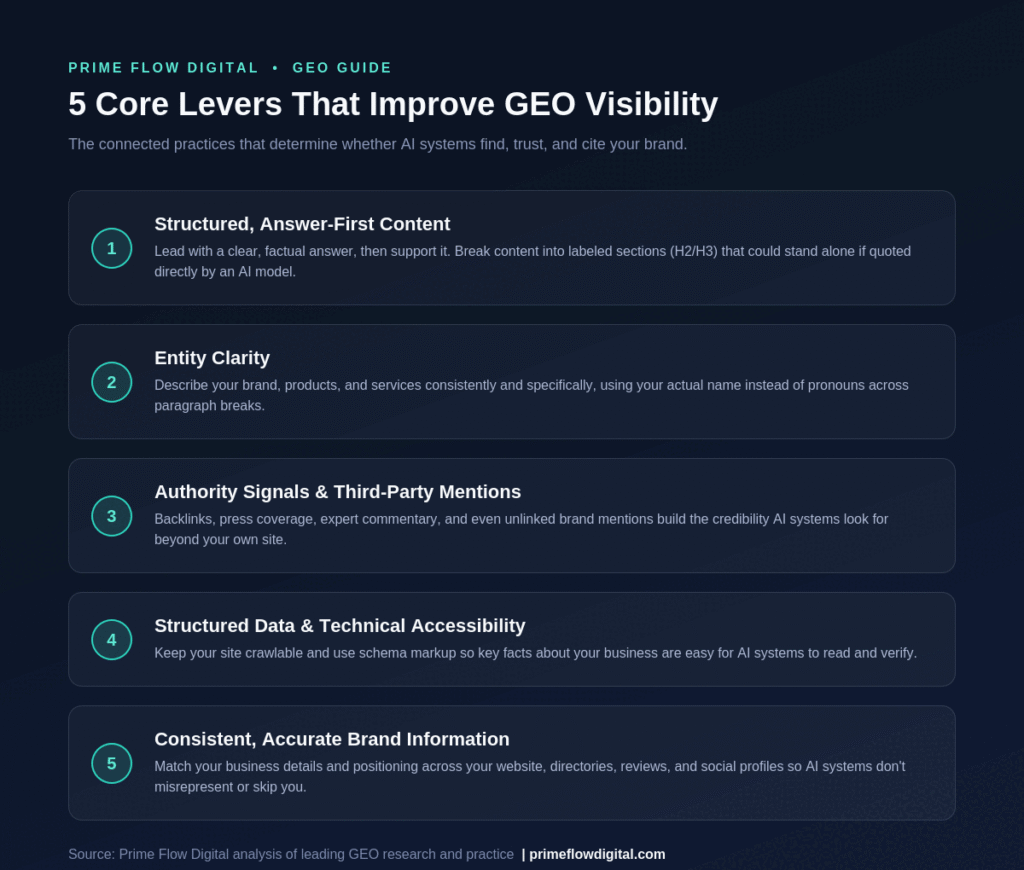
1. Structured, Answer-First Content
AI systems favour content that gets to the point. Extractability (how easily a model can pull a clear, factual answer out of your page) depends on stating the answer early, defining key terms plainly, and avoiding long throat-clearing introductions before you get to the substance.
Practically, that means:
- Answering the core question in the first paragraph or two of a section, not the last.
- Breaking content into clearly labelled sections (H2s and H3s) that could stand alone if an AI model quoted just that piece.
- Backing claims with specific numbers, named sources, and concrete examples rather than vague generalities. Content built around real statistics and direct quotes has been shown to perform meaningfully better in AI-generated responses than content without them.
2. Entity Clarity
AI systems need to understand who you are and what you do before they’ll confidently mention you. That means consistently and specifically describing your brand, products, and services: using your actual brand name instead of pronouns across paragraph breaks and making sure your positioning doesn’t contradict itself from one page to the next.
If your brand’s information is scattered, outdated, or inconsistent across your website, directory listings, and social profiles, AI models are more likely to either leave you out of an answer entirely or describe you inaccurately.
3. Authority Signals and Third-Party Mentions
AI models weigh more than what a brand says about itself. They lean on signals of credibility from elsewhere on the web: backlinks from reputable sites, independent press coverage, expert commentary, and even unlinked brand mentions that show up across other people’s content.
Interestingly, some research suggests AI systems give real weight to brand mentions even when there’s no link attached, meaning a strong digital PR presence and consistent, favourable coverage across the web can move your visibility even outside your own website.
4. Structured Data and Technical Accessibility
Before an AI model can evaluate your content, it has to be able to access it. That means keeping your site technically crawlable, using structured data (schema markup) to make key facts about your business machine-readable, and ensuring your most important information isn’t buried behind interactions that crawlers can’t process.
5. Consistent, Accurate Brand Information Everywhere
Because generative engines draw from many sources rather than a single index, consistency across the web matters more than it ever did in classic SEO. Your business details, positioning, and key facts should match across your website, directory listings, review platforms, and social presence. Inconsistency is one of the fastest ways to get misrepresented or skipped entirely.
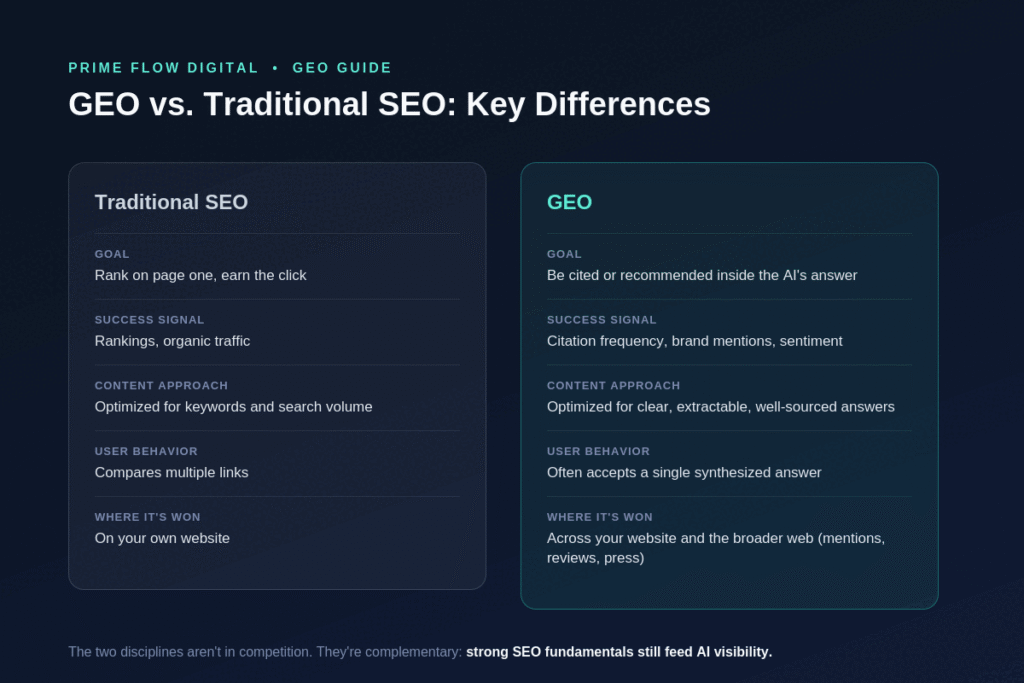
GEO vs. Traditional SEO: Key Differences
| Traditional SEO | GEO | |
| Goal | Rank on page one, and earn the click. | Be cited or recommended inside the AI’s answer. |
| Success signal | Rankings, organic traffic | Citation frequency, brand mentions, sentiment |
| Content approach | Optimised for keywords and search volume | Optimised for clear, extractable, well-sourced answers |
| User behaviour | Compares multiple links | Often accepts a single synthesised answer |
| Where it’s won | On your own website | Across your website and the broader web (mentions, reviews, press) |
The two disciplines aren’t in competition. They’re complementary. Strong SEO fundamentals still feed AI visibility, since most generative engines pull from live web search results and established authority signals to build their answers.
Common Mistakes That Hurt AI Visibility
A few recurring issues show up again and again in brands that struggle to gain AI visibility:
- Inconsistent brand information across the web, which confuses AI systems trying to build a clear picture of who you are.
- Burying the answer under long, generic introductions instead of leading with substance.
- Chasing keyword-stuffed content written for old-style SEO instead of clear, useful answers written for real questions.
- Ignoring sentiment. Being mentioned isn’t automatically good: if the surrounding sentiment is negative or the description is inaccurate, appearing in an AI answer can hurt more than help.
- Treating GEO as a one-time project rather than an ongoing practice. AI citation patterns shift as models update, so visibility needs to be monitored and maintained, not set and forgotten.
How to Measure GEO Success
Traditional metrics like organic traffic and keyword rankings are still worth tracking, but they don’t tell you whether AI systems are actually citing or recommending your brand. A fuller picture includes:
- Citation frequency: how often your brand or content is referenced across major AI platforms.
- Share of voice in AI answers: how you compare to competitors when the same question is asked.
- Sentiment of AI mentions: whether the tone attached to your brand is positive, neutral, or negative.
- Referral traffic from AI platforms: the (often smaller, but higher-intent) traffic that does click through from an AI-generated answer.
Because this data isn’t visible in standard analytics tools, tracking it typically requires monitoring your brand’s presence directly across multiple AI platforms on an ongoing basis.
How Prime Flow Digital Approaches GEO
At Prime Flow Digital, we treat GEO the way we’ve always treated SEO: as a discipline built on real content quality, genuine authority, and structure that respects both human readers and machine readers. Our approach combines technical groundwork (making sure your site is accessible and structured for AI crawlers), content strategy (building answer-first, well-sourced content that AI systems want to cite), and authority building (earning the third-party mentions and citations that establish trust beyond your own website), then measuring what’s actually working across the AI platforms that matter to your audience.
The Bottom Line
AI search isn’t a distant shift. It’s already changing how your customers find and choose brands. The companies that treat GEO as a continuous practice, not a one-off project, are the ones that will be part of the answer when it counts. Ready to see where your brand currently stands in AI search results? Prime Flow Digital can run a GEO visibility audit and build a roadmap to get you cited, mentioned, and recommended where your customers are already asking.
Frequently Asked Questions
What is GEO in SEO?
GEO (Generative Engine Optimisation) is the practice of structuring content and brand information so AI systems (ChatGPT, Google AI Overviews, Perplexity, Gemini) can find it, understand it, and cite it in generated answers. It sits alongside traditional SEO rather than replacing it: SEO earns rankings and clicks, and GEO earns citations and mentions inside the answer itself.
How is GEO different from traditional SEO?
Traditional SEO optimises a page to rank on a results page and earn a click. GEO optimises content and brand signals so an AI model chooses to reference or recommend the brand directly inside its generated response, often without the user ever visiting the website. GEO builds on SEO fundamentals like crawlability, backlinks, and content quality rather than replacing them.
How is GEO different from AEO?
GEO and Answer Engine Optimisation (AEO) overlap heavily and are often used interchangeably. AEO traditionally referred to optimising for direct-answer boxes and voice search; GEO expanded that idea to cover full generative AI platforms. In practice, both rely on the same core levers: clear, answer-first content, structured data, and strong topical and entity authority.
Does traditional SEO still matter if I invest in GEO?
Yes. Most generative AI platforms still rely on live web search, indexed content, and backlink authority to generate their answers, so strong SEO fundamentals remain the foundation GEO is built on top of. Neglecting SEO to chase GEO tactics typically backfires, since AI models can’t cite content they can’t find or trust in the first place.
How do I know if my brand is showing up in AI search results?
You’ll need to monitor your brand directly across AI platforms, since this activity doesn’t show up in standard analytics or Search Console data. That typically means running test prompts across the major AI assistants and tracking citation frequency, share of voice against competitors, and the sentiment of how your brand is described over time.
How long does it take to see GEO results?
Timelines vary by AI platform and how much authority your brand already has across the web, but companies that apply structured GEO practices consistently have reported measurable increases in citations and AI-driven referral traffic within weeks rather than months. As with SEO, sustained visibility comes from ongoing optimisation, not a one-time content push.