Creating content without understanding what your customers are actually searching for is a bit like opening a shop without knowing what people want to buy. You may publish regularly and target keywords with strong search volume, but if the content does not match the reason behind a search, it may attract the wrong audience—or fail to turn visitors into enquiries.
For UK businesses, this becomes even more important. Search behaviour varies by industry, location, terminology, customer need and stage of the buying journey. A customer looking for information needs a different experience from someone comparing providers or ready to request a quote.
A successful content strategy therefore starts with a simple question: What is my UK customer actually trying to find, understand or do when they search online?
Once you understand that, you can build content around real customer needs rather than publishing articles simply because a keyword tool shows search volume.
What Is Search Intent?
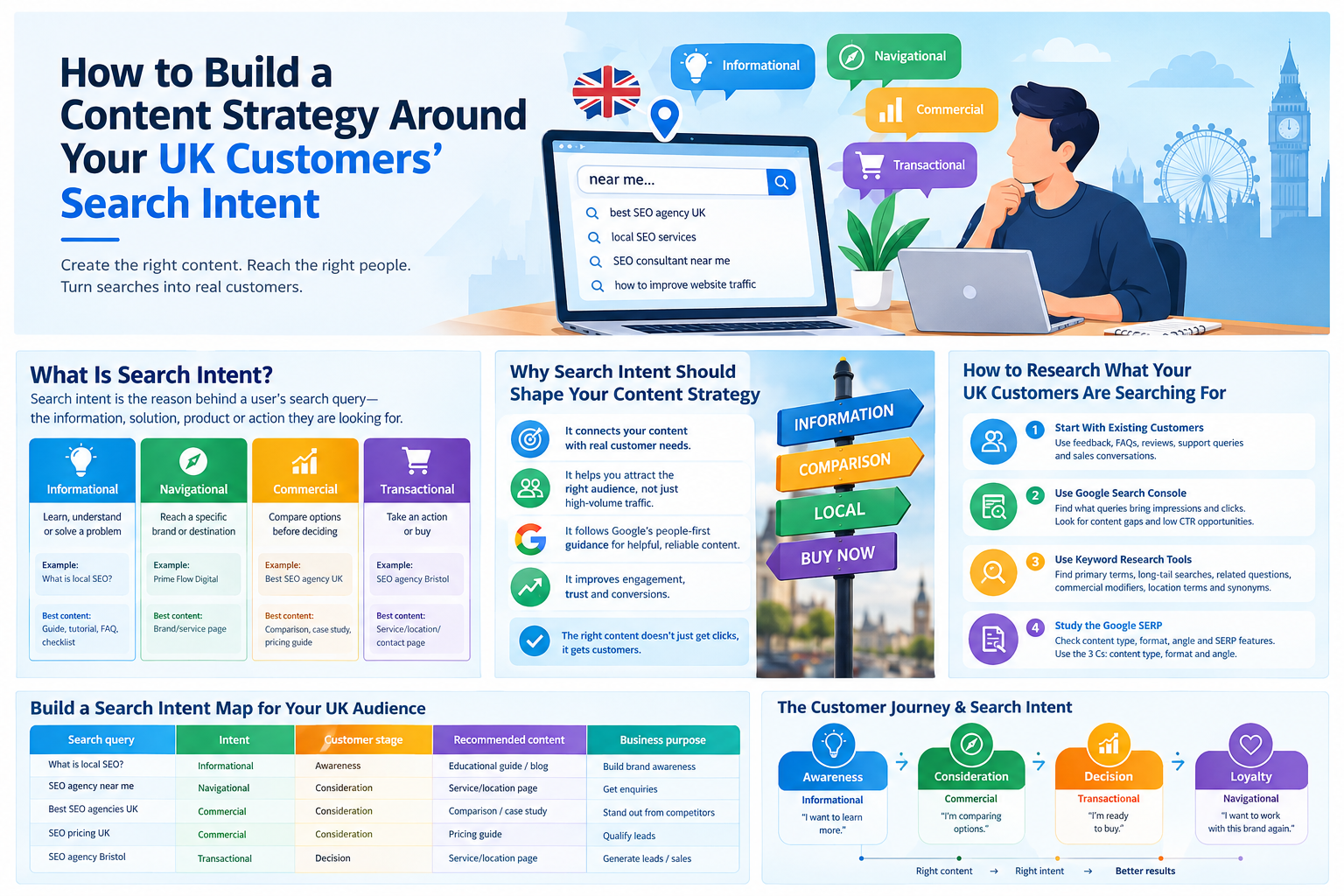
Search intent is the reason behind a user’s search query—the information, solution, product or action they are looking for. Understanding that purpose helps you decide what page to create, what information to include and what next step the visitor should be able to take.
The four commonly used categories are informational, navigational, commercial investigation and transactional intent.
| Intent | What the searcher wants | Example | Suitable content |
| Informational | Learn, understand or solve a problem. | What is local SEO? | Guide, tutorial, FAQ, checklist |
| Navigational | Reach a specific brand or destination. | Prime Flow Digital | Brand/service page |
| Commercial | Compare options before deciding. | Best SEO agency UK | Comparison, case study, pricing guide |
| Transactional | Take an action or buy | SEO agency Bristol | Service/location/contact page |
Why Search Intent Should Shape Your Content Strategy
Many businesses start content planning with a list of keywords. A stronger approach starts with the customer. A keyword tells you what someone typed; search intent helps you understand why they typed it.
Google’s people-first guidance emphasises creating helpful, reliable content for an existing or intended audience rather than producing content primarily to manipulate search rankings. Your strategy should therefore connect customer needs, search behaviour, intent and business goals.
For example, a UK plumbing company could receive searches such as “why is my boiler losing pressure?”, “boiler repair Birmingham” and “emergency boiler repair Birmingham”. They concern the same broad service, but the first is mainly informational, while the latter two carry increasingly strong local and commercial intent. Each deserves a different content experience.
How to Research What Your UK Customers Are Searching For
1. Start With Existing Customers
Your customers are one of the best sources of content ideas. Review sales conversations, customer emails, support enquiries, phone calls, live chat, reviews, social comments, common objections and frequently asked questions.
If prospects repeatedly ask how much SEO costs, how long SEO takes, whether local SEO is worthwhile or what AEO and GEO mean, those questions can become useful content assets.
2. Use Google Search Console
Search Console can reveal the queries already generating impressions and clicks for your website. Review queries, impressions, clicks, click-through rate, average position and pages receiving visibility. Pay particular attention to queries where your site receives impressions but relatively few clicks: these can reveal content, title or intent-alignment opportunities.
3. Use Keyword Research Tools
Keyword research remains important, but do not automatically turn every keyword into a separate page. Identify primary terms, long-tail searches, related questions, commercial modifiers, location terms and synonyms, then group them according to topic and intent.
4. Study the Google SERP.
Before creating a page, search the target query yourself. Look at the dominant content type, content format, content angle, SERP features and the questions that appear. This gives you evidence about the kind of result users expect.
A useful framework is the three Cs of search intent: content type, content format and content angle. Use this as research input, not as a reason to copy competitors.
Build a Search Intent Map for Your UK Audience
| Search query | Intent | Customer stage | Recommended content | Business purpose |
| What is local SEO? | Informational | Awareness | Educational guide | Build awareness. |
| Local SEO benefits | Informational | Awareness | Blog/guide | Educate |
| Best local SEO agency UK | Commercial | Consideration | Comparison/guide | Support evaluation |
| Local SEO agency UK | Commercial | Decision | Service page | Generate enquiries |
| Hire a local SEO agency. | Transactional | Decision | Service/contact page | Drive action. |
This map prevents a common SEO mistake: trying to rank every keyword with a blog post. Some searches need guides, others need service pages, location pages, comparison pages or FAQs. The format should follow the intent.
Map Content to the UK Customer Journey
Awareness: “I Have a Problem”
At this stage, the customer may not know which solution they need. Create educational guides, definitions, how-to content, checklists and beginner resources. The objective is to explain the problem clearly and help the reader understand possible solutions.
Consideration: “I’m Looking for a Solution”
Now the customer is researching options. Useful formats include comparison articles, case studies, pricing guides, service explainers, expert guides and reviews. The objective is to help the reader evaluate alternatives.
Decision: “I’m Ready to Act”
At this stage, users may search for a provider, location or specific service. Service pages, location pages, consultation pages, pricing information, case studies and contact pages are usually more appropriate than broad educational posts.
Not Every Keyword Deserves a Blog Post
Suppose you want to target “SEO services Bristol”. A long beginner article about “What is SEO?” is not necessarily the best page for that query. A dedicated service page is more closely aligned with the likely commercial and local intent.
Before creating a page, ask: What would genuinely satisfy someone who searched this query? That question can prevent large amounts of content from being created in the wrong format.
Use Semantic SEO to Build Deeper Content
Semantic SEO focuses on the concepts and relationships surrounding a topic rather than repeating one exact keyword. For a search-intent article, relevant concepts include keywords, queries, SERPs, customer journeys, content formats, entities, topic clusters, internal links and conversions.
A strong semantic structure helps readers understand the subject and gives search systems clearer context. It also makes it easier to build supporting content around a central topic.
Build Topic Clusters Around Customer Intent
Instead of publishing unrelated articles, organise content into topic clusters. A UK digital marketing business could use “SEO Content Strategy for UK Businesses” as a pillar topic and support it with pages about search intent, keyword research, semantic SEO, local SEO, technical SEO, content optimisation, topic clusters, internal linking, AEO, GEO and AI search.
For Prime Flow Digital, this approach fits naturally with the existing guide on How SEO, AEO and GEO Work Together for UK Businesses.
Use Search Intent to Strengthen AEO.
Answer Engine Optimisation focuses on making important information easy to identify and understand in answer-led search experiences. A practical structure is short answer first, detailed explanation second.
Use question-led headings, concise definitions, lists, tables, FAQs and self-contained explanations. Do not reduce every page to short answers; instead, make the important answers easy to find before providing deeper context.
For example, “What is search intent?” can be answered directly in one or two sentences, followed by examples, intent categories and practical advice.
Optimise Your Content for GEO and AI Search
Generative Engine Optimisation, or GEO, focuses on improving how clearly a brand and its information can be understood within generative AI and AI-powered search environments. It should complement rather than replace SEO.
Strong foundations include clear entity information, topical authority, original insights, accurate facts, consistent brand information, useful supporting content and logical site structure.
Prime Flow Digital already positions SEO, AEO and GEO as complementary layers of modern search visibility. This article should reinforce that positioning rather than treating the three disciplines as isolated campaigns.
Localise Your Content for UK Customers
UK localisation should go beyond adding “UK” to a title. Use British English, appropriate terminology, pounds where pricing is discussed, relevant UK regulations where applicable, genuine regional examples and useful location information.
For local businesses, location and service combinations such as “SEO agency Bristol” or “accountant Manchester” can have strong local intent. However, location terms should be used naturally. A useful local page gives customers genuine information about the service and area rather than repeating a city name.
For more detail, link this section to Prime Flow Digital’s Complete Local SEO Guide for Small Businesses in the UK.
Create Content That Answers the Next Question
Useful content anticipates what the reader is likely to ask next. If someone searches “How much does SEO cost in the UK?”, they may also want to know what affects price, what is included, how long SEO can take, whether freelancers or agencies are appropriate, and how to evaluate an SEO provider.
Prime Flow Digital can support this section with its UK SEO Cost Guide.
Prioritise Content Based on Business Value
Search volume should not be the only prioritisation metric. Consider search demand, intent, relevance, business value, competition and the opportunity to provide genuinely useful information.
| Factor | Question to ask |
| Demand | Are people searching for this? |
| Relevance | Is the topic closely related to our business? |
| Intent | Does the searcher’s goal match the proposed page? |
| Business value | Could this audience become a customer? |
| Opportunity | Can we provide something substantially useful or distinctive? |
Measure Whether Your Content Strategy Is Working
Publishing is only the beginning. Measure organic clicks, impressions, CTR, rankings, keyword visibility and non-brand traffic. Then connect these to engagement and business outcomes such as leads, calls, enquiries, quote requests, purchases and conversion rate.
Where measurable, also monitor featured snippets, People Also Ask visibility, branded searches and visibility or citations in AI-powered search experiences. The purpose is to understand whether visibility is contributing to meaningful business outcomes.
Common UK Content Strategy Mistakes
- Writing about what the business wants to promote instead of what customers need.
- Targeting keywords without understanding the intent behind them.
- Turning every keyword into a separate blog post.
- Ignoring commercial and transactional searches.
- Publishing generic content with little UK-specific value.
- Copying competitor structures instead of adding original expertise.
- Overusing location keywords without improving the local user experience.
- Publishing without measuring leads, enquiries and conversions.
A Practical UK Search-Intent Content Strategy Template
- Define your ideal UK customer, including industry, location, needs and buying behaviour.
- Identify customer problems and recurring questions.
- Collect real questions from sales, support, reviews, Search Console and keyword tools.
- Conduct keyword research and group related searches.
- Classify each topic as informational, navigational, commercial or transactional.
- Analyse the SERP to understand content type, format, angle and SERP features.
- Map important entities, attributes, questions and semantic relationships.
- Connect each topic to the customer journey.
- Choose the content format that best satisfies the intent.
- Build topic clusters and strategic internal links.
- Optimise for SEO, AEO and GEO using clear, useful and structured information.
- Measure performance and refresh the strategy based on real data.
UK Search-Intent Example: A Local Plumbing Business
| Search | Intent | Stage | Best-fit content |
| Why is my boiler losing pressure? | Informational | Awareness | Troubleshooting guide |
| Boiler repair Birmingham | Local + commercial | Consideration | Birmingham service page |
| Emergency boiler repair Birmingham | Local and transactional | Decision | Emergency service landing page |
The topic is still boiler repair, but the searcher’s purpose changes. The content should change with it.
The UK Search-Intent Content Framework
Prime Flow Digital can use a simple seven-stage framework for planning content:
Research → Classify → Map → Create → Optimise → Connect → Measure
Research: Find what customers actually search for.
Classify: Understand why they search.
Map: Connect searches to the customer journey.
Create: Choose the content format that best satisfies the intent.
Optimise: Apply SEO, semantic SEO, AEO and GEO principles.
Connect: Use internal links and topic clusters to build a connected content ecosystem.
Measure: Track visibility, engagement and business outcomes.
How Prime Flow Digital Can Help
Building an effective content strategy requires more than finding keywords. It requires understanding how customers search, what they expect to find, how different searches connect and which content can contribute to business objectives.
Prime Flow Digital provides SEO services covering technical SEO, content, local strategy, internal linking, content silos and AI optimisation. Explore the SEO Services page to learn more.
The process can begin with understanding your current visibility, identifying content gaps, researching customer searches and building a structured strategy around the opportunities that matter to your business.
The aim is not to create content simply because there is a keyword to target. The aim is to create useful content for the right customer, at the right stage, with the right information.
Frequently Asked Questions
What is search intent?
Search intent is the reason behind a search query. It describes what a person wants to find, understand, compare or accomplish when using a search engine.
What are the four types of search intent?
The four commonly used categories are informational, navigational, commercial investigation and transactional intent.
Why is search intent important for SEO?
Search intent helps you create content that matches what searchers actually want. It informs the page type, content format, depth and next action.
How do you identify search intent?
Start with the query, then analyse the current search results. Look at dominant content types, formats, angles, SERP features and recurring questions.
How do I create a content strategy based on search intent?
Research customer questions and keywords, classify intent, map topics to the customer journey, choose the right format and connect related pages into topic clusters.
How can UK businesses localise their content?
Use British English, relevant UK terminology, genuine local information and location-specific examples where they help the customer. Avoid unnecessary repetition of place names.
What is the difference between keyword research and search-intent research?
Keyword research identifies the words people use. Search-intent research goes further by identifying what those people are trying to accomplish.
Can one piece of content support SEO, AEO and GEO?
Yes. Strong content can satisfy search intent, provide direct answers, establish clear topic and entity relationships and demonstrate expertise, allowing one asset to support multiple search-visibility objectives.