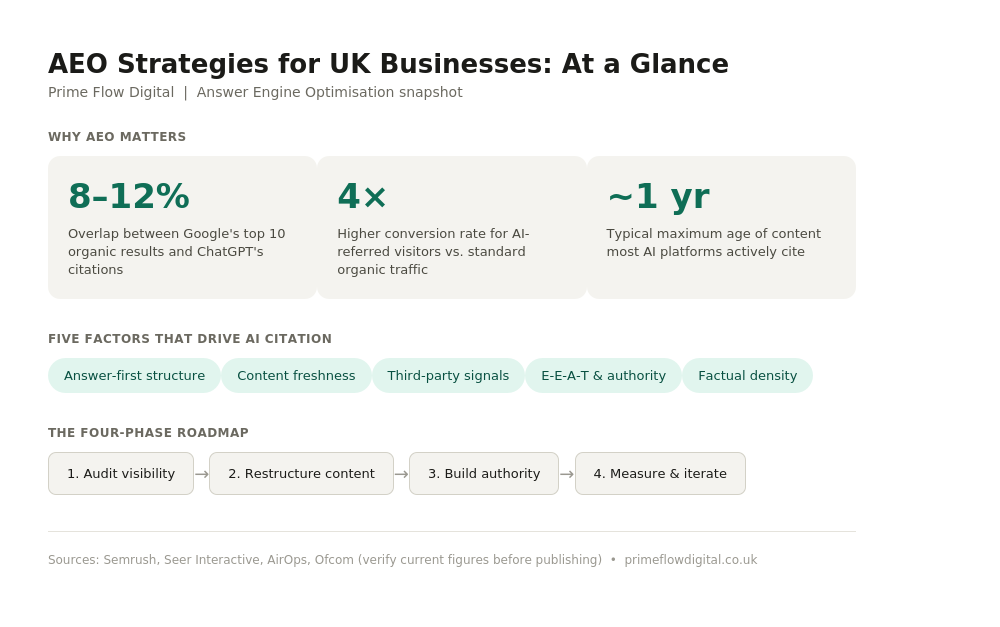
Answer Engine Optimisation, or AEO, is the practice of structuring your content, technical markup, and brand signals so AI platforms like ChatGPT, Google AI Overviews, Perplexity, and Claude cite your business when answering a user’s question. Here’s why it matters right now: the overlap between URLs cited by ChatGPT and pages ranking in Google’s own top 10 organic results has been measured at only around 8 to 12%. Ranking well on Google no longer guarantees you’ll be found inside an AI-generated answer. A separate, deliberate AEO strategy is genuinely required.
This piece assumes you already have some grasp of what AEO is. If you want the fuller conceptual picture of how SEO, AEO, and GEO relate to each other, we’ve covered that in full here. If you want deep, platform-specific mechanics for ChatGPT, Perplexity, and Google’s AI tools individually, that’s covered here too. This guide is the strategy itself: what actually drives AI citations, how to build a practical roadmap, and what’s genuinely different for UK businesses right now.
AEO vs. SEO: How They Actually Differ
| Traditional SEO | Answer Engine Optimisation | |
| Goal | Rank in the top 10 blue links | Get cited inside AI-generated answers. |
| Platforms | Google and Bing organic results | ChatGPT, Perplexity, Google AI Overviews, Copilot, Claude, Gemini |
| Success metric | Keyword rankings and organic traffic | AI citation rate and share of AI voice |
| Content format | Long-form pages optimised for keywords | Answer-first passages, structured data, modular blocks |
| Authority signals | Backlinks, domain authority | Third-party mentions, E-E-A-T, schema markup, entity clarity |
There’s a genuine debate worth acknowledging here rather than glossing over. Some well-known voices in the SEO industry argue AEO is simply good SEO repackaged under a new name, and there’s real truth in that: answer-first content, structured data, and strong E-E-A-T signals have always been good practice. Others point out that AEO and SEO share a substantial foundational overlap, commonly estimated at around 80%, with the real distinction being where each strategy focuses its energy.
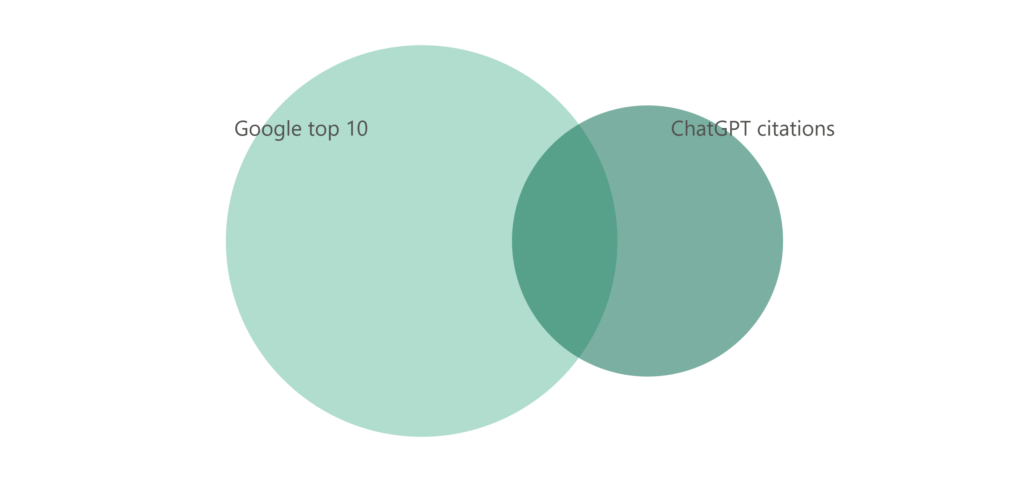
Our own position, set out in more depth in our guide to how SEO, AEO and GEO work together, sits closer to this: they build on the same foundation, but a page can rank first in Google and still be entirely absent from ChatGPT or Perplexity, because AI citation relies on signals traditional ranking doesn’t fully capture: entity clarity, third-party corroboration, and how easily a passage can be lifted and presented as a standalone answer. That gap is exactly why a deliberate AEO strategy earns its place alongside SEO rather than folding into it unnoticed.
What Actually Drives AI Citations
Large-scale analysis of AI citation behaviour points to five evaluation dimensions that matter simultaneously, not in isolation: authority, recency, relevance, structure, and factual density. Strength in one alone isn’t enough; the research consistently shows citation depends on all five together.
Answer-first structure
Lead every section with a direct answer in roughly 40 to 60 words, then elaborate underneath. Think of each section as a self-contained “answer capsule”: Open with the question as a heading, deliver a complete, definitive answer immediately, then expand with supporting detail. Pages built this way, with clean structure and schema, have been shown to earn meaningfully higher AI citation rates than pages that bury the answer in the middle of a paragraph. Question-format headings that match how people actually phrase queries outperform generic ones.
Content freshness and recency
AI systems weigh recency more heavily than most SEO practitioners expect. A large majority of AI citations reportedly come from content published or updated within roughly the last year, and content updated within the last few months performs disproportionately well. A clear, visible “last updated” date and a dateModified field in your schema function as genuine ranking signals here, not just cosmetic details.
Third-party signals and off-site corroboration
Most brand mentions inside AI answers come from other websites, not your own. Content that includes quotes, statistics, and citations tends to see a meaningful uplift in AI visibility, and community platforms, Reddit in particular, show up disproportionately often among the sources AI models cite across multiple platforms. This is genuinely counterintuitive for a lot of UK businesses used to thinking of their own website as the main asset to optimise.
E-E-A-T and demonstrable authority
Named authors with verifiable credentials, original research, and consistent publication on a topic all strengthen AI trust in your content. A small number of links from genuinely major, reputable publications tends to outperform a much larger number of links from low-authority sites, and having an accurate, well-maintained presence somewhere like Wikipedia, where applicable, noticeably improves consistency of citation.
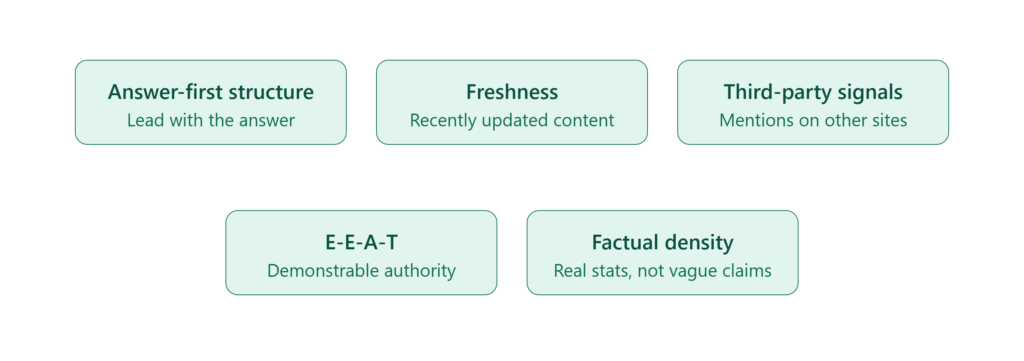
Factual density and specificity
Content containing real statistics and specific claims consistently earns higher citation rates than content making the same point in vague, general terms. This is part of why generic marketing copy performs poorly here: an AI system has no concrete reason to cite a claim it can’t verify or attribute, when a more specific competitor makes the same point with real numbers attached.
How Each AI Platform Sources Its Answers
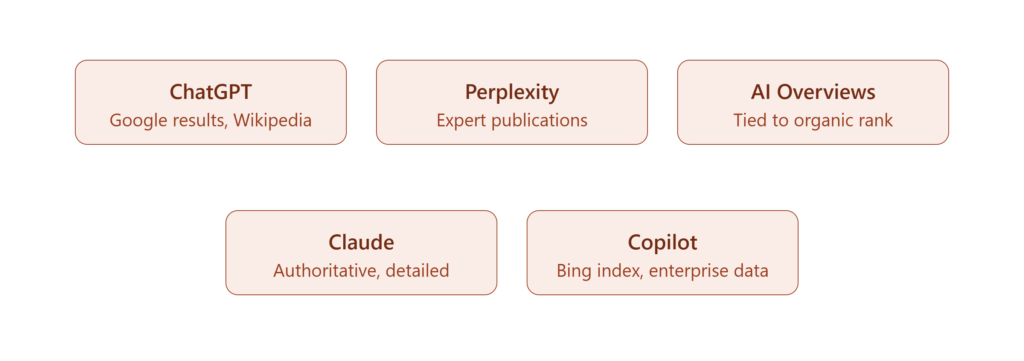
Different platforms genuinely favour different kinds of sources, which is exactly why optimising for one doesn’t automatically mean visibility everywhere.
| Platform | Citation preference |
| ChatGPT | Leans heavily on Google’s own search results and favours encyclopaedic, high-factual-density sources like Wikipedia |
| Perplexity | Draws heavily on expert publications and shows its sources directly, favouring recency and demonstrable credibility |
| Google AI Overviews | Closely tied to organic ranking, blogs and news sources feature heavily. |
| Claude | Favours authoritative, detailed, well-explained sources over shorter or thinner content |
| Microsoft Copilot | Draws on the Bing index and enterprise data sources |
We’ve gone deep on exactly how each of these platforms sources and weighs content in our dedicated guide to optimising for ChatGPT, Google AI, and Perplexity, worth reading in full if you want to prioritise a specific platform.
A Practical AEO Roadmap
AEO can feel like a lot at once given how many platforms and signals are involved. A phased approach works better than trying to do everything simultaneously.
Phase 1: Audit your current AI visibility.
Ask ChatGPT, Perplexity, Google AI Overviews, and Claude your top 15 to 20 buyer questions directly, and record whether your business is mentioned, how accurately, and which competitors show up instead. Separately, check your robots.txt for AI crawler access; many shared hosting setups block AI crawlers by default without anyone realising.
Phase 2: Restructure your content for extractability.
Rework your most important pages using answer-first formatting: a direct 40- to 60-word answer opening each section, question-format headings matching how customers actually ask, and content broken into modular blocks that make sense to read in isolation. Build out a proper topical cluster around your core expertise, with one strong pillar page supported by several related articles covering the surrounding questions in depth. Add clear “last updated” dates throughout, and include real statistics and named-author input wherever you can.
Phase 3: Build off-site authority and citations
Since most AI citations come from third-party sources rather than your own site, this phase matters as much as your own content does. Contribute genuine expertise to relevant industry publications, engage authentically in the forums and communities your customers actually use, and make sure your details are accurate anywhere your business is already mentioned. Connecting your various online profiles together, your website, social profiles, and directory listings through consistent schema markup helps AI systems build a clearer, more confident picture of who you are.
Phase 4: Measure and iterate
Set up a basic AEO measurement routine: track whether your business appears for your priority queries across the major platforms, note which competitors keep appearing instead, and revisit your content on a genuine schedule, quarterly at minimum, since AI systems clearly favour freshness and the landscape itself keeps shifting.
The Technical Side of AEO
A few technical details matter specifically for AEO, beyond the general technical SEO fundamentals we’ve covered in our guide to optimising your website for AI search engines.
Schema markup priorities
Not all schemas carry equal weight for AEO. Prioritise in roughly this order: Article or blog posting schema with full author details and a date Modified field, organisation schema with the same As links connecting your other profiles, the Person schema for author credentials, the FAQPage schema for genuine question-and-answer content, and the HowTo schema for instructional material. Implementing several of these together tends to outperform relying on just one.
Managing AI crawlers
Not every AI crawler serves the same purpose, and treating them all identically is a mistake. Crawlers like OAI-SearchBot, ChatGPT-User, ClaudeBot, and PerplexityBot are generally worth allowing, since they’re the ones responsible for live citation and search. Crawlers like GPTBot, anthropic-ai, and Google-Extended are typically used for training data collection rather than live citation, and you may choose to restrict these separately depending on your preference. Many shared hosting firewalls block unrecognised crawlers by default, so it’s worth auditing your setup directly rather than assuming access is fine.
llms.txt: a genuine caveat
The llms.txt standard, a simple markdown file at yourdomain.com/llms.txt intended to help AI systems understand your content, has gained some attention as an emerging practice. Worth being honest about its current state: testing so far has found no reliable evidence that major AI crawlers actually use it consistently. It costs little to implement and is a reasonable low-effort addition, but treat it as a hedge, not a primary AEO strategy.
The UK Regulatory Picture
This is genuinely worth understanding, since it’s actively shaping how AI search works in the UK and differs meaningfully from how the US and EU are approaching the same questions.
The Digital Markets, Competition and Consumers Act came into force at the start of 2025. Under it, the Competition and Markets Authority designated Google with Strategic Market Status in late 2025, with scope that explicitly includes AI Overviews and other generative AI search features. Proposed conduct requirements under consultation include the ability for publishers to opt out of AI Overviews, mandatory fair attribution within AI results, and greater transparency around how ranking actually works.
The UK has taken a notably different approach here than the EU’s broader AI Act, regulating AI in search through existing competition law and communications regulation rather than a single new statute. What this means practically for your business: the rules governing how AI overviews surface and attribute content could genuinely shift, and publishers may eventually gain new rights over how their content is used. The sensible response isn’t to wait and see; it’s to build AEO foundations, a schema, answer-first content, and genuine authority that hold up regardless of exactly how the specific platform rules evolve.
How to Measure AEO Success
Standard SEO metrics don’t capture AEO performance well, so it needs its own measurement approach.
AI Citation Rate: the percentage of your tracked, priority queries where your business is actually mentioned across the platforms you care about.
Share of AI Voice: how often you’re mentioned relative to your named competitors across the same set of queries.
AI referral traffic quality: the visitors who do click through from an AI answer tend to convert at a noticeably higher rate than standard organic traffic, since the AI has effectively pre-qualified the match before they ever arrive.
Citation Drift Rate: how often an AI system misrepresents or gets something wrong about your business when it does mention you, worth tracking in its own right, since an inaccurate citation can do more harm than no citation at all.
A few dedicated tools now exist specifically for this: Otterly.AI, Ahrefs Brand Radar and Semrush all offer AI citation tracking, and Semrush has built out an AI visibility toolkit. Worth knowing plainly: GA4 has no built-in AI channel grouping, so unless you set up custom segments manually, your standard analytics will likely understate how much of your traffic is genuinely AI-influenced.
How Prime Flow Digital Can Help
AEO works best as part of the same integrated strategy we’ve set out across our SEO, AEO, and GEO content, not as a separate, bolted-on service. At Prime Flow Digital, we help UK businesses audit their current AI visibility, restructure content for genuine extractability, build the off-site authority that actually earns citations, and track the metrics that reflect real AI-search performance rather than standard analytics alone.
If you’re not sure how your business currently shows up across ChatGPT, Perplexity, and Google’s AI tools, get in touch with the Prime Flow Digital team for an AI visibility audit and a clear, honest view of where you stand today.
Frequently Asked Questions
What is AEO, and how is it different from SEO?
AEO is the practice of structuring content and technical signals so AI platforms cite your business directly in generated answers, rather than simply linking to your page in a results list. Traditional SEO targets page rankings; AEO targets being the actual cited source, which depends on a partly different set of signals.
Can AEO replace traditional SEO, or do UK businesses need both?
You need both. AI citation relies heavily on content that’s already well-structured, technically sound, and reasonably authoritative and the same foundation good SEO builds. AEO adds a layer on top focused specifically on extractability and multi-platform citation, rather than replacing SEO’s underlying work.
How long does it take to see results from AEO?
Initial visibility improvements can appear within a few weeks if your existing SEO foundations are already solid. Genuinely measurable business impact and more consistent citation across priority queries typically take several months of sustained, consistent work.
What schema markup should UK businesses prioritise for AEO?
Start with the Article or BlogPosting schema, including full author details and a dateModified field, followed by the Organisation schema with sameAs links, the Person schema for author credentials, and the FAQPage schema on genuine question-and-answer content. Implementing several types together tends to outperform relying on a single one.
Does my business need a presence on Reddit or forums for AEO to work?
It genuinely helps. Most brand mentions inside AI answers come from third-party sites rather than a business’s own website, and community platforms are cited disproportionately often across several AI models. Authentic participation, actually answering questions and sharing real expertise, is the useful version of this; posting purely to seed mentions tends not to work.
How do I measure whether my AEO strategy is actually working?
Track AI Citation Rate (how often you’re mentioned for your priority queries), Share of AI Voice relative to named competitors, the quality of any AI-referred traffic you do get, and Citation Drift Rate (how accurately you’re being represented when you are mentioned). Dedicated tools like Otterly.AI and Ahrefs Brand Radar now support this directly.
Is AEO worth investing in for a small UK business, or only larger companies?
It’s worth it for businesses of any size where customers are already researching decisions using AI tools, which is an increasingly large share of most markets. The foundational work, answer-first content, basic schema, and genuine authority building scale down perfectly well for a smaller business; it simply requires less volume than a large enterprise programme would.
How does UK regulation affect how AI overviews and AI searches work?
The Competition and Markets Authority has designated Google with Strategic Market Status, with scope explicitly covering AI Overviews, and proposed requirements could eventually include publisher opt-outs and mandatory fair attribution. This is still an active, evolving process, so treat any specific rule as subject to change, and build AEO foundations general enough to hold up regardless of the exact outcome.