By the Prime Flow Digital Team
Here’s something most business owners get wrong: you don’t need to add “near me” to your website content. Plenty of advice out there still says otherwise, and it’s outdated. Google treats “near me” as a signal it interprets using the searcher’s actual location, not a phrase it looks for on your page. Understanding that one distinction changes where you should be spending your effort, and this guide walks through exactly where that is.
- “Near me” is a proximity signal Google interprets using the searcher’s location, not a keyword you need to add to your content
- Your Google Business Profile is the single most important factor in whether you appear
- NAP consistency and genuine local citations reinforce that Google can trust your details
- Mention your actual town, city, or service area naturally in your content, not the literal phrase “near me”
- For full setup details, see our guides to local SEO and ranking in Google Maps
What “Near Me” Searches Actually Are
Why “near me” is a proximity signal, not a keyword
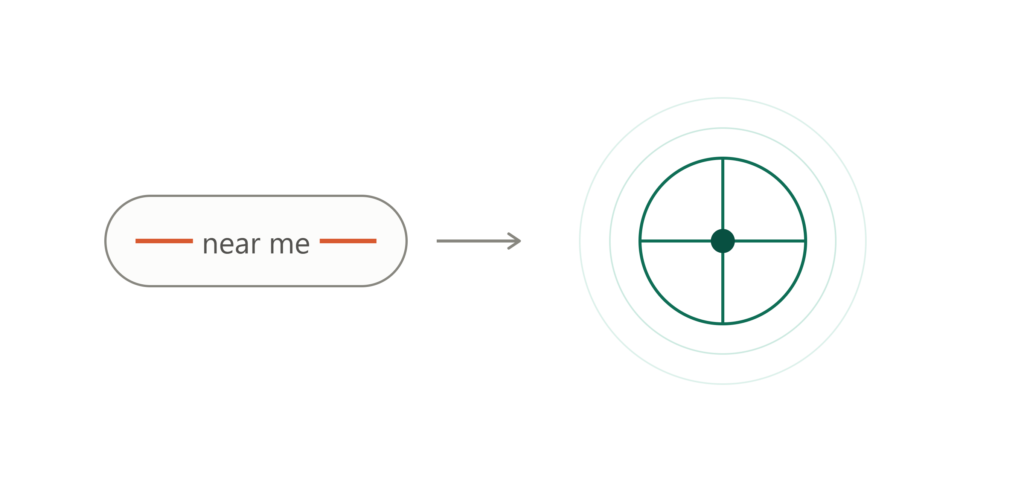
When someone searches “plumber near me”, Google isn’t scanning the web for pages containing the literal words “near me”. It’s using the searcher’s location data to find plumbers close to where they actually are, then ranking those results using the same signals it uses for any local search. Writing “near me” into your page titles or body content does nothing for you here and can make your copy read as unnatural or spammy.
How Google works out where a searcher is
On mobile, Google typically uses GPS data from the device, which is precise enough to identify a searcher’s immediate area within metres. On desktop, it usually falls back on IP address data, which is considerably less precise but still enough to establish a general location. This is also why the same search can return different results for two different people typing the identical phrase, since each is anchored to a different starting point.
Explicit vs. implicit local search
Local searches come in two forms, and both need attention, just in different ways.
Explicit local searches include a place name directly in the query: “plumber Bristol”, “dentist in Manchester”, and “accountant Leeds”. Here, your job is straightforward: make sure your website and profile clearly mention that specific location.
Implicit local searches are the “near me” kind, or simply a service typed with no location at all, trusting Google to work out the context. “Coffee shop near me” and just “coffee shop” typed while standing in a specific area both fall into this category. There’s no place name to match here; instead, Google is relying entirely on local signals it already has about your business, your Google Business Profile, your citations, and your reviews to decide whether you’re a good match for wherever the searcher happens to be.
A plumber who only optimises for “plumber Bristol” and ignores implicit signals will miss a large share of ready-to-buy searchers who never typed a place name at all.
The Three Factors Behind Every “Near Me” Result
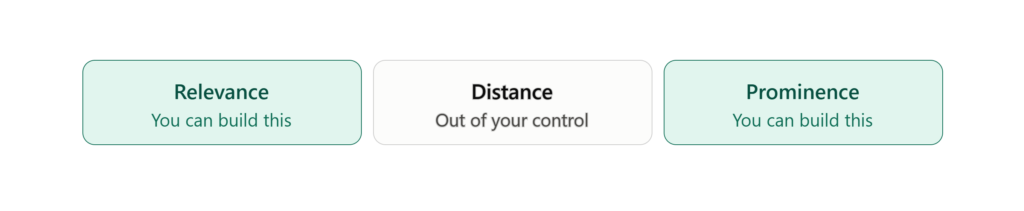
Every “near me” result Google shows comes down to the same three factors it uses across local search generally: relevance (how well your business matches the query), distance (how close you are to the searcher), and prominence (how well-known and trusted your business is). We’ve covered these in full depth, including exactly how to strengthen each one, in our guide to ranking your business in Google Maps. The short version for “near me” specifically: since you can’t influence a searcher’s actual location, your leverage sits almost entirely in making your profile as relevant as possible and building genuine prominence over time.
Do You Need to Put “Near Me” in Your Website Content?
No. Adding the literal phrase “near me” throughout your titles, headings, or body copy does nothing for your rankings and risks reading as unnatural to anyone who lands on the page.
What actually helps is mentioning your real location naturally: your town, city, or the specific areas you serve, woven into your titles, headings, and content the way you’d genuinely talk about your business. A roofer covering Leeds and Bradford benefits far more from a page titled “Roofing Services in Leeds” than from a paragraph stuffed with “roofer near me, roofer near me now, best roofer near me.”
This distinction matters because a fair amount of advice circulating online still recommends stuffing “near me” into content directly. That advice hasn’t kept pace with how Google actually processes these queries, and following it risks making your copy worse without any ranking benefit to show for it.
The Practical Steps That Actually Move the Needle
The bulk of what determines your “near me” visibility is standard local SEO fundamentals, already covered in full elsewhere in our guides, so here’s the short version.
A complete, accurate Google Business Profile. This is the single biggest factor in whether you appear at all. Claim it, verify it, and fill in every section, category, hour, service, and photo, rather than leaving it half-finished. Full setup guidance is in our complete local SEO guide.
Consistent NAP everywhere. Your business name, address, and phone number need to match exactly across your website, your Google profile, and every directory listing. Small inconsistencies, “Street” in one place and “St” in another, quietly undermine Google’s confidence in your data. Our local SEO guide includes a full NAP audit process if you haven’t run through one yet.
Genuine, steady reviews. Reviews are one of the clearest prominence signals. Google has, and a steady flow of recent, detailed ones does more for you than a single old batch. Ask at the point of highest satisfaction, and respond to every review you get.
Location-specific landing pages, done properly. If you serve more than one area, each one deserves its own dedicated page, with genuine local detail (real landmarks, testimonials from customers in that specific area, and an embedded map), not a template with the town name swapped and nothing else changed.
How “Near Me” Thinking Extends to AI Search
The instinct behind a “near me” search hasn’t gone away; it’s just started showing up inside conversational AI tools too. Someone typing “coffee shop near me” into Google and someone asking ChatGPT, “What’s a good coffee shop near me right now?” are driven by the exact same underlying need, even though the two platforms find their answers very differently.
The fundamentals that help you with traditional “near me” searches, an accurate, complete profile, consistent details across the web, and genuine reviews also feed directly into how AI tools verify and recommend local businesses. We’ve covered the platform-specific mechanics of this, including how ChatGPT, Perplexity, and Google’s AI tools each source their local answers differently, in our guide to optimising for ChatGPT, Google AI, and Perplexity.
How Prime Flow Digital Can Help
Ranking for “near me” searches isn’t a separate discipline from the local SEO fundamentals you’re likely already working on; it’s the same foundation, aimed correctly. At Prime Flow Digital, we handle the full picture: Google Business Profile setup and optimisation, NAP and citation clean-up, and the ongoing review and content work that keeps your business showing up when nearby customers are ready to act.
If you’re not sure whether your current setup is actually working for “near me” searches, get in touch with the Prime Flow Digital team and we’ll take a look.
Frequently Asked Questions
What does “near me” SEO actually mean?
“Near me” SEO is the practice of optimising your online presence so your business appears when people search using proximity-based phrases like “near me”. It’s a subset of local SEO focused specifically on implicit searches, where Google determines the location rather than the searcher typing one in.
Do I need to add “near me” to my website content?
No. Google treats “near me” as a proximity signal it works out from the searcher’s location, not a phrase it matches against your page. Focus on naturally mentioning your actual town, city, or service area instead.
How does Google know what “near me” means for each searcher?
Google uses location data from the searcher’s device, typically GPS on mobile and IP address on desktop, to determine roughly where they are, then shows local results based on that. The same search phrase can return different results for two different people depending on where each of them is searching from.
Why doesn’t my business appear in “near me” searches?
The most common causes are an incomplete or unverified Google Business Profile, inconsistent NAP details across the web, or too few genuine reviews. Working through the practical steps in this guide, starting with your Google Business Profile, usually resolves it.
What’s the difference between local SEO and “near me” SEO?
“Near me” SEO is a specific slice of local SEO. Local SEO covers all local searches, including explicit searches with a place name like “plumber Bristol”. “Near me” SEO focuses specifically on implicit searches, where the searcher’s location does the work a place name would otherwise do.
What’s the difference between explicit and implicit local searches?
Explicit local searches include a place name directly, such as “dentist in Manchester”. Implicit local searches, like “dentist near me” or simply “dentist” typed while in a specific area, rely on Google inferring the location itself. Both need attention, but implicit searches depend far more heavily on your Google Business Profile and prominence signals than on any location keyword.
How long does it take to rank for “near me” searches?
Most UK businesses see early movement within a few weeks of fixing the fundamentals, with meaningful progress in the local pack typically following within three to six months. Genuinely competitive positions in busier markets can take six to twelve months of consistent work, consistent with the timeline we’ve seen across local SEO generally.