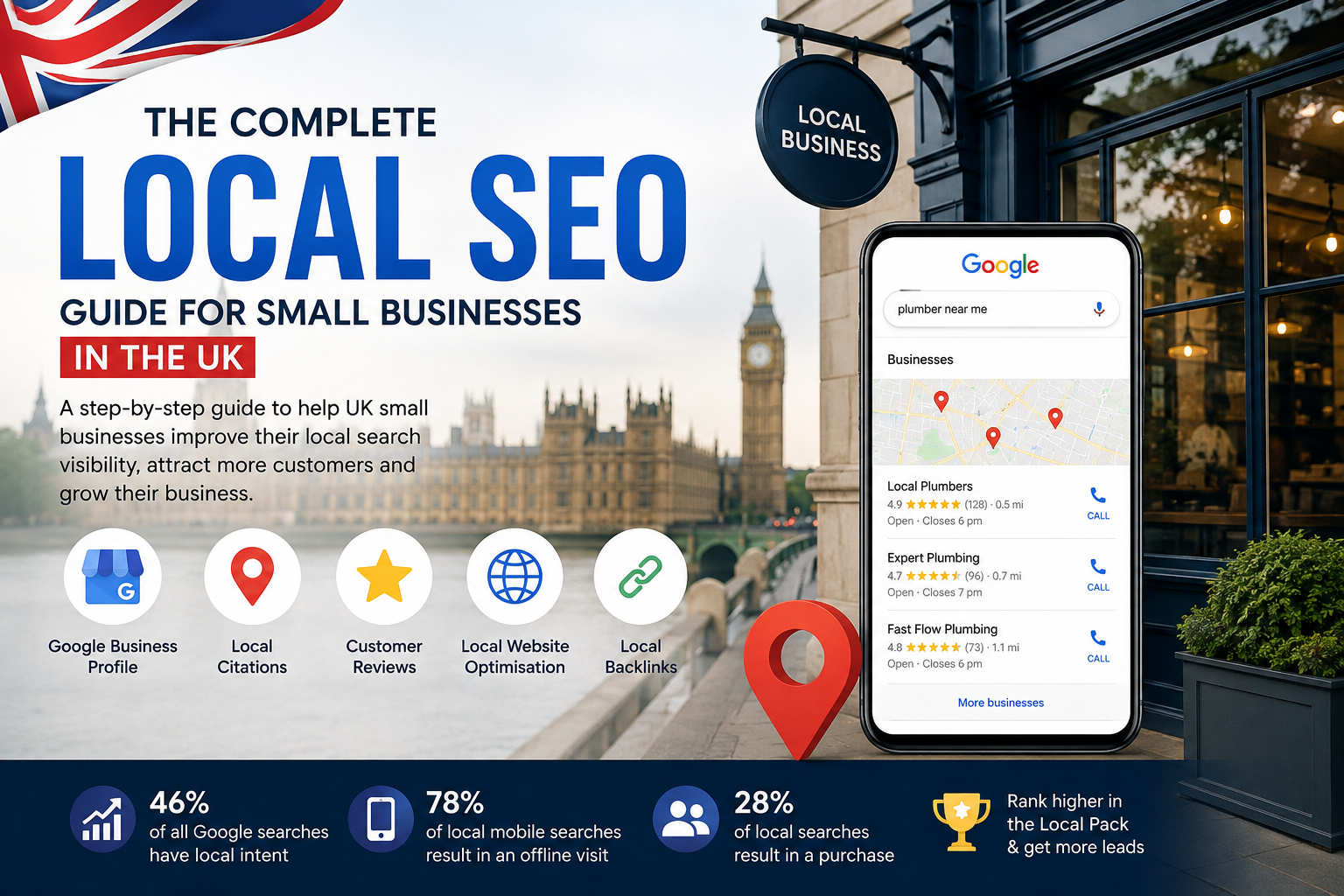
Local SEO is the practice of improving your business’s visibility in location-based Google searches, such as “plumber near me” or “accountant in Leeds”. For UK small businesses, it rests on five pillars: a fully optimised Google Business Profile, consistent citations across UK directories, a steady flow of genuine reviews, local signals on your website, and links from other local, UK-relevant sites. Around 46% of all Google searches carry local intent, which means getting this right isn’t optional for any business that serves a specific area.
Whether you run a plumbing business in Birmingham, a café in Bristol, or an accountancy firm in Edinburgh, the customers who matter most to you are almost certainly within driving distance. When someone nearby searches for what you offer, Google decides which businesses to show using a specific set of local signals, and most UK small businesses have never properly optimised for a single one of them.
That’s the opportunity. Local search is far less saturated than national organic search, which means a business willing to do the work described in this guide can outrank competitors many times its size. This guide walks through exactly what to do, in order, with UK-specific advice throughout.
What Is Local SEO?
Local SEO is a specialised branch of search engine optimisation focused on improving your visibility in geographic, location-based search results, rather than broad, national ones. Where traditional SEO competes for terms like “accounting software”, local SEO competes for terms like “accountant in Manchester” or “accountant near me”.
The Local Pack, explained
The most visible outcome of good local SEO is the Local Pack, sometimes called the Map Pack or the Google 3-Pack. It’s the box containing a map and three business listings that appears at the top of the results page for local queries, above the standard organic listings. It shows up on the vast majority of local-intent searches, and it captures a disproportionate share of clicks. Businesses that make it into the Local Pack consistently receive significantly more calls, direction requests, and website visits than businesses ranked just below it in the regular organic results.
Local SEO vs. traditional SEO
| Local SEO | Traditional SEO | |
| Primary goal | Appear in the Local Pack and on Google Maps | Rank in national/global organic results |
| Key ranking factors | Google Business Profile, reviews, citations, proximity | Content quality, backlinks, technical SEO |
| Geographic focus | A specific town, city, or service radius | National or global |
| Main platform | Google Business Profile plus your website | Your website primarily |
How Google decides who ranks locally
Google has confirmed that local pack rankings come down to three factors: relevance (how well your business matches what was searched), distance (how close you are to the searcher), and prominence (how well-known and trusted your business is across the web). You can’t move your premises, so distance is largely outside your control. Relevance and prominence, however, are entirely buildable, and that’s what the rest of this guide focuses on.
Why Local SEO Matters for UK Small Businesses
The numbers make the case better than any pitch could. Roughly 46% of all Google searches now carry local intent, meaning people are actively looking for a business near them, not just information. A large majority of people who run a local search on their phone go on to visit a business within 24 hours, and a meaningful share of those visits convert into a purchase the same day.
(Note for publication: verify the exact current figures for “near me” search growth and visit-conversion rates against a named, current source, such as Think with Google or a recent ONS release, before this goes live, since different UK agencies currently cite noticeably different numbers for the same claims.)
What makes this genuinely urgent for small businesses specifically is the gap between how many people use local search and how few businesses have properly optimised for it. A large share of UK small businesses still have an incomplete, unclaimed, or neglected Google Business Profile, the single most influential local ranking factor available. That gap is your opportunity. The businesses that close it first and keep at it tend to build a lead that gets harder and harder for late arrivals to close.
Step 1: Claim and Optimise Your Google Business Profile
Your Google Business Profile (GBP), formerly known as Google My Business, is the single most important factor in local search rankings. It’s what determines whether you appear in the Local Pack, on Google Maps, and in the knowledge panel that shows up when someone searches for your business by name. If you only do one thing after reading this guide, do this properly.
Claim and verify your listing.
Go to business.google.com and either claim an existing listing or create a new one. Google verifies ownership, usually by sending a postcard containing a code to your business address; in the UK this typically takes one to two weeks, so start this today if you haven’t already.
Choose the right categories.
Your primary category is one of the strongest ranking signals available to you. Google offers thousands of category options, so be as specific as possible. A dental practice should select “Dental Clinic”, not the broader “Healthcare Provider”. A plumber should select “Plumber”, not “Home Services”. You can add up to nine secondary categories on top of your primary one, and you should use all of them, provided each genuinely reflects a service you offer. Checking which categories your top-ranking local competitors use is a quick way to spot options you may have missed.
Complete every field.
Google’s algorithm consistently favours complete profiles over sparse ones. Work through every field:
- Business name: your exact legal or trading name, matching your real-world signage. Never add keywords or locations to the name field (“Smith Plumbing, Best Emergency Plumber Manchester”); Google can and does suspend profiles for this.
- Address: full and accurate, matching the Royal Mail PAF database format. Service-area businesses that travel to customers can hide their address and define a service area instead.
- Phone number: use a local number where possible, not an 0800 or generic mobile.
- Business hours: keep these accurate, including bank holidays and seasonal changes. Rankings can noticeably soften in the final hour before you’re due to close if your hours aren’t current.
- Business description: you get 750 characters. Use them to describe what you do, who you serve, and what makes you different, weaving in your services and locations naturally rather than stuffing them in.
- Services: list everything you offer, with descriptions and pricing where applicable.
- Attributes: select every relevant one, such as wheelchair accessible, free Wi-Fi, or woman-owned.
Add quality photos and video.
Businesses with a strong library of high-quality photos receive substantially more direction requests and website click-throughs than those without. Upload real images of your premises (interior and exterior), your team at work, your products or completed projects, and, for trades and services, genuine before-and-after shots. Add new photos regularly rather than uploading everything once and forgetting about it; Google rewards profiles that show ongoing activity, and video content remains underused by most UK small businesses despite generating strong engagement.
Post regularly.
Google Posts are short updates that appear directly on your profile in search results, and they stay prominent for about seven days. Aim for at least one post a week covering offers, new services, completed projects, industry tips, or community involvement. This is a low-effort, high-visibility habit that most competitors neglect.
Manage your Q&A section.
The Questions & Answers section is easy to overlook but genuinely useful. Proactively seed it with five to ten common questions and detailed answers. It functions as a built-in FAQ for potential customers and sends positive engagement signals to Google.
Google Business Profile optimisation checklist
| Element | Best practice | Common mistake |
| Business name | Exact legal/trading name only | Adding keywords or locations (violates guidelines) |
| Address | Matches Royal Mail PAF format exactly | Inconsistent abbreviations across listings |
| Phone number | Local area code as primary | Using 0800 numbers or mobiles as primary |
| Opening hours | Accurate, updated for holidays | Left blank or never updated seasonally |
| Categories | Most specific primary, all 9 secondary slots used | Overly broad or missing relevant categories |
| Description | Full 750 characters, natural keyword use | Keyword stuffing or generic filler text |
| Photos | High-quality, geotagged, added monthly | No photos or low-resolution phone snapshots |
| Posts | Weekly | Never posting or posting inconsistently |
| Reviews | Responded to within 24-48 hours | Ignored, especially negative ones |
Step 2: Build Consistent Local Citations
A citation is any online mention of your business’s name, address, and phone number, commonly abbreviated to NAP. Citations act as independent verification that your business exists, is legitimate, and is located where you say it is. The more consistent your citations across reputable UK sites, the more confidence Google places in your business data, and the more prominently it’s willing to display your listing.
Priority UK directories
Start with the foundational, near-universal platforms: Google Business Profile, Bing Places for Business (which also feeds a meaningful share of ChatGPT’s local business recommendations), and Apple Business Connect (which powers Apple Maps and Siri). From there, move on to the major UK-specific directories: Yell.com, Thomson Local, FreeIndex, Scoot, and Facebook Business Pages.
Then layer in the directories relevant to your specific industry, since these tend to send stronger relevance signals than generic listings.
| Industry | Key directories |
| Trades (plumbers, electricians, builders) | Checkatrade, TrustATrader, MyBuilder, Rated People, Bark |
| Hospitality (restaurants, cafés, hotels) | TripAdvisor, OpenTable, VisitBritain |
| Professional services | Law Society, ICAEW, RICS, RIBA (your relevant industry body) |
| Healthcare | NHS.uk, Care Quality Commission (CQC) |
| Retail | Local council directories, community/”best of” town directories |
Many UK councils also run free business directories on their .gov.uk domains. These carry unusually strong trust signals because of their government association, and getting listed takes minutes.
How many citations do you actually need?
Quality and consistency matter more than sheer volume. For most UK small businesses, being accurately listed on 15 to 25 well-chosen directories, the foundational platforms plus your relevant industry ones, is enough to be competitive. Beyond that point, the priority shifts from adding new listings to keeping the ones you have accurate and current.
NAP Consistency: Getting the Basics Right
NAP consistency, meaning your business name, address, and phone number appearing identically everywhere they’re mentioned online, is one of the simplest yet most commonly neglected factors in local SEO. Even small inconsistencies, such as “Street” in one listing and “St” in another, can quietly erode Google’s confidence in your business data and soften your rankings.
UK-specific formatting decisions to lock in
Pick one format for each of the following and use it everywhere, without exception:
- Address abbreviations: choose “Street” or “St” and stick with it across every listing.
- Postcodes: always include the space (SW1A 1AA, not SW1A1AA).
- Phone number format: if you write “+44 20 7946 0958” on your Google listing, use exactly that format on Yell, Thomson Local, and everywhere else.
- Business name: exactly as it appears on your signage, never “Smith’s Plumbing” on one platform and “Smiths Plumbing Services” on another.
Consistent vs. inconsistent NAP
Consistent (correct): Name: Smith & Sons Plumbing Ltd Address: 42 High Street, Manchester, M1 4BT Phone: 0161 234 5678 Result: Google cross-references multiple sources, builds confidence, and rewards the listing with stronger local pack positioning.
Inconsistent (harmful): Name: Smith and Sons Plumbing / Smiths Plumbing / Smith & Sons Ltd Address: 42 High St, Manchester / 42 High Street, M1 4BT / Unit 3, 42 High Street Phone: 0161 234 5678 / 07700 900123 Result: Google can’t confidently verify your business data, may treat variations as separate entities, and dilutes your ranking signals across them.
How to audit your NAP
Write down your official NAP format in a reference document, then search your business name on Google and note every listing that appears. Check each one against your official format, correct anything inconsistent (most directories let you claim and edit listings directly), and set a quarterly reminder to repeat the check. If your business has moved premises or changed its phone number in the last few years, this audit is especially important, since old listings have a habit of quietly surviving long after the details change.
Step 3: Collect and Manage Customer Reviews
Reviews are one of the more heavily weighted local ranking signals, and they matter just as much as a trust factor for the people reading them. A large majority of UK consumers say online reviews influence their decision to choose one local business over another, which makes review management both a ranking activity and a direct conversion lever.
How to generate a steady flow of reviews
The most reliable approach is a simple, repeatable process rather than occasional, ad hoc requests:
- Ask in person, immediately after completing the work, while the customer is still satisfied.
- Follow up within 24 to 48 hours by email or text with a direct link to your Google review page.
- Send one gentle reminder about a week later for anyone who hasn’t got round to it.
QR codes on receipts, invoices, or counter signage make this genuinely frictionless. Aim for a steady trickle of reviews rather than sudden bursts, since a sudden spike can trigger fraud detection on Google’s side
Responding to reviews
Respond to every review, positive and negative. Google has said that responses don’t directly influence rankings, but they visibly shape whether a prospective customer decides to click through and get in touch. For positive reviews, a brief, genuine thank-you referencing something specific from the review is enough. For negative ones, respond promptly and professionally, acknowledge the issue without getting defensive, and offer to resolve it offline. How a business handles criticism in public is something potential customers actively notice, and a calmly handled negative review can do more for your reputation than another five-star one.
UK law on reviews: DMCCA 2024
This is worth understanding properly, since it’s a genuinely live compliance issue that many local SEO guides still overlook. The Digital Markets, Competition and Consumers Act 2024 (DMCCA) made several previously common review practices illegal in the UK: publishing fake reviews, offering incentives conditional on a positive review, and “review gating”, the practice of pre-screening customers to filter out anyone who might leave negative feedback. The Competition and Markets Authority (CMA) began active enforcement of these provisions in 2025.
In practice, this means you can absolutely ask every customer for an honest review, but you cannot offer a discount or reward conditional on it being positive, and you cannot filter who gets asked based on how happy they seem. The safest approach, asking everyone, consistently, without conditions, also happens to be the approach that builds the most credible review profile anyway.
(Note for publication: verify the current CMA enforcement guidance at gov.uk before publishing, since enforcement detail in this area continues to develop.)
Step 4: Optimise Your Website for Local Search
Your Google Business Profile does a lot of the heavy lifting, but your website still needs to clearly communicate where you’re located and which areas you serve, particularly if you’re trying to rank across more than one town or region.
Local landing pages, done properly
If you serve multiple areas, create a dedicated page for each one, for example, “Plumbing Services in Bristol” and a separate page for “Plumbing Services in Bath”. Each page needs a minimum of 500 to 800 words of genuinely unique content: real references to local landmarks or property types, testimonials from customers in that specific area, an embedded map, and a clear call to action.
The mistake to avoid here is creating dozens of near-identical pages where the only difference is the town name swapped in and out. Google is highly effective at identifying this kind of thin, duplicative content, and the practice tends to do more harm than good.
On-page local signals
Make sure the following are present and consistent across your site: your full address and phone number in the footer of every page, an embedded Google Map on your contact page, location terms used naturally in titles, headings, and meta descriptions (never stuffed), and descriptive, geotagged alt text on your images.
Local business schema markup
Schema markup gives Google a machine-readable summary of your business details: name, address, phone number, opening hours, geographic coordinates, and service area. Use the most specific schema subtype available for your business, such as Plumber, Restaurant, Dentist, LegalService, or AccountingService, rather than the generic LocalBusiness type. If your site runs on WordPress, plugins like Yoast SEO or Rank Math can add this automatically; for custom-built sites, your developer will need to add JSON-LD markup directly. Always validate the result using Google’s Rich Results Test before publishing.
Mobile-friendliness and page speed
The large majority of local searches in the UK now happen on mobile devices, and Google’s mobile-first indexing means it primarily evaluates the mobile version of your site when deciding rankings. Test your site with Google’s PageSpeed Insights tool, aim for a mobile score above 70, and make sure your phone number is a tappable click-to-call link on every page. A slow, hard-to-use mobile site quietly costs you the majority of your local search traffic before a visitor even reaches your content.
Step 5: Create Local Content
Content marketing plays a specific role in local SEO: it helps you rank for informational searches your local customers are making, and it builds genuine topical and geographic authority over time.
Location pages vs. local blog content
Location pages (covered above) target commercial, ready-to-buy searches. Local blog content plays a different role, capturing people earlier in their research and demonstrating real local expertise. Ideas that work well include:
- Local guides: “The Best Parks in Somerset” or “Where to Eat in Yeovil”
- Seasonal, climate-specific content: “Preparing Your Boiler for a Yorkshire Winter”
- Case studies: work completed for named local clients, with permission
- Local statistics and commentary: data or news relevant to your area and industry
- Community involvement: events you sponsor, attend, or support
The consistent thread across all of these is genuine usefulness to someone in your area, not keyword-stuffed filler dressed up as a blog post. Quality wins over volume every time in local content.
Step 6: Build Local Links
Backlinks remain one of the most influential ranking factors in SEO generally, and for local SEO specifically, the geographic relevance of the linking site matters as much as its raw authority. A link from a regional newspaper or a local Chamber of Commerce often carries more local ranking value than a link from a nationally authoritative but geographically unrelated site.
UK-specific link opportunities
- British Chambers of Commerce: over 50 regional chambers across the UK maintain member directories with followed links from high-authority .co.uk domains. Annual membership typically runs a few hundred pounds, making it one of the most cost-effective local link sources available.
- Local newspapers and news sites: regional publications are consistently looking for expert commentary, local business news, and data-driven stories. Offering a journalist a useful quote or a newsworthy update about your business is a realistic way to earn coverage.
- Sponsorships: sponsoring a local sports team, charity event, or community festival almost always earns a link from the organisation’s website, alongside genuine local goodwill.
- Industry body directories: the Law Society, ICAEW, RICS, RIBA, and equivalent professional bodies list members with links.
- Guest posts on local blogs: offering to write genuinely useful content for a complementary local business in exchange for an author bio and link.
- Local council business directories: many councils list local businesses for free on .gov.uk domains, which carry strong inherent authority.
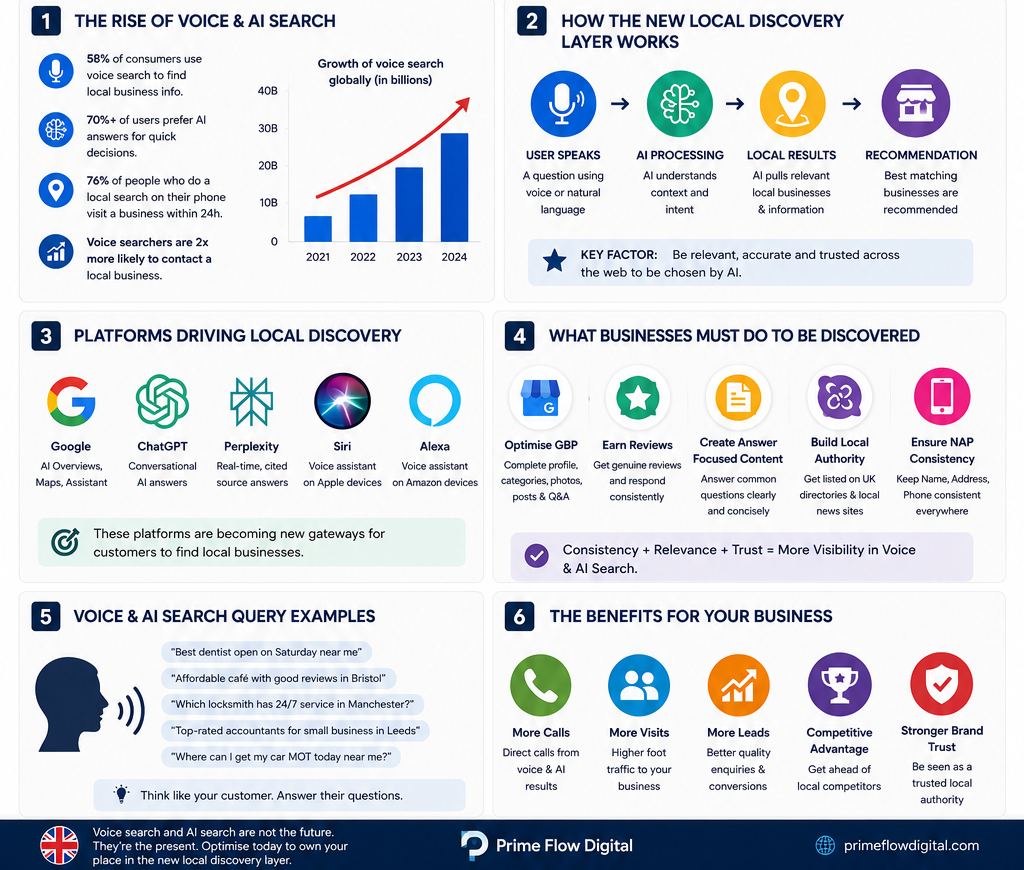
Voice Search and AI Search: The Emerging Local Discovery Layer
Local discovery is no longer just about Google’s traditional results. Voice assistants and AI search tools are increasingly part of how people find local businesses, and each one sources its information a little differently.
How voice queries differ
Typed searches tend to be short: “plumber Manchester”. Voice queries are longer and conversational: “Who is the best plumber near me that can come out tonight?” A meaningful and growing share of UK consumers now use voice search to find local businesses. To optimise for it, structure your content to answer questions directly, in plain, conversational language, ideally in an FAQ format that mirrors how people actually speak rather than how they type.
How AI tools source local business data
This is where it gets genuinely useful to understand, because the platforms don’t all pull from the same place:
- ChatGPT draws a substantial share of its local business data from Foursquare’s Places database, supplemented by Bing. If your business isn’t listed on Foursquare, you’re largely invisible to ChatGPT’s local recommendations, regardless of how strong your Google presence is.
- Perplexity leans heavily on live web citations and industry-specific directories such as Yelp and TripAdvisor.
- Google’s AI Overviews favour content from your own website more than the other platforms do, drawing a large share of citations directly from brand-owned sites.
The practical takeaway is that no single platform covers all the bases. A local SEO strategy built exclusively around Google Business Profile, however well executed, leaves you invisible on tools that are increasingly part of how people discover local businesses.
Practical steps to prepare
Claim and complete your Foursquare listing, since it’s routinely neglected by UK small businesses despite its outsized influence on ChatGPT. Check that your robots.txt file isn’t inadvertently blocking AI crawlers such as GPTBot or PerplexityBot. Structure your content so the direct answer to a likely question appears in the first sentence or two, with supporting detail underneath. Implement the full LocalBusiness schema, including AggregateRating, so AI systems have clean, machine-readable data to work from. And keep building presence on the industry-specific directories mentioned earlier, since Perplexity in particular weights these heavily.
This area is moving quickly, and the specifics will keep shifting. The underlying fundamentals, consistent data, genuinely useful content, and broad presence across multiple platforms will remain valuable regardless of how any individual platform’s algorithm evolves.
How to Track Your Local SEO Results
You can’t improve what you don’t measure, and the good news is that the most useful tracking tools are free.
| Tool | What it tells you |
| Google Business Profile Insights | Profile views, the search queries that triggered your listing, and customer actions (calls, direction requests, website clicks) |
| Google Search Console | Which search terms bring visitors, click-through rates, ranking positions, and indexing issues? |
| Google Analytics 4 | Website traffic sources, user behaviour, and conversion tracking (form submissions, phone clicks) |
Track a small, consistent set of metrics monthly: GBP profile views and the search queries triggering them, customer actions from your listing (direction requests are the strongest intent signal), review count and average rating, website traffic from local searches, and your target keyword rankings, paying particular attention to anything sitting in positions 11 to 30, since these are usually the fastest wins available with targeted effort.
Common Local SEO Mistakes UK Businesses Make
- Ignoring Google Business Profile after initial setup. A profile claimed years ago and never touched since signals inactivity to Google. Review and refresh it monthly.
- Inconsistent NAP information. Different phone numbers or address formats across directories quietly fragment your local ranking signals.
- Keyword-stuffing the business name. Adding location or service keywords to your GBP name violates Google’s guidelines and risks suspension.
- Thin, duplicate location pages. Dozens of near-identical pages with only the town name changed do more harm than good.
- Ignoring negative reviews or responding defensively. Both erode trust with anyone reading the review afterward.
- Neglecting mobile experience. If your site is difficult to use on a phone, you’re losing the majority of your local search audience before they even reach your content.
- Fake or incentivised reviews. Beyond the ranking risk, this is now a clear DMCCA compliance issue in the UK, not just a reputational one.
DIY vs. Professional Local SEO Services
When DIY makes sense
If you’re in a lower-competition area, have a few hours a month to spare, and don’t mind the hands-on work, doing this yourself is genuinely viable. Everything covered in Steps 1 through 3, claiming and completing your Google Business Profile, building your core UK citations, and asking customers for reviews, is achievable without hiring anyone. For a newer business, this is often the smartest starting point: you learn how local search actually behaves before spending anything on it.
When professional help earns its fee
The case for bringing in professional local SEO services strengthens the moment your market gets competitive, your time gets scarce, or your rankings stall despite having the basics in place. A good provider runs competitive analysis you likely wouldn’t do yourself, fixes technical issues like schema and site speed, keeps your citations accurate as details change, and runs a steady, DMCCA-compliant review programme, consistently, month after month, which is the part most business owners struggle to sustain alongside actually running the business.
| DIY | Professional services | |
| Cost | Free, beyond your time | Typically ranges by scope and market competitiveness |
| Time | Several hours per week | Roughly 1-2 hours a month for approvals/communication |
| Best for | Lower-competition markets, single location | Competitive markets, multi-location, limited owner time |
| Pros | Cost-effective, deep knowledge of your own business | Expert knowledge, professional tools, faster results |
| Cons | Time-intensive, steep learning curve | Ongoing costs require finding a trustworthy provider. |
What to look for in a provider
Look for demonstrated experience with UK businesses in your industry, transparent reporting on the specific local metrics that matter (not just generic traffic numbers), and a clear, plain-English explanation of what they’re doing and why. Be cautious of anyone guaranteeing specific rankings (no legitimate provider can guarantee a Google position), anyone using opaque methods they won’t explain, and anyone requiring a long lock-in contract with no performance benchmarks along the way.
How Prime Flow Digital Can Help
Local SEO rewards consistency more than any single clever tactic, and that consistency is exactly where most small business owners run out of time. At Prime Flow Digital, we handle the full picture for UK businesses: Google Business Profile management, UK citation building and clean-up, a DMCCA-compliant review strategy, local schema implementation, and the ongoing local content and link building that keeps your rankings moving rather than stalling out after the first few wins.
If you’re not sure where your current local search presence stands, or which of the steps above would move the needle fastest for your specific market, that’s exactly the kind of gap we help close. Get in touch with the Prime Flow Digital team to talk through where your business stands today.
Frequently Asked Questions
What is local SEO, and how is it different from regular SEO?
Local SEO focuses on improving your visibility in location-based searches, such as “plumber near me” or “coffee shop in Manchester”. It relies heavily on your Google Business Profile, local citations, and reviews, while traditional SEO focuses more on broader content and backlinks. Around 46% of Google searches carry local intent, making this essential for any business serving a specific area.
How much does local SEO cost in the UK?
Pricing varies considerably by provider, market competitiveness, and scope, from a few hundred pounds a month for a freelancer handling the basics up to several thousand for a full-service agency running content, technical SEO, and link building together. DIY local SEO is free beyond your own time.
How long does local SEO take to show results?
Most UK small businesses see measurable improvements in local pack visibility within three to four months of starting a structured campaign, with more significant ranking gains typically appearing between months six and nine. Quick wins, like claiming and completing your Google Business Profile, can show up within days.
Do I need a physical address for local SEO?
You need a legitimate address to verify a Google Business Profile, but Google accommodates two business types: shopfront businesses, which display their address publicly, and service-area businesses, which can hide their address and define a coverage area instead. Virtual offices and PO boxes are not permitted and risk suspension.
How many Google reviews do I need to rank locally?
There’s no fixed number, but somewhere in the range of 15 to 50 quality reviews is typically enough to be competitive for most UK small businesses. Beyond that, consistency and recency matter more than raw volume; a smaller number of recent, detailed reviews will often outperform a larger pile of old ones.
Can I do local SEO myself, or do I need to hire someone?
Many of the foundational activities, claiming your Google Business Profile, building citations, and asking for reviews, are entirely manageable for you. Professional help tends to add the most value in competitive markets, technical implementation (schema, site speed), and sustaining consistent effort month after month.
What are citations, and why do they matter for local SEO?
Citations are online mentions of your business’s name, address, and phone number on sites other than your own. Google uses them as independent verification of your business’s legitimacy and location, so consistent, accurate citations across reputable UK directories directly support your local rankings.
How do I rank for “near me” searches?
You can’t directly optimise for the phrase “near me” itself, since Google treats it as a location signal rather than a keyword and substitutes the searcher’s actual coordinates. Instead, focus on the fundamentals: a fully optimised Google Business Profile, a strong citation profile, a steady stream of positive reviews, and a fast, mobile-friendly website.
What is the Google Local Pack, and how do I get into it?
The Local Pack is the box of three business listings with a map that appears at the top of local search results. Getting into it requires a combination of a complete Google Business Profile, strong review signals, consistent citations, and a locally optimised website, weighted against your proximity to each individual searcher.
Is it legal to ask customers for reviews in the UK?
Yes, you can ask any customer for an honest review. What’s now illegal under the Digital Markets, Competition and Consumers Act 2024 is publishing fake reviews, offering incentives conditional on a positive review, or “review gating”, pre-screening customers to filter out anyone likely to leave negative feedback. The safest approach is to ask everyone, consistently, with no conditions attached.