These years, businesses focused primarily on ranking their websites in traditional search engine results. If your website appeared on Google for the right keywords, attracted organic traffic and generated enquiries, your SEO strategy was considered successful.
Today, the search journey is more complex.
People still use Google and other search engines, but they also ask questions through voice search, interact with AI assistants and use generative AI platforms to research products, services and businesses. A potential customer may search for a service on Google, ask ChatGPT for recommendations, compare options through an AI-powered search platform and then search directly for a company before making contact.
For UK businesses, this means search visibility is no longer only about ranking for keywords.
Businesses increasingly need to think about how their information is discovered, understood and presented across different search environments. This is where SEO, AEO and GEO work together.
SEO helps your website become discoverable and rank in search results. AEO helps your content provide clear and direct answers to user questions. GEO helps improve how your brand, expertise and content are understood and potentially referenced within generative AI environments.
These strategies should not be viewed as competitors.
They are complementary parts of a modern search visibility strategy.
For businesses looking to improve their digital presence, the goal should not be to choose between SEO, AEO or GEO. The goal should be to understand how these approaches overlap and build a strategy that allows your business to remain visible as search behaviour continues to evolve.
The Short Answer: SEO, AEO and GEO Work Better Together
SEO, AEO and GEO work together because they solve different parts of the same problem: helping people and search technologies find, understand and trust your information.
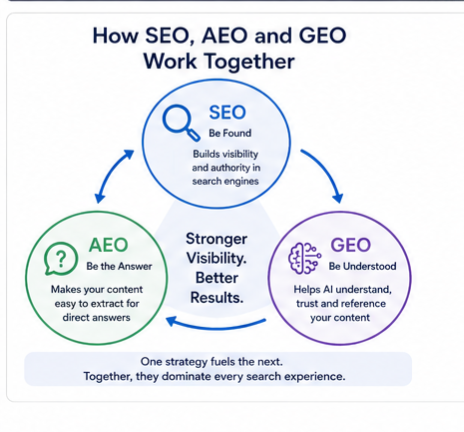
SEO improves discoverability and organic search visibility.
AEO improves answerability by making content easier to extract as a direct response to a question.
GEO focuses on improving visibility and understanding within generative AI environments.
A strong SEO foundation makes it easier for search engines to discover and understand your website. AEO improves the clarity and structure of your information so that it can answer specific user questions. GEO builds on these foundations by focusing on entity understanding, topical authority, factual accuracy and brand consistency.
A simple way to understand the relationship is:
SEO → Discoverability
AEO → Answerability
GEO → AI visibility
These are not completely separate processes. Many of the activities that improve one area can also support the others. For example, well-structured content that answers a specific question may improve organic search visibility, provide a direct answer for users and make the information easier for AI systems to understand.
The most effective approach is to build a connected strategy rather than three disconnected campaigns.
What Is SEO, and Why Does It Still Matter for UK Businesses?
SEO stands for Search Engine Optimisation.
It is the process of improving a website so that search engines can crawl, understand, index and rank its pages for relevant searches.
Despite the growth of AI-powered search, SEO remains a critical foundation for online visibility.
Before a search engine or other system can understand the value of your website, your information needs to be accessible, organised and relevant. A website with poor technical performance, weak content and unclear structure may struggle to achieve visibility regardless of how advanced the search environment becomes.
SEO generally consists of three major areas.
Technical SEO
Technical SEO focuses on the infrastructure of your website.
Important areas include:
- Website speed
- Crawlability
- Mobile responsiveness
- XML sitemaps
- Robots.txt
- Core Web Vitals
- Internal linking
- Structured data
- Semantic HTML
Technical SEO helps search engines access and understand your website efficiently.
For example, if important pages cannot be crawled or if internal links make it difficult to discover key content, your website may struggle to achieve its full search potential.
Technical SEO also contributes to the overall user experience. Fast, accessible and mobile-friendly websites create a stronger foundation for visitors and search platforms.
On-Page SEO
On-page SEO focuses on the content and information presented on individual pages.
This includes:
- Search intent
- Keywords
- Topic coverage
- Headings
- Title tags
- Meta descriptions
- Internal links
- Content relevance
Modern SEO is no longer simply about repeating a keyword throughout a page.
Search engines are increasingly focused on understanding the meaning and context of information. A page about SEO, for example, should naturally cover related concepts such as search intent, keywords, crawling, indexing, rankings, content and technical optimisation where relevant.
This is one reason semantic SEO is becoming increasingly important.
Instead of focusing on individual keywords in isolation, semantic SEO focuses on the relationship between topics, entities and concepts.
Off-Page SEO
Off-page SEO focuses on signals beyond your own website.
These may include:
- Backlinks
- Brand mentions
- Reviews
- Digital PR
- Website development
These signals can help establish credibility and demonstrate that a business is recognised within its industry.
For UK businesses, SEO remains essential because it creates the foundation for discoverability. Search engines still need to understand what your business does, which services you provide and which topics your website covers.
SEO is not becoming irrelevant.
Instead, SEO is becoming part of a broader approach to search visibility.
What Is AEO?
AEO stands for Answer Engine Optimisation.
AEO focuses on making information easy for search and answer systems to extract and present as a clear response to a user’s question.
Traditional SEO often focuses heavily on improving rankings and organic traffic. AEO focuses more directly on whether your content can answer a question clearly and efficiently.
For example, consider the question:
What is the difference between SEO and AEO?
An AEO-focused page should provide a direct answer quickly:
SEO focuses primarily on improving visibility in search results, while AEO focuses on structuring content so that search and answer systems can extract clear responses to user questions.
After providing the answer, the content can then offer a more detailed explanation.
This approach benefits users because they can quickly understand the main point. It can also make content easier to process for systems that surface direct answers.
The content brief recommends a clear “short answer first, detailed explanation second” approach throughout the article because this structure supports both readability and answer extraction.
Important Elements of AEO
AEO commonly focuses on search experiences and features such as:
- Featured snippets
- Answer boxes
- People also ask questions
- Voice search
- Conversational search
- Voice assistants
- AI-powered answer experiences
To improve answerability, content should generally be:
- Question-led
- Concise
- Clear
- Self-contained
- Conversational
- Logically structured
- Easy to understand
This does not mean every page should only contain short answers.
Detailed content remains important.
The difference is that important answers should not be hidden beneath several paragraphs of unnecessary information. A reader should be able to find the direct answer before exploring the deeper explanation.
For UK businesses, AEO can be particularly valuable because potential customers increasingly search using natural language.
Instead of searching only:
SEO agency UK
A user may ask:
What does an SEO agency do for a small business?
Or:
How can my business appear in AI search results?
Question-based content helps businesses address these search behaviours.
What Is GEO?
GEO stands for Generative Engine Optimisation.
It focuses on improving how a brand and its content can be understood, retrieved and potentially referenced within generative AI environments.
Generative AI platforms can help users research information through conversational queries rather than traditional keyword searches.
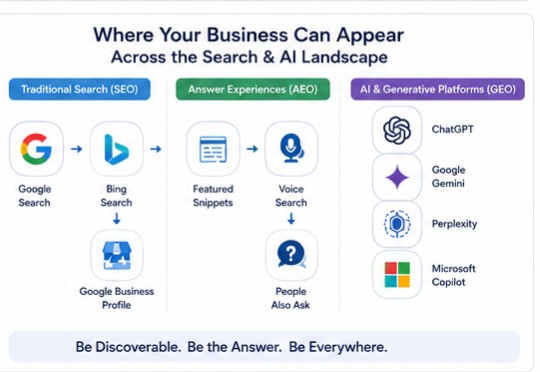
Relevant platforms may include:
- ChatGPT
- Google Gemini
- Perplexity
- Microsoft Copilot
- Claude
- AI-powered search experiences
GEO does not simply mean adding the words “AI” or “ChatGPT” to a webpage.
Effective GEO is more closely connected to the quality, clarity and credibility of information.
Content that supports generative search visibility should demonstrate:
- Clear entity information
- Topical authority
- Original insights
- Verifiable facts
- Expert perspectives
- Named sources where appropriate
- Consistent brand information
- Comprehensive topic coverage
- Logical content structure
For example, imagine two businesses offering the same service.
One website contains vague descriptions, generic blog posts and inconsistent information about its services.
The other provides clear explanations, detailed service pages, expert content, consistent business information and well-structured resources.
The second business provides stronger signals about who it is, what it does and which topics it understands.
This is where GEO overlaps with semantic SEO and entity optimisation.
AI-powered systems need to process relationships between concepts. The clearer and more consistent those relationships are, the easier it becomes to understand the context of your information.
SEO vs AEO vs GEO: The Key Differences
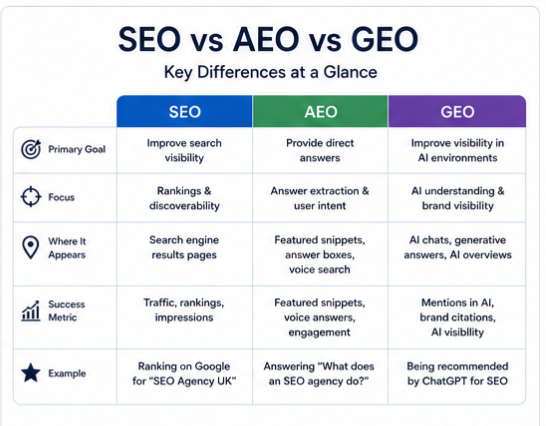
Although SEO, AEO and GEO overlap, each has a different primary focus.
| Factor | SEO | AEO | GEO |
| Primary goal | Improve search visibility. | Provide direct answers. | Improve generative AI visibility. |
| Main focus | Rankings and discoverability | Answer extraction | AI understanding and brand visibility |
| User experience | Search results | Direct responses | AI-generated responses |
| Important content feature | Topical relevance | Clear answers | Authority and verifiable information |
| Key outcome | Organic traffic and rankings | Answer visibility | Brand mentions and AI visibility |
The important point is that these disciplines should not be treated as completely separate.
A single piece of high-quality content can support all three.
For example, a detailed article can:
- Rank in traditional search results through SEO.
- Answer specific questions through AEO.
- Provide clear, authoritative information that supports understanding in generative AI environments through GEO.
The strategies have different priorities, but they share many of the same foundations.
How SEO, AEO and GEO Work Together
The strongest way to approach these strategies is to think of them as connected layers.
Step 1: SEO Creates the Foundation
SEO ensures that your website has the basic structure required for search visibility.
This includes making sure that:
- Important pages can be crawled.
- Pages can be indexed.
- Content is relevant.
- The website has a logical architecture.
- Search engines can understand the topic of each page.
Without this foundation, it becomes more difficult to build sustainable visibility.
A website with excellent content may still face problems if important pages cannot be discovered or if the website structure is confusing.
SEO provides the technical and content foundation.
Step 2: AEO Makes Information Easier to Answer From
Once a website has a strong foundation, AEO focuses on improving how information responds to user questions.
This can include:
- Question targeting
- Direct answers
- Concise explanations
- FAQ content
- Conversational queries
- Structured information
AEO encourages businesses to think more carefully about what users actually want to know.
Instead of creating a page simply because a keyword has search volume, businesses can explore the questions behind that keyword.
For example, someone searching for:
SEO services in the UK
may also want to know:
- How much does SEO cost?
- How long does SEO take?
- Is SEO worth it for a small business?
- What is included in SEO services?
- Can SEO help a local business?
Creating useful answers around these questions can improve the overall value of your content.
Step 3: GEO Strengthens AI Search Visibility
GEO focuses on how your brand and information can be understood in generative environments.
Important areas include:
- Entity understanding
- Brand authority
- Factual accuracy
- Source attribution
- Original insights
- Topical expertise
- Brand consistency
For businesses, this means thinking beyond individual pages.
Your digital presence should provide a consistent understanding of your brand.
Search engines and AI systems should be able to identify:
- Who your business is.
- What services you provide.
- Which industries do you understand.
- Which locations you serve.
- What topics you have expertise in.
This is why brand consistency and entity optimisation are increasingly important.
Together, the relationship looks like this:
SEO makes your website discoverable.
AEO makes your content answerable.
GEO makes your information easier to understand and reference within generative AI environments.
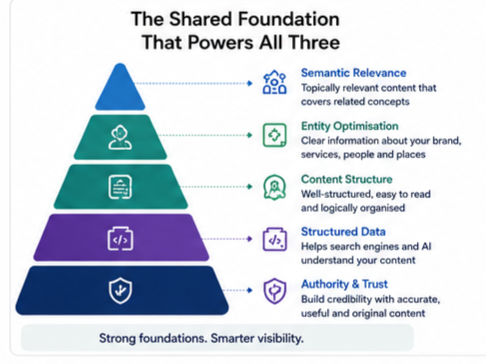
The Shared Foundation Behind SEO, AEO and GEO
Although the names are different, SEO, AEO and GEO rely on several shared principles.
These include semantic relevance, content structure, entity understanding and topical authority.
Clear Topic Relationships
Content should demonstrate how important concepts relate to one another.
For example:
SEO → Search engines → Crawling → Indexing → Rankings
AEO → User questions → Direct answers → Extractable content
GEO → Entities → Authority → AI understanding → Generative visibility
This helps create a stronger semantic structure.
Instead of publishing isolated articles, businesses can build topic clusters around important areas of expertise.
For a digital marketing business, this might include a main topic about SEO supported by related content about:
- Technical SEO
- On-page SEO
- Semantic SEO
- Local SEO
- AEO
- GEO
- AI search
- Content strategy
These connected topics can help demonstrate broader expertise.
Entity Optimisation
An entity can be understood as a clearly identifiable thing or concept.
Examples include:
- A business
- A person
- A service
- A location
- A technology
- A recognised organisation
For a business, entity optimisation involves making important information clear and consistent.
Search technologies should be able to understand:
- The name of your business.
- The services you offer.
- The areas you serve.
- Your industry.
- Your areas of expertise.
For Prime Flow Digital, consistency should be maintained across website pages, service pages, blog content, business profiles, social profiles and relevant third-party mentions.
Consistency helps reduce confusion and creates a stronger digital identity.
Structured Data
Structured data can provide additional information about the meaning of content.
Relevant schema types may include:
- Organisation schema
- LocalBusiness schema
- Service schema
- Article schema
- FAQPage schema where appropriate
- BreadcrumbList schema
Structured data should not be viewed as a shortcut to rankings.
Instead, it should support clarity and help machines understand the structure and context of your information.
Why UK Businesses Should Not Choose Between SEO, AEO and GEO
Modern customers do not always follow a single search journey.
A potential customer might:
- Search Google for a service.
- Ask an AI platform for recommendations.
- Use a voice assistant to ask a question.
- Compare providers through traditional search.
- Search for a recommended business by name.
Each stage can influence the final decision.
Imagine a UK business owner looking for digital marketing support.
They may begin by searching:
SEO agency UK
Later, they might ask:
What is AEO, and do I need it?
Then they could ask an AI platform:
Which digital marketing strategies should a UK business use for AI search?
After finding a potential provider, they may search directly for the company name, visit its website and read reviews before making contact.
A business that focuses only on one search environment may miss opportunities during other stages of this journey.
A connected SEO, AEO and GEO strategy helps businesses create stronger visibility throughout the customer research process.
How Different UK Businesses Should Prioritise SEO, AEO and GEO
Not every business needs to invest in every area equally.
The right priorities depend on the business model, audience and customer journey.
Local Businesses
Examples include:
- Plumbers
- Electricians
- Restaurants
- Dentists
- Solicitors
Local businesses should generally place strong emphasis on:
- Local SEO
- Business profile optimisation
- Reviews
- Location pages
- Service pages
- Conversational customer questions
For example, a plumber could create useful content answering questions such as:
- How quickly can an emergency plumber arrive?
- What should I do if a pipe bursts?
- How much does an emergency plumbing service cost?
This type of content can support local SEO and AEO simultaneously.
Professional Service Businesses
Examples include:
- Accountants
- Consultants
- Law firms
- Financial service providers
Professional service businesses often benefit from demonstrating expertise.
Important areas include:
- Detailed guides
- Expert content
- Question-based content
- Strong entity signals
- Author information
- Verifiable information
These businesses often need to build trust before a customer makes contact.
Comprehensive and accurate information can therefore support SEO, AEO and GEO.
B2B Companies
B2B companies often deal with longer and more complex customer journeys.
Useful priorities may include:
- Topic clusters
- Expert-led content
- Comparison content
- Research-driven content
- Product and service entities
- Industry authority
B2B buyers frequently conduct extensive research before contacting a company.
A strong content ecosystem can help the business remain visible throughout that research process.
E-Commerce Businesses
E-commerce businesses may prioritise:
- Technical SEO
- Product information
- Product entities
- Reviews
- Structured data
- Buying guides
- Comparison content
Clear and detailed product information can help customers, search engines and AI-powered systems understand what is being offered.
How Prime Flow Digital Can Build an Integrated SEO, AEO and GEO Strategy
An integrated strategy should begin with understanding the current situation.
Step 1: Conduct a Search and AI Visibility Audit
The first step is to analyse the current digital presence.
This may include:
- Organic rankings
- Content gaps
- Technical SEO issues
- Existing AI visibility
- Entity consistency
- Competitor content
The purpose is to understand where opportunities and weaknesses exist.
Step 2: Conduct Keyword and Question Research
Traditional keyword research remains valuable.
However, modern research should also identify:
- Long-tail keywords
- Conversational queries
- Common customer questions
- Informational searches
- Commercial searches
- People Also Ask topics
The goal is to understand not only what people search for but also what they actually want to know.
Step 3: Build a Semantic Topic Map
A semantic content strategy connects related topics.
For example, a business providing SEO services may build relationships between:
SEO → Technical SEO → Content → Search Intent → Entities → AI Search
This creates a more comprehensive information structure.
A semantic topic map can identify:
- Primary topics
- Supporting topics
- Entities
- Attributes
- User questions
Step 4: Create Multi-Purpose Content
Every important piece of content should ideally support multiple visibility opportunities.
For SEO, the content should demonstrate topical relevance.
For AEO, it should answer important questions clearly.
For GEO, it should demonstrate authority, consistency and useful information.
Instead of creating separate pages for every new search trend, businesses can create stronger content that serves multiple purposes.
Step 5: Strengthen Brand and Entity Signals
Businesses should ensure that important brand information is consistent across relevant platforms.
This includes:
- Business name
- Services
- Locations
- Contact information
- Brand descriptions
- Areas of expertise
For Prime Flow Digital, consistent association with SEO, AEO, GEO, semantic SEO, content strategy and AI search optimisation can strengthen the clarity of its brand positioning.
Step 6: Monitor Performance Across Multiple Search Environments
Businesses should not rely on one metric alone.
Useful areas to monitor include:
- Organic traffic
- Keyword rankings
- Search impressions
- Conversions
- Featured snippet visibility
- Branded searches
- AI mentions and citations where measurable
The goal is to understand how visibility contributes to meaningful business outcomes.
A Simple SEO, AEO and GEO Content Framework
A single blog post can be designed to support multiple search environments.
A practical structure could include:
H1: The Main Topic
Clearly define the page’s primary subject.
Introduction: Provide a Direct Answer
Give readers an immediate understanding of the topic.
H2: Address a Major Question
Use headings that reflect real user questions where appropriate.
Provide a Concise Answer
Answer the question before expanding into more detail.
Add Supporting Information
Use examples, explanations and practical advice.
Include Relevant Entities
Mention relevant companies, technologies, locations and concepts naturally where they improve context.
Support Claims With Reliable Information
Use verifiable data and trustworthy sources where factual claims are made.
Add Internal Links
Connect readers to relevant services and related content.
Include FAQs.
Answer additional questions that may not fit naturally within the main article.
This structure creates content that can support discoverability, answerability and broader information understanding.
Common Mistakes UK Businesses Make
Treating SEO, AEO and GEO as Separate Strategies
One common mistake is creating completely separate content strategies.
This can result in duplicated content, inconsistent messaging and unnecessary work.
A better approach is to identify shared foundations and create content that supports multiple objectives.
Focusing Only on Keywords
Keywords remain important, but they should not be the only focus.
Businesses also need to understand:
- Search intent
- User questions
- Entities
- Topic relationships
- Customer needs
A keyword may show what someone searched for, but understanding intent helps explain why they searched.
Writing Content Without Clear Answers
Some websites bury useful answers beneath long introductions.
This can create a poor experience for users.
When a page addresses a clear question, provide the answer early and then offer additional detail.
Ignoring Brand Authority
Search visibility is not only about individual keywords.
Businesses should also build a clear and consistent identity.
Your audience should understand:
- Who you are.
- What you do.
- What expertise you have.
- Which services you provide.
Publishing Generic AI Content
AI tools can make content production easier, but publishing large volumes of generic content is unlikely to create meaningful authority.
Businesses should focus on usefulness, accuracy, originality and genuine expertise.
The objective should be to create content that deserves attention rather than simply increasing the number of pages on a website.
The Future of Search for UK Businesses
Search is becoming increasingly fragmented.
Users can now:
- Search
- Ask questions
- Compare options
- Converse with AI
- Use voice interfaces
This does not mean traditional search engines are disappearing.
It means businesses need to prepare for more ways in which customers can discover information.
The future of SEO is likely to become increasingly connected with broader information optimisation.
The fundamental objective remains the same:
Make your business and its information easy to discover, understand and trust.
The technologies may change, but businesses that consistently provide useful, accurate and well-structured information will be better positioned to adapt.
Frequently Asked Questions
What is the difference between SEO, AEO and GEO?
SEO focuses primarily on improving visibility in traditional search results. AEO focuses on making content easy to extract as a direct answer to user questions. GEO focuses on improving how brands and information are understood and potentially referenced within generative AI environments. These strategies overlap and can work together as part of a broader search visibility strategy.
Does AEO replace SEO?
No. AEO does not replace SEO. SEO provides important technical and content foundations that support search visibility. AEO builds on this by focusing more specifically on clear, direct and extractable answers. Businesses can use both approaches together.
Does GEO replace traditional SEO?
No. GEO should not be viewed as a replacement for traditional SEO. Generative AI visibility is an additional area of opportunity, but businesses still benefit from strong technical SEO, relevant content and clear website structures.
Can one piece of content be optimised for SEO, AEO and GEO?
Yes. A well-planned piece of content can target relevant search intent, rank for appropriate topics, provide direct answers and demonstrate expertise and clear entity relationships. This makes it possible for one strong piece of content to support SEO, AEO and GEO objectives simultaneously.
Which strategy should UK businesses prioritise?
Most businesses should begin with a strong SEO foundation. The next priorities depend on the business model and customer behaviour. Businesses with question-driven audiences may benefit strongly from AEO, while brands looking to strengthen visibility in AI-powered discovery environments should also consider GEO.
How can businesses improve visibility in AI search?
Businesses can improve their readiness for AI-powered search by creating clear, useful and well-structured content, demonstrating topical expertise, maintaining consistent brand information and providing accurate and verifiable information.
Why is entity optimisation important for GEO?
Entity optimisation helps search and AI systems understand who a business is, what it does and how it relates to important topics, services and locations. Clear and consistent entity information can reduce ambiguity and strengthen the overall understanding of a brand.