If a potential customer asked ChatGPT to recommend a business like yours right now, would your name come up? For most UK businesses, the honest answer is probably not. Research from SOCi’s 2026 Local Visibility Index found that ChatGPT recommends roughly 1.2% of local businesses it evaluates, Perplexity recommends around 7.4%, and Gemini around 11%, compared with a 35.9% visibility rate in Google’s own local pack. Ranking well on Google no longer guarantees you appear when someone asks an AI assistant for a recommendation instead.
This is a genuinely different discipline from traditional local SEO, and it’s distinct from the general fundamentals covered in our guide to optimising your website for AI search engines. This piece focuses specifically on the UK angle: how ChatGPT, Google AI Overviews, Perplexity, Gemini, and AI Mode each actually work, what determines whether they recommend you, and what to do about it. If you haven’t yet worked through the technical basics, robots.txt access, schema markup, and site structure, that guide is worth reading first. This one assumes you’re ready to go platform by platform.
Check Your Own AI Visibility in 5 Minutes
Before changing anything, find out where you actually stand. Open ChatGPT, Perplexity, and Google in separate tabs, and search the way a real customer would:
- “Best SEO Service in UK”
On Google, look for an AI Overview box at the top of the results and check whether your business appears in it. Across all three platforms, ask yourself the same four questions: does your business appear at all, is the name, address, and phone number correct, are your services described accurately, and are reviews mentioned, and are they recent?
Worth knowing before you draw conclusions: AI answers are increasingly personalised to location and context, so two people asking the identical question from different areas can get different results. Treat this as a starting baseline, not a final verdict, and check again periodically rather than assuming one test tells you everything.
How Each AI Platform Actually Works
Not every AI platform sources its answers the same way, and understanding the differences is the single most useful thing in this guide. A tactic that moves the needle on Perplexity might do nothing for ChatGPT.
ChatGPT
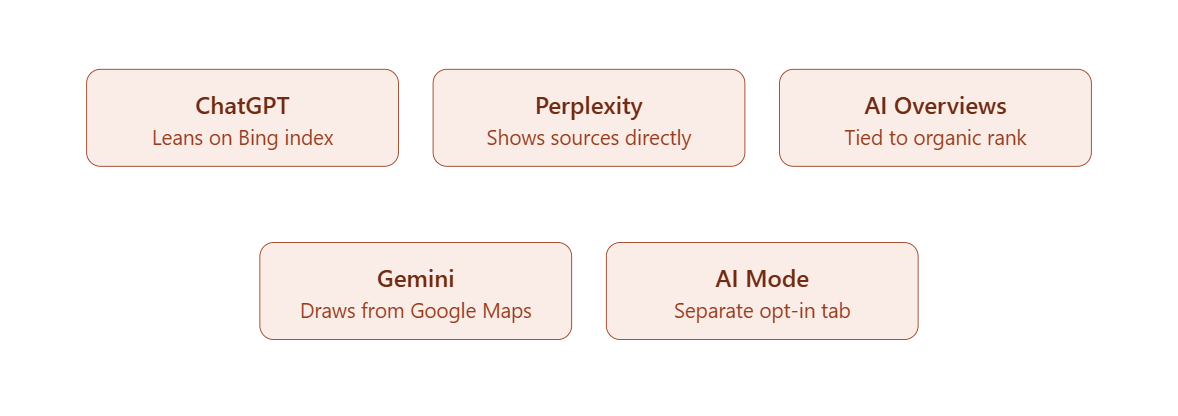
ChatGPT’s search function leans heavily on Bing’s index behind the scenes, though its alignment with Google’s own index has been increasing. It also favours authoritative, encyclopedic sources; Wikipedia alone reportedly accounts for a large share of ChatGPT’s most-cited sources. For a UK business, this means strong Google Business Profile data and genuine third-party citations (established review platforms, local press coverage) tend to drive ChatGPT visibility more than your own website copy alone.
Perplexity
Perplexity shows its sources directly in a panel alongside every answer, which makes it by far the easiest platform to audit. If your website or a directory listing appears in that panel, you can see exactly what it’s drawing from. Perplexity also leans unusually heavily on community discussion; Reddit in particular shows up disproportionately often among its top-cited sources, and it rewards content that’s recently updated over content that’s simply been around a long time.
Google AI Overviews
AI overviews are the most closely tied to traditional organic ranking signals of any platform covered here. A large share of AI Overview citations come from pages that already rank well organically, so strong SEO fundamentals remain one of the most reliable routes to visibility here specifically. For local queries, your Google Business Profile quality, completeness, photo recency, posting frequency, and review engagement are the dominant signals.
Gemini
Gemini is tightly integrated with Google’s own ecosystem and responds particularly well to businesses with a well-maintained Google Business Profile and a website with clear, specific content about services and locations. Because Gemini draws directly from Google Maps data, it tends to have far more accurate business information than platforms pulling from more fragmented sources, which is a meaningful part of why it recommends local businesses at a noticeably higher rate than ChatGPT.
Google AI Mode
AI Mode is a separate, opt-in tab within Google Search that behaves more like ChatGPT or Perplexity than a traditional results page, giving a fully conversational answer rather than a list of links. It draws on different sources than AI Overviews, so the two are worth optimising for separately rather than assuming success on one guarantees success on the other.
Different platforms, different plumbing underneath, but the same underlying principle applies everywhere: be findable, be accurate, and be consistent.
What Actually Determines Your AI Visibility
Your Google Business Profile is doing more work than you’d think.
A complete, accurate, actively maintained Google Business Profile determines two things at once: where you appear in the local pack and whether AI platforms cite you in the answers sitting above it. For a large share of customers, the profile is the entire interaction; they search, see the listing, and call or get directions without visiting your website at all.
What to check: business name, address, and phone number identical across every directory and listing; the primary category reflecting your main revenue-generating service; service descriptions, hours, and the Q&A section complete and current; photos updated regularly, since fresh images send a stronger activity signal than a static gallery; and posts published consistently, since both Google and AI tools read regular activity as a freshness signal.
Your website needs to say what it needs to say in plain text.
AI tools build their picture of your business from what your website actually says and how clearly it says it. Dedicated service pages describing what you do and where, in the direct language customers actually type, consistently outperform vague homepage copy. This is the core principle behind generative engine optimisation: structuring content so an AI system can read, understand, and cite it with confidence, rather than having to guess at what you mean.
One easy-to-miss failure mode: content that loads dynamically via JavaScript, animated counters, sliders, and content that only appears after a script runs can render as blank or as zero to a crawler even though it looks complete to a human visitor. If your homepage proudly displays “500+ clients served”, but that number is animated in by JavaScript, an AI tool reading your raw page source may see nothing there at all. Check what your site actually says in its underlying text, not just what it looks like on screen.
Your reviews are read, not just counted.
AI platforms read the content of your reviews, not merely your star rating. A business with recent, detailed reviews that mention specific services and locations gives an AI system considerably more to work with than one with a high rating and no accompanying text. According to SOCi’s research, locations recommended by ChatGPT average a 4.3-star rating, while locations near 3.4 stars with low review-response rates tend to be excluded from AI recommendations entirely, not simply ranked lower. Responding to every review, positive and negative, is itself a strong activity signal on top of the rating alone.
Inconsistency reads as a red flag, not a rounding error.
AI systems verify a business by cross-referencing its details across multiple sources: your website, your Google Business Profile, directories, and social profiles. When those sources disagree, with different opening hours here and a mismatched address there, the system loses confidence rather than simply averaging the discrepancy out. That ambiguity tends to result in your business being left out of an answer altogether, not mentioned with a caveat.
Third-party mentions carry more weight than your own website can.
Coverage in local press, listings in relevant industry directories, and genuine community discussion all carry a kind of authority that self-published content simply can’t replicate. AI tools weight these third-party references heavily when deciding which businesses are credible enough to recommend, which is exactly why a strong Google presence alone isn’t sufficient on its own.
Technical accessibility is the gate everything else has to pass through.
If an AI crawler can’t read your content, none of the above matters. ChatGPT uses a crawler called GPTBot; Perplexity uses PerplexityBot. Many AI crawlers still struggle with JavaScript-heavy pages that rely on client-side rendering, meaning genuinely good content can receive zero citations simply because the crawler saw a blank page. Confirm these crawlers aren’t blocked in your robots.txt, and check that your key pages render fully without relying on JavaScript to display their core content.
A UK-Specific Technical Detail Most Businesses Miss
Here’s one that’s easy to overlook and rarely mentioned: many UK businesses only ever submit their XML sitemap to Google Search Console. That leaves them effectively invisible to any AI platform leaning on Bing’s index instead, which includes ChatGPT’s search function and Microsoft Copilot. Submitting your sitemap to Bing Webmaster Tools as well takes a few minutes and closes a gap most businesses don’t even know exists.
How Long This Actually Takes
There’s no single date you can circle on a calendar, and it’s worth being honest about the shape of the timeline rather than pretending there’s a quick fix.
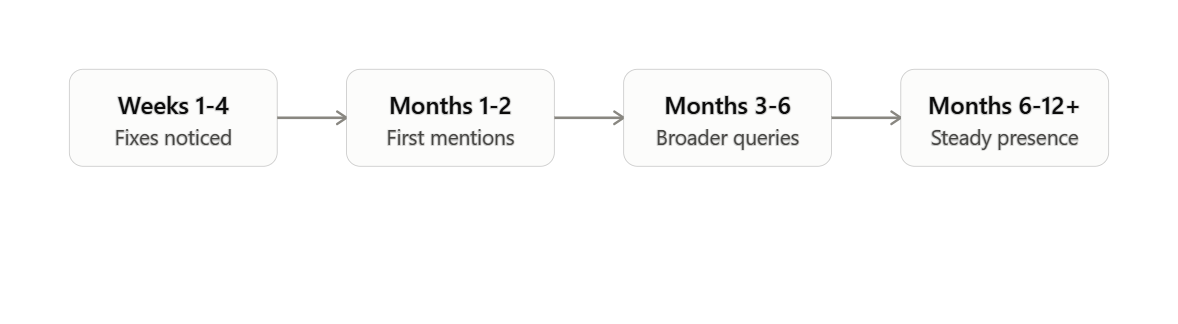
Early technical improvements, fixing crawlability issues, cleaning up inconsistent NAP details, submitting sitemaps properly tend to be noticed within a few weeks, especially if you actively prompt a recrawl rather than waiting passively. The first genuine mentions from AI tools usually follow within one to two months, though typically only for specific, lower-competition questions, things like “what does this cost” or “who runs this company”, where there’s less competition and a clear, specific answer stands out easily.
Broader, more competitive questions, the “who’s the best” kind, take considerably longer, typically three to six months, because they depend on more than your own website; they pull heavily from reviews, directories, and third-party mentions, and that kind of presence simply takes time to build. A genuinely steady, consistent presence across the board usually takes six to twelve months of sustained effort, and even then it isn’t a finish line, since AI tools continuously re-read and re-evaluate the information available to them.
If someone promises this can be done in two weeks with guaranteed results, that claim is worth being sceptical of.
How Prime Flow Digital Can Help
AI visibility isn’t a switch you flip once. It rewards the same kind of ongoing consistency as local SEO, just spread across more platforms with less visibility into how each one is actually deciding. At Prime Flow Digital, we help UK businesses audit exactly where they currently stand across ChatGPT, Perplexity, Google AI Overviews, and Gemini, close the accuracy and consistency gaps that quietly exclude businesses from AI recommendations, and build the ongoing content and citation profile that keeps you visible as these platforms keep evolving.
If you’re not sure whether your business is currently showing up, or showing up accurately, across the AI tools your customers are already using, that’s exactly the kind of gap we help close. Get in touch with the Prime Flow Digital team for an AI visibility audit and a clear view of where you stand today.
Frequently Asked Questions
How are optimising for ChatGPT and Perplexity different from regular SEO?
Traditional SEO is mostly about ranking high enough in search results to get clicked. AI visibility is about being read, understood, and mentioned accurately by a system composing an answer on someone’s behalf, often without any click happening at all. The foundations overlap significantly, but the goal is different: convincing a machine to vouch for you, not just convincing Google to rank you.
Do ChatGPT, Google AI Overviews and Perplexity all use the same information?
No. ChatGPT leans heavily on Bing’s index and favours authoritative sources like Wikipedia; Perplexity draws unusually heavily on Reddit and shows its sources directly; Google AI Overviews are closely tied to traditional organic rankings; and Gemini draws directly from Google Maps data. Each platform needs to be considered somewhat separately.
How long does it take to start appearing in AI search results?
Early technical fixes can be noticed within a few weeks. First mentions for specific, lower-competition questions often appear within one to two months. Broader, more competitive queries typically take three to six months, and a genuinely steady presence usually takes six to twelve months of consistent effort.
Does my Google Business Profile affect my visibility in ChatGPT?
Yes, indirectly and directly. A complete, accurate, active profile is one of the sources AI systems cross-reference when verifying your business details, and it’s the dominant signal for Gemini and Google AI Overviews specifically. For ChatGPT, it matters most as part of the wider, consistent picture across the web that the platform is checking against.
Do reviews affect whether AI tools recommend my business?
Yes. AI platforms tend to treat your review profile as a confidence threshold rather than a gradual ranking factor, meaning a business below a certain rating or with very few recent, detailed reviews can be excluded from recommendations entirely rather than simply ranked lower.
Is this a one-time fix or an ongoing process?
An ongoing process. AI tools continuously re-read and re-evaluate the information available about your business, so staying visible means staying accurate and active, not completing a project once and moving on.
Can I improve my AI visibility myself, or do I need outside help?
The basics, readable website content, consistent details across platforms, collecting genuine reviews, any business can start alone. It tends to get harder when it comes to producing the kind of specific, genuinely useful content AI tools favour and maintaining consistency across many platforms over time, which is usually where outside help earns its cost.